Kairos Pharma (KAPA) - Scientific Deep Dive for ENV-105 and Pipeline Products
Executive Summary
The Hook. ENV-105 is carotuximab — the anti-endoglin (CD105) antibody formerly known as TRC105, which Tracon Pharmaceuticals ran into five randomized comparisons across four sponsors and three indications and lost every one, before selling global rights, all patents, and the entire vial inventory to Kairos’s predecessor for $300,000 of recognized revenue. Kairos’s proposition is that the drug failed because it was paired with the wrong partner — VEGF inhibitors — and that pairing it with an androgen receptor pathway inhibitor (ARPI) targets the actual resistance mechanism.
The Bull Case. At $0.32 and 23,697,683 shares outstanding, the whole company is worth roughly $7.6M against $2.6M of cash — an enterprise value near $5M. NCT05534646 is a genuinely randomized Phase 2 of apalutamide with or without ENV-105, and the biology has real published support: CD105 is upregulated on ARPI exposure and drives the AR-V7 splice variant. Both trials are investigator-sponsored, so Kairos pays a fraction of the cost, and management claims $8M of non-dilutive grant support. If the control arm lands near CARD’s 3.7-month ARPI-switch benchmark and the ENV-105 arm holds near the advertised 13.7 months, a $5M EV re-rates by an order of magnitude. CEO John Yu owns 25%.
The Bear Case. The number carrying this stock is a single-arm read of ten patients from a randomized trial, benchmarked against historical controls from two unrelated studies instead of against the control arm sitting inside the same protocol. Eight of ten had stable disease; there is not one confirmed partial or complete response in the disclosed dataset. The backbone drug, apalutamide, is not approved in mCRPC — Janssen’s ACIS trial (n=982) hit rPFS, missed overall survival, and Janssen abandoned the filing in April 2021. Apalutamide after abiraterone produces 22% PSA50 and 3.7 months to PSA progression. U.S. composition of matter expires March 31, 2030. Cash was $2.626M against roughly $3.7M of unpaid, already-contracted manufacturing obligations. Management and the auditor both carry going-concern doubt, disclosure controls were concluded not effective as of June 30, 2026, and shareholders authorized a reverse split of up to 1-for-250 on June 29.
Bottom Line. The biology is interesting and the price is genuinely distressed, but this is a recycled asset with a 0-for-5 randomized record, a nine-patient efficacy story with no responses, a 2030 patent cliff, and a balance sheet that cannot fund the vials it has already ordered. PASS.
Catalyst Calendar & Financial Runway
Upcoming Catalysts (next 12–18 months)
NCT05534646 Phase 2 prostate — randomized efficacy update, guided Q3 2026. The only catalyst that matters. What has to read out is the randomized comparison: median rPFS on apalutamide + ENV-105 versus apalutamide alone, RECIST 1.1/PCWG3, both arm sizes disclosed. Anything less is not a readout. As of August 18, nothing has been issued.
NCT05401110 Phase 1 lung — safety delivered July 16, 2026; efficacy outstanding. Thirteen patients on osimertinib + ENV-105, zero Grade 3+ toxicities attributed to ENV-105 — and no efficacy, no dose levels, no RP2D. Guidance was “safety data and interim efficacy” in Q2; it delivered safety only, a quarter late. 13 of a 60-patient target is 22%.
KROS-741 cMET inhibitor IND, guided Q3 2026. No IND announced. And note what KROS-741 is: CL-741, an asset owned by Celyn Therapeutics under a term sheet Kairos has not closed. The deck gives it a Phase 1 design and a “METAL-2” Phase 2 concept. It is optioned, not owned.
Bayer / Xofigo. Announced July 22, 2026 as a “strategic collaboration.” The 8-K describes an Agreement for the Support of Investigator/Institution Initiated Research: Bayer supplies radium-223 for a study “in models of prostate cancer bone metastasis,” Kairos is “solely responsible for initiating, managing, and financing the study,” and no upfront, milestone, royalty, or funding is disclosed. The market priced it correctly — KAPA fell 12.65% on ~28.5M shares and set a 52-week low of $0.27 the next session.
The Dilution Gap. Cash was $2,626K at June 30, 2026, down from $4,491K at year-end; operating burn was $2,048K in six months, roughly $1.0M a quarter. Management states existing cash “may not be adequate to fully fund planned operating expenses and capital expenditure requirements for at least the next 12 months,” and both management and the auditor carry going-concern doubt.
Now the part the deck omits. Kairos has contracted for ENV-105 drug substance and product it has not paid for: a Lonza amendment of $1,143K (November 12, 2025) plus an additional statement of work of approximately $2,000K (March 27, 2026), against which only $193K has been paid, and a Brammer Bio/Patheon agreement of $783K (May 11, 2026). That is $3.9M of gross commitments, ~$3.7M of it unpaid, against $2.6M of cash. The company has ordered more antibody than it can pay for. (Note that the same 10-Q paragraph says both that the Company “had yet to make any payments to Lonza” and that it “made a payment of $193 to Lonza” — a contradiction inside a single paragraph, which is its own signal.)
Financing is already in motion. After June 30, Kairos sold 2,359,326 shares for $911K gross under the ATM — $0.386 a share, Shares outstanding went from 21,423,300 at June 30 to 23,697,683 on the August 12 cover, a 10.6% increase in six weeks — 84,943 fewer than the ATM sales alone imply, a gap the filing does not reconcile. The ATM was capped at roughly $4.5M under the baby-shelf rule when the S-3 went effective January 23, 2026, sized off a $13.6M non-affiliate float at $0.97; at $0.32 that float is roughly $5M and the trailing-twelve-month cap collapses toward $1.7M against $1.3M already sold — by my estimate, under half a million dollars of headroom. Which forces them back to Helena. The equity line provides for up to $30,000K of stock sales with 16,680,100 shares registered for resale, roughly 70% of shares outstanding; it was drawn in FY2025 for 3,510,000 shares and has been untouched through the first half of 2026. Add the June 29 approval of 5,000,000 new plan shares plus a 5% evergreen every January 1 through 2033, and this capital structure is built for grinding, price-insensitive issuance. A raise happens before the next data drop — it already is, at $0.386 — and the 1-for-3 to 1-for-250 reverse split approved June 29 is what makes the ELOC usable at scale.
Insiders & Institutions. John S. Yu (CEO/Chairman) holds 25.0%, Neil Bhowmick (CSO) 5.3%, Technomedics Management and Systems 5.3%, directors and officers as a group 31.9%. The company reported 48 holders of record. There is no smart money here, and the absence is the signal: exactly one Schedule 13G has ever been filed on KAPA — Armistice Capital at 9.99%, a textbook warrant-blocker cap — and Armistice has since cut to ~4.13%, below the threshold. No Fairmount, RA Capital, Baker Bros, Deep Track, Perceptive, or EcoR1; institutional ownership is ~7% and the largest positions are market-maker flow. Sell-side is two Buy ratings against a $0.32 stock: H.C. Wainwright at $12 — also the ATM placement agent, collecting 3% of gross proceeds — and Maxim at $4, on a thesis built around the Celyn CL-273 acquisition, which is dead.
The Science: Mechanism & Chemistry
ENV-105 is a chimeric IgG1 monoclonal against endoglin (CD105). It is not new, not novel, and not Kairos’s molecule. It is carotuximab, previously TRC105, first dosed in humans in 2008 and run through more than twenty trials by Tracon, the NCI, the Alliance cooperative group, and Santen (as DE-122 in ophthalmology). Kairos acquired it via Enviro Therapeutics’ May 21, 2021 Tracon license for a $100,000 upfront, up to $1.0M of financing-triggered milestones, a 3% net-sales royalty, and 7% of Enviro’s equity (converted to 280,000 Kairos shares, since sold). What transferred: inactive INDs, GMP vials manufactured October 11, 2018 with four-year dating, and the CD105 patent estate. This is a repositioned me-too-that-already-failed, not a first-in-class or a bio-better.
Mechanism Validation. No anti-endoglin agent has ever been approved anywhere, for anything. Kairos is not a participant in the endoglin field — Kairos is the endoglin field: a ClinicalTrials.gov sweep returns exactly two active interventional endoglin-targeting therapeutic trials worldwide, and both are ENV-105 at Cedars-Sinai. The field’s review is blunt — across the two randomized VEGF-combination studies, “no improvement in PFS was observed by the addition of TRC105”.
Five randomized comparisons. Zero wins. In four of the five, the carotuximab arm was numerically worse than control. TAPPAS was stopped for futility on IDMC recommendation. None of this appears in the deck.
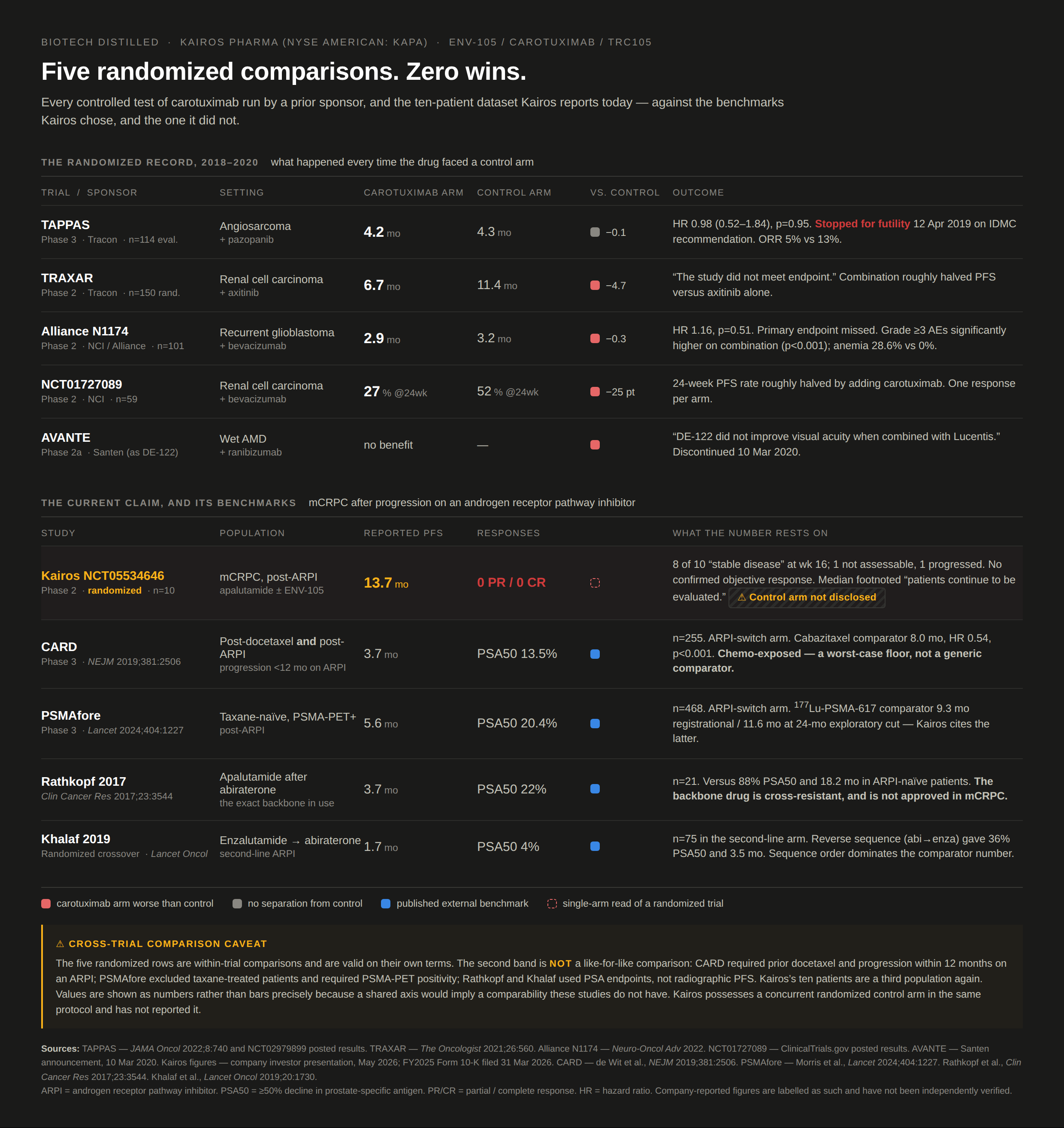
Kairos’s own filings concede the single-agent case is dead: “ENV105 administration alone has no clinical benefit… through trials performed by the National Cancer Institute”. Accurate. NCI’s mCRPC study (NCT01090765, n=21) produced zero objective responses and never advanced to Phase 2. NCI’s urothelial study (n=13) produced zero responses and a 1.9-month median PFS.
Manufacturing / CMC Risks. The original Cedars-Sinai Phase 2 (NCT03418324) “closed to accrual prior to its planned enrollment of 40 patients due to limitation of the drug supply from the manufacturer” — eleven patients against a forty-patient target, because they ran out of antibody. Kairos is now re-establishing the process at Lonza and fill-finish at Brammer Bio/Patheon, ~$3.9M of commitments against $2.6M of cash. Tech transfer of a legacy chimeric IgG1 to a new supply chain, funded quarter to quarter off an ATM, is precisely how a Phase 2 stalls again. No BIOSECURE exposure — both CMOs are Western — but the funding risk is worse than the geopolitical one.
Biochemical Deep Dive
The Target and the Mechanism. Endoglin (CD105) is a homodimeric TGF-β superfamily co-receptor, densely expressed on proliferating endothelium and cancer-associated fibroblasts. The disease-relevant claim in prostate cancer is narrower and more interesting than the angiogenesis story, and it is specific and testable: ARPI exposure induces CD105 on tumor and stromal cells; CD105 signaling supports generation of the AR-V7 splice variant, a truncated androgen receptor lacking the ligand-binding domain that is constitutively active and therefore blind to enzalutamide, abiraterone, and apalutamide. Blocking CD105 reportedly suppresses AR-V7 formation and restores ARPI sensitivity. ENV-105 also hits cancer-associated fibroblasts, which adapt more slowly than tumor cells — a defensible reason to expect durability if the mechanism holds. If true, endoglin is not a generic angiogenesis target but a specific adaptive-resistance node, which is why the VEGF-combination failures do not automatically condemn the ARPI hypothesis. This is the strongest argument Kairos has, and it is legitimate.
The Chemistry. There isn’t any. ENV-105 is a chimeric (mouse variable / human IgG1 constant) monoclonal — 2008-era engineering, with no Fc modification, no YTE half-life extension, no afucosylation, no bispecific format, no ADC payload. Tracon-era dosing was 10 mg/kg weekly intravenous. A weekly infusion is a serious commercial handicap against oral ARPIs taken once daily at home, and exactly the kind of quiet killer that surfaces as discontinuations in a Phase 3 and never in a ten-patient Phase 2. What Kairos contributed to the molecule is a three-gene companion biomarker panel, unvalidated and unapproved.
The Biomarker Receipts. Thin, and this is where the thesis is weakest. What exists: preclinical AR-V7 westerns, PDX H&E, murine tumor curves, and a three-gene panel to be “verified” in the current trial. What does not exist: no published human pharmacodynamic data showing CD105 target saturation at the administered dose; no paired pre/post biopsies showing AR-V7 suppression in patients; no circulating-tumor-cell AR-V7 kinetics. The NIH awarded Dr. Bhowmick $3.2M to generate exactly this, dispersed to Cedars-Sinai in stages — and none of it has read out.
Bottom Line on the biology: the ARPI-resistance hypothesis is the only thing that could justify overriding a 0-for-5 randomized record, and it is precisely the part with no human biomarker confirmation. Until paired-biopsy AR-V7 data exists, an investor here is underwriting a mouse.
Clinical Data
Efficacy. From NCT05534646: ten patients listed, eight with “stable disease” at week 16, one not assessable (unrelated stroke), one clinical progression at three months, and a median PFS of 13.7 months (59 weeks) footnoted “Patients continue to be evaluated”. The company has separately promoted an “86% clinical benefit rate” in nine evaluable patients — a figure that appears in its press releases, not in the deck or either filing; the deck’s own table implies 8 of 9 assessable, or 89%. Figure 1, band two, sets that against the verified benchmarks — including the two Kairos does not cite: apalutamide after abiraterone at 22% PSA50 and 3.7 months, and second-line ARPI at 4% PSA50 and 1.7 months.
Cross-trial caveat, and it is severe. CARD required prior docetaxel and progression within 12 months on an ARPI — an enrichment for primary-refractory disease that makes 3.7 months a worst-case floor, not a generic comparator. PSMAfore excluded taxane-treated patients and required PSMA-PET positivity. Kairos’s patients are a third population again. And Kairos’s chosen PSMAfore figure (11.6 months) is the 24-month exploratory analysis, not the 9.3-month number the FDA approved on.
The P-Hacking Check. The denominator trick, in its purest form. NCT05534646 is a randomized trial of apalutamide with or without ENV-105. Kairos possesses a concurrent, randomized, contemporaneously-enrolled control arm — and reports against historical controls from CARD and PSMAfore instead. There is exactly one reason to benchmark against a 2019 NEJM paper when your own control arm is down the hall.
Three more.
Stable disease is not a response — eight of ten are stable disease, zero PRs, zero CRs, and a “clinical benefit rate” that is essentially all stable disease in a bone-predominant cancer with frequently non-measurable lesions rewards slow imaging more than drug activity.
The data is immature and presented as mature — a 13.7-month median from ten patients, footnoted “patients continue to be evaluated,” moves violently with the next two events.
And the endpoint history drifts the right way — the prior trial (NCT03418324) reported a 62% clinical benefit rate, which is 5 of 8 assessable patients by the 10-K’s own arm-level arithmetic (1 of 2 on abiraterone, 4 of 6 on enzalutamide), even though the same filing elsewhere says nine of eleven were evaluable. The current trial reports 86% in nine. Single-digit denominators, an internally inconsistent one at that, and the number went up. That is small-sample noise narrated as progress. One further precision point: deck slide 9 labels the apalutamide randomized trial as NCT03418324 — it is NCT05534646 — and its schematic shows darolutamide arms.
Safety/Tolerability — The Quiet Killers. Kairos reports zero Grade 3+ toxicities attributed to ENV-105 across both trials. Here is the randomized, controlled TAPPAS data on the same molecule:
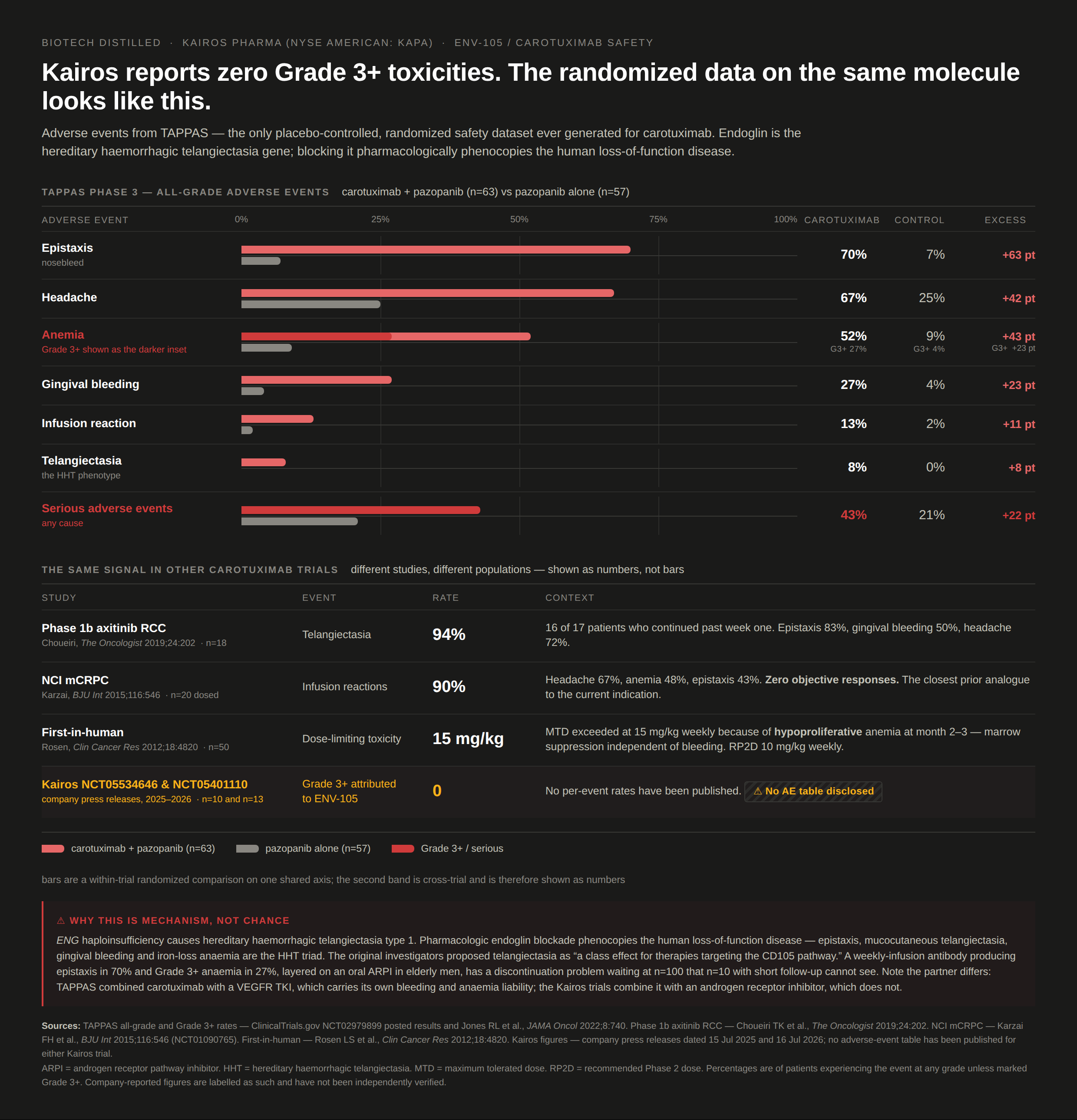
In the Phase 1b axitinib RCC study, 16 of 17 patients (94%) who continued past week one developed telangiectasia; in the NCI mCRPC study, infusion reactions occurred in 90%. This is not idiosyncratic toxicity — it is mechanism. ENG haploinsufficiency causes hereditary hemorrhagic telangiectasia type 1, and pharmacologic endoglin blockade phenocopies the human loss-of-function disease: epistaxis, mucocutaneous telangiectasia, gingival bleeding, iron-loss anemia. The original investigators proposed telangiectasia as “a class effect for therapies targeting the CD105 pathway”, and the first-in-human MTD was exceeded at 15 mg/kg weekly because of hypoproliferative anemia — bleeding-independent marrow suppression. A weekly-infusion antibody causing epistaxis in 70% and Grade 3+ anemia in 27%, layered on an oral ARPI in elderly men, has a discontinuation problem waiting at n=100 that n=10 cannot see.
Data Integrity. NCT05534646: randomized, open-label, target 100 across two arms, three sites (Cedars-Sinai, City of Hope, Huntsman), a December 27, 2023 start date on ClinicalTrials.gov against the 10-K’s “began accruing patients for the trial in September 2023,” and an estimated completion of January 2027. NCT05401110: Phase 1, target 60, 13 dosed. Both list an academic principal investigator as sponsor of record — Drs. Edwin Posadas and Karen Reckamp respectively, not Kairos. That keeps Kairos’s cash cost low and means Kairos does not control enrollment pace, protocol amendments, or data timing. Actual Phase 2 enrollment has not been disclosed; the last ClinicalTrials.gov update was January 29, 2026. A trial that opened in late 2023 with a 100-patient target and is still disclosing ten-patient datasets in mid-2026 has put up roughly one patient per quarter across three of the best-known cancer centers in the country. At that rate the remaining ninety patients take decades, not years — which means either enrolment is far ahead of what has been disclosed, or the trial as designed will never read out.
Pipeline
ENV-105 — prostate. Randomized Phase 2, NCT05534646, apalutamide ± ENV-105, mCRPC post-ARPI. Reality check: this is the entire company. Value driver — and the only one.
ENV-105 — lung. Phase 1, NCT05401110, osimertinib + ENV-105 in EGFR-mutant NSCLC post-osimertinib. 13 of 60 dosed; safety clean, no efficacy.
Reality check: the window is closing. MET amplification is the largest identified osimertinib-resistance mechanism at ~15–20%, and roughly 60–65% of patients have no identifiable mechanism at all. The competitive set has moved: amivantamab + chemotherapy approved post-osimertinib (MARIPOSA-2, ORR 53% vs 29%), datopotamab deruxtecan accelerated-approved June 2025 (ORR 45%), and on August 17, 2026 — one day before this writeup — AstraZeneca announced SAFFRON, the global Phase 3 of savolitinib + osimertinib, hit on both PFS and OS. The instructive negative is patritumab deruxtecan: it won on PFS (5.8 vs 5.4 mo, p=0.011) with a 10-point ORR advantage, showed no OS benefit, and Merck withdrew the BLA. A single-arm Phase 1 signal will not clear that bar. Optionality at best.
KROS-741 (cMET antagonist). Reality check: Kairos does not own this. It is Celyn’s CL-741 under an unclosed term sheet. Companion asset CL-273 was announced as a binding term sheet on March 2, 2026 for 16.5% of Kairos’s outstanding capital stock plus a $15M milestone and 2% royalty — then disclosed as dead in one sentence of the Q2 10-Q: “As of June 30, 2026, the CL-273 asset acquisition was no longer under negotiation.” No press release announced the termination. The deck’s comparator table also needs correcting: it benchmarks cabozantinib at “10% ORR / 3.5 mo PFS,” which matches NCI 9303 — cabozantinib plus erlotinib in EGFR-TKI-resistant NSCLC (n=37, ORR 10.8%, mPFS 3.6 mo), not a MET-selected monotherapy study. Actual cabozantinib in MET-altered lung cancer is ORR 20% / 4.5 mo. The bar to clear is capmatinib (1L ORR 68%, mPFS 12.5 mo) and tepotinib (1L ORR 57%, mPFS 12.6 mo) — and neither Novartis nor Merck KGaA breaks out Tabrecta or Tepmetko revenue, the best available evidence that METex14, at 3–4% of NSCLC and ~5,300–7,800 U.S. cases a year, is sub-material to a large pharma. Zero-NPV placeholder until the term sheet closes.
KROS-201 (glioblastoma), KROS-101/102 (GITR ligand), KROS-301 (RelA/NF-κB), KROS-401 (IL-4/IL-13 peptide), ENV-205 (anti-mtDNA). KROS-201 has an IND submitted; the rest are preclinical or pre-IND. All were silent through 2026 and none is mentioned in the June 4 shareholder letter; the guided Q3 2026 “research collaboration for KROS-101 GITRL” has not materialized. An autologous, dendritic-cell-primed T cell product needs cell manufacturing, apheresis logistics, and cold chain that a company with one full-time employee and $2.6M of cash cannot build, and GITR agonism as a class has a poor clinical record across multiple large-pharma antibody programs. Zero-NPV placeholders. No Rare Pediatric Disease Designation is in play anywhere, so there is no Priority Review Voucher to add to a sum-of-the-parts.
Pipeline Verdict. Seven-to-nine “drugs” on the slide, one clinical asset that matters, and that asset is a repositioned failure. The 10-K’s framing — a “seven-drug portfolio” that “offers diversification and mitigates the overall exposure to many of the inherent risks of drug development” — is inverted: six non-lead programs at a company with one full-time employee (the CFO) and three part-time officers, burning $1M a quarter, is not diversification. It is a company that cannot fund any of them. The valuation rests on one randomized Phase 2 readout in ~100 mCRPC patients and essentially nothing else.
Intellectual Property & The Moat
The summary provided below is based on the 10-K filed by the Company in March 2026, with updates from the 10-Q filed in August 2026.
Kairos reports exclusive rights to eight issued U.S. patents, four U.S. applications, 24 issued patents and 24 applications in foreign jurisdictions under the Tracon license, plus four Kairos-Cedars licenses and two Enviro-Cedars licenses novated to Kairos effective April 17, 2025. Critically, the 10-K states flatly: “We do not own any issued patents.” Every right is in-licensed from Cedars-Sinai or taken by assignment from Tracon, and is therefore subject to a licensor’s termination rights.
Asset-Specific Patent Runways. The deck’s headline is “IP extends to 2040.” For ENV-105 in the United States, composition of matter (US 9,944,714) reportedly expires March 31, 2030 — under four years from now, well before any plausible approval date for a Phase 2 asset that has not started Phase 3. The 2040 dates belong to KROS-201 and ENV-205, both preclinical.
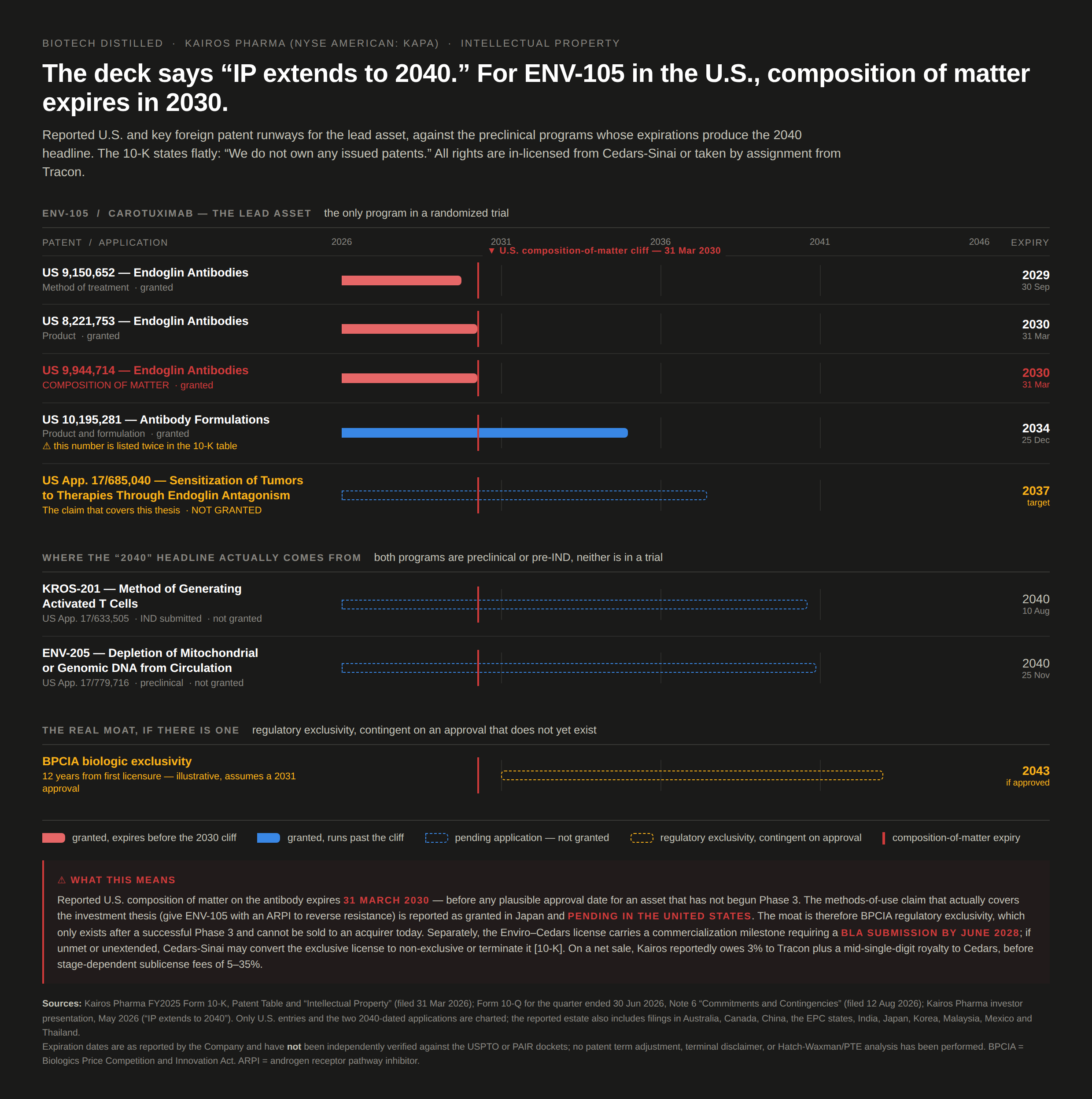
The patent that actually matters to this thesis — “Sensitization of Tumors to Therapies Through Endoglin Antagonism,” the methods-of-use claim covering give ENV-105 with an ARPI to reverse resistance — is reported as granted in Japan (JP 7092684) and pending everywhere else, including the United States (App. 17/685,040). The commercially decisive claim in the commercially decisive market is unissued.
Practically, then, the moat is not patents but BPCIA regulatory exclusivity — 12 years from first licensure, plus potential Orphan Drug designation (7 years U.S. / 10 years EU; carotuximab held FDA orphan designation in soft tissue sarcoma from January 2016, not in prostate cancer). A 2031 approval would run exclusivity to 2043 regardless of the 2030 patent expiry. That is a real backstop, but it only exists after a successful Phase 3 — it is not an asset today and cannot be sold to an acquirer as one.
Ownership, licensing, and the royalty stack. On a net sale of ENV-105, Kairos reportedly owes 3% to Tracon, a mid-single-digit percentage to Cedars-Sinai, plus non-royalty sublicense fees to Cedars of 5% to 35% of consideration depending on the FDA stage at which a sublicense is signed. Milestones run to $7,150,000 for ENV-105, plus $4,400,000 under the KROS-201 license. Two structural landmines follow. The stage-dependent sublicense fee means partnering at Phase 2 could hand Cedars a materially higher share of upfront consideration than partnering post-approval — a direct disincentive to the very partnership the deck lists as a catalyst. More seriously, the Enviro-Cedars licenses carry commercialization milestones including an NDA or BLA submission within seven years of the June 2, 2021 effective date — by June 2028. If unmet or unextended, “Cedars may convert the exclusive licenses into non-exclusive licenses or to co-exclusive licenses, or terminate the licenses”. A BLA by June 2028 is not achievable from a Phase 2 that has enrolled a few dozen patients, so Kairos depends on Cedars-Sinai’s continued willingness to extend the license underpinning its lead asset. No extension is disclosed.
A diligence flag on the filing itself. The 10-K patent table lists US 10,195,281 twice — as an ENV-105 antibody-formulation patent expiring 2034-12-25, and as a KROS-301 NF-κB methods patent expiring 2037-11-30. One patent number cannot cover two unrelated inventions with two expiration dates. A clerical error — but in the one table an IP-focused investor reads most closely, at a company whose CEO and CFO concluded disclosure controls were not effective.
Competitive Landscape. The shark tank is fully stocked and not waiting: Xtandi (enzalutamide) at roughly $6.0B in Astellas’s FY2025, facing 2027 U.S. LOE and IRA-negotiated pricing from January 2027; Erleada (apalutamide) at $3,574M FY2025, +19%, on the CMS Selected Drug list for 2028; Nubeqa (darolutamide) at €2,385M FY2025, +57%; abiraterone fully genericized; and Pluvicto compounding at $651M in Q2 2026 alone, +43% cc, a ~$2.6B run-rate on a label now extending into mHSPC. ENV-105 is not differentiated against any of these. It is a weekly IV add-on to a drug not approved in the indication, in a setting where the incumbent orals are cheap and entrenched and the growth is going to radioligands.
The Verdict
Scientific Conviction: Low. The ARPI-resistance/AR-V7 hypothesis is legitimate and the preclinical work is from serious labs — but the molecule carrying it has lost five randomized trials, has produced no confirmed objective response in any disclosed prostate dataset — the NCI’s single-agent study reported zero, and the current trial reports none, with the 10-K’s mention of one enzalutamide-arm patient showing “scan improvement” the sole unresolved counterexample — and has no human pharmacodynamic data confirming target engagement.
Commercial Viability: Low. A weekly IV chimeric antibody, added to a drug not approved in the indication, with a 2030 U.S. composition-of-matter expiry, a royalty stack of roughly 8–9% before Cedars sublicense fees, and CMC commitments that already exceed cash.
M&A Appeal: Low. The logical acquirers for a prostate asset — Novartis (Pluvicto), Bayer (Nubeqa/Xofigo), J&J (Erleada), Pfizer/Astellas (Xtandi) — all have the resistance problem on their radar and none needs an antibody Tracon sold for $300K that has yet to produce a confirmed objective response in mCRPC. Bayer has already established the cheapest possible relationship with this asset: free radium for preclinical models, no money, no option, no equity. That is a company that wants to see data, not own it.
Trader Profile: Sub-$0.50 nano-cap momentum traders and reverse-split arbitrageurs. Not for binary-event gamblers — the binary is real but the financing will front-run it — not for compounders, not for M&A specvestors. For most books: avoid.
Buy Thesis
Target Audience. Deep-value nano-cap specialists running a 30-to-50-name basket where any position can go to zero without hurting the book, underwriting the randomized Phase 2 as a pure lottery ticket at a ~$5M enterprise value.
Rationale. Down ~85% from a 52-week high of $2.11. The randomized Phase 2 is real; if the apalutamide-alone arm lands near CARD’s 3.7 months and the combination holds near the advertised 13.7, this is a 5-to-10-bagger from $0.32 on the print alone. Investigator-sponsored trials keep the burn to the readout small, and Yu’s 25% means the CEO’s incentive is a re-rate, not a wind-down.
Execution/Strategy. Lottery-ticket weight — 25 to 50 basis points, money you will write to zero. Consider buying after the next financing prints, not before — every dollar Helena draws here is a dollar of your entry gapped down. Hard rule: exit on any 8-K disclosing an ELOC draw above $2M, and treat the reverse split as a re-underwriting event, not a technicality.
Hold Thesis
Target Audience. Existing holders already underwater, choosing between averaging down and taking the tax loss.
Rationale. One genuine catalyst is outstanding, and downside from $0.32 on a $5M EV is compressed relative to upside on a clean randomized print. Selling the day before the only readout that matters is how holders capitulate at the bottom.
Execution/Strategy. Consider holding what you own; do not add. Do not average down into the ATM — you would be buying from a motivated seller sitting on $3.7M of unpaid manufacturing commitments. Set a stop tied to disclosure, not price: exit on a NYSE American deficiency notice, on the reverse split going effective without accompanying data, or on the Q3 window closing with no randomized readout.
Sell Thesis
Target Audience. Everyone else, including anyone who bought the Bayer press release.
Rationale. Five losing randomized trials, zero responses, a nine-patient efficacy story benchmarked against historical controls when a randomized control arm exists in the same protocol, a backbone drug not approved in the indication, a 2030 patent cliff, a Cedars license with a June 2028 BLA milestone that cannot be met, $3.9M of manufacturing commitments against $2.6M of cash, going-concern doubt, disclosure controls concluded not effective, a $30M equity line with 16.68M shares registered and 3.51M already issued through it, and a 1-for-250 reverse split authorization in the board’s pocket. The single 2026 business-development deal announced as “binding” was dead within three months and buried in a 10-Q footnote.
Execution/Strategy. Sell into liquidity, which means selling into promotional news flow — this trades 20 to 30 million shares on press-release days and two million on quiet ones. Think twice before shorting it: borrow on a $7M-market-cap NYSE American name is expensive and unreliable, the float is small, and a reverse split plus a promotional cycle can squeeze violently against a thesis that is nonetheless correct. Being right and being liquidated are compatible outcomes.
Final Verdict
PASS. A repositioned antibody with a 0-for-5 randomized record and zero objective responses in prostate cancer, carried by a nine-patient dataset benchmarked against the wrong controls, on a balance sheet that cannot pay for the drug substance it has already ordered — revisit only if the randomized Phase 2 reports both arms with the control arm intact.
This report is strictly for informational and educational purposes only. It does not constitute financial advice, investment advice, or a recommendation to buy or sell any securities mentioned.
The scientific and clinical analyses herein should not be interpreted as medical guidance, diagnostic information, or treatment recommendations.
At the time of writing, the author does not hold a position in Kairos Pharma, Ltd. (KAPA).
Biotech investing is inherently volatile. Past scientific validation does not guarantee future clinical or regulatory success. Treat all clinical-stage biopharma allocations accordingly.
For informational and educational purposes only — not investment advice. The author's position (if any) is as stated in the original article. Always verify against primary sources and do your own due diligence.