Anixa Biosciences (ANIX) — Scientific Deep Dive for Lira-cel, the α-Lactalbumin Vaccine, and Pipeline Products
Executive Summary
The Hook. Anixa runs two first-in-class immunotherapy concepts: a CAR-T that swaps the usual antibody fragment for a natural hormone ligand (FSH) to hit follicle-stimulating hormone receptor (FSHR) on ovarian tumors and their vasculature, and a vaccine against α-lactalbumin, a “retired” lactation protein that reappears in triple-negative breast cancer (TNBC). Both were invented elsewhere. Anixa in-licensed them, runs them with four full-time employees, and lets Moffitt Cancer Center, Cleveland Clinic, the Department of Defense, and the NCI do the work.
The Bull Case. FSHR is one of the cleanest solid-tumor antigens anyone has found — Anixa’s own expression panel shows detectable mRNA essentially only in ovary, testis, and fetal thymus. Intraperitoneal (IP) delivery keeps the cells where the lesions are and has produced no ICANS and no significant cytokine release syndrome (CRS) through the first three dose cohorts, with no dose-limiting toxicities (DLTs) through cohort 4. If cohorts 5–7 — the first doses that are actually therapeutic, at 1×10⁷ to 1×10⁹ CAR+ cells/kg with lymphodepletion — convert that safety margin into RECIST-confirmed responses, this becomes the first credible solid-tumor CAR-T franchise and a licensing target. At a ~$104M market cap, two first-in-class assets is a lottery ticket priced like one.
The Bear Case. The survival narrative carrying this stock rests on a comparator wrong by a factor of three to four. Anixa benchmarks against an “expected median survival of approximately three to four months”; the published figure for platinum-resistant recurrent ovarian cancer on investigator’s-choice chemotherapy is 13.34 months (MIRASOL control arm), and roughly 8.9 months measured from third relapse. Worse, trial eligibility requires a life expectancy of at least three months. A protocol that structurally excludes anyone expected to die inside three months cannot use three months as its natural-history benchmark. Strip that out and 14 patients producing survivors at 28, 20, 17, 17, and 13 months is an unremarkable draw from the underlying distribution. Meanwhile: 13.77M options against 33.9M shares, a $97M at-the-market (ATM) facility on a $104M company, G&A running ahead of R&D, and four years of dosing producing 14 patients and not one reported objective response.
Bottom Line. The FSHR biology is real. Everything wrapped around it — the survival framing, the “clean capital table,” the patent press-release drumbeat — is promotional. Watch List. Wait for cohorts 5–7 to report a response rate with a denominator attached.
Catalyst Calendar & Financial Runway
Upcoming Catalysts (next 12–18 months). There are no dated catalysts — that is the company’s own disclosure, not an omission here. The deck lists lira-cel milestones as “Periodic data releases (enrollment based)” and the breast vaccine as “Phase 2 enrollment,” with no quarters attached. The 10-Q says Phase 2 “will commence following FDA consultations, protocol development, manufacturing and clinical site selection” — four sequential gating items, none dated.
In flight: lira-cel cohort 5 (1×10⁷ CAR+ cells/kg + cyclophosphamide 500 mg/m² and fludarabine 30 mg/m² × 3 days), first patient announced treated July 6, 2026, 3–6 patients planned, cohorts 6 (1×10⁸/kg) and 7 (1×10⁹/kg) to follow; breast vaccine Phase 2, neoadjuvant, two-arm, IND sponsorship now transferred to Anixa; and ovarian vaccine (AMHR2-ED) IND-enabling studies inside the NCI PREVENT program at no cost to Anixa.
The enrollment arithmetic is the real constraint. First patient dosed August 2022; 14 dosed as of July 6, 2026 — roughly 3.6 patients per year over 47 months, against a design of “up to 24 to 48 patients”. At that rate, cohorts 5–7 alone (9–18 more patients) take 2.5 to 5 years. Anyone modeling a 2027 readout is modeling a rate this site has never achieved.
The Dilution Gap. Cash, cash equivalents and short-term investments were $13,686,000 at April 30, 2026, down from $15,174,000 at October 31, 2025. Net cash used in operating activities was $4,351,000 for H1 FY2026 and $7,173,000 for full-year FY2025 — 19 months of runway at the H1 rate, 23 at the FY2025 rate (H1 FY2025 burn was 61% of that full year, so the annual figure is the fairer basis). That is genuinely longer than most Phase 1 microcaps, and the one place the “capital efficient” claim survives contact with the filings.
The dilution risk is not a cliff; it is a faucet. Under the ATM, “as of April 30, 2026, we may sell approximately $97 million of common stock” — 93% of the entire $103.8M market cap, registered and effective. Anixa already used it, selling 887,134 shares for ~$2,870,000 net (~$3.24/share). With no dated catalyst to sell into, expect drip issuance rather than a discrete raise. The deck’s “Clean Capital Table“ headline and the fact sheet’s “no preferred shares, and no warrants” are literally true and materially incomplete: neither mentions the ATM or the option pool.
Insiders & Institutions. Options outstanding at April 30, 2026 total 13,772,094 (741,000 under the 2010 Plan at $2.72 weighted-average exercise price; 13,031,094 under the 2018 Plan at $3.56) against 33,922,776 shares — a 40.6% overhang, of which 10,562,358 are already exercisable, with a further 1,395,000 available for grant and evergreen replenishment to 2,000,000 every January. “No warrants” is also newly true: 300,000 were outstanding at October 31, 2025, zero at April 30, 2026. At $3.05 only ~4.3M options are in the money, so near-term dilution is modest — but every dollar of appreciation above ~$3.50 is shared with 13.8M option shares. Not a dilution gap; an upside tax.
Against that, the deck’s “Strong Consistent Insider Buying“: four insiders bought approximately $316,000 over the trailing twelve months — roughly 0.3% of market cap — of which the three most recent trades total ~$31,000 (CEO Amit Kumar, 3,188 shares at $3.37 on July 27 and 3,000 at $3.73 on July 24; director Lewis Titterton, 2,797 at $3.28 on July 15). Real and directionally positive — optics, not skin in the game, next to 13.8M options.
The largest institutional holders are Laird Norton Wetherby Trust, UBS Group AG, and D.A. Davidson — wealth managers holding for retail clients. There is no RA Capital, Perceptive, Baker Bros, EcoR1, Deep Track, Fairmount, Avoro, OrbiMed, or Venrock. Four years into a first-in-class solid-tumor CAR-T at Moffitt, the absence of a single specialist crossover fund is the loudest signal in the ownership table. Coverage is H.C. Wainwright, Maxim, D. Boral, and Freedom Capital — the standard small-cap banking roster.
The Science: Mechanism & Chemistry
Two modalities, both first-in-class, neither invented here. Lira-cel (liraltagene autoleucel) is an autologous CAR-T — more precisely a chimeric endocrine receptor T cell (CER-T) — licensed from The Wistar Institute in November 2017. The breast asset is a recombinant protein vaccine (α-lactalbumin plus zymosan adjuvant), licensed from Cleveland Clinic in July 2019.
Mechanism Validation. Split verdict. CAR-T as a modality is thoroughly de-risked — Kymriah (tisagenlecleucel), Yescarta (axicabtagene ciloleucel), Carvykti (ciltacabtagene autoleucel) — but only in hematologic malignancy. Anixa’s own deck concedes it: “CAR-T in solid tumors has failed.” No CAR-T has ever been approved for a solid tumor, FSHR has zero approved-drug validation, and no preventive cancer vaccine against a self-antigen has ever been approved anywhere.
Manufacturing / CMC Risks. The most underappreciated risk here, and it is structural. Lira-cel is autologous — every dose is a bespoke run from that patient’s own leukapheresed T cells, carrying vein-to-vein time, manufacturing failure rates, and per-patient COGS that the entire field is trying to escape via allogeneic and in-vivo approaches. Anixa has four employees and no disclosed manufacturing footprint of its own; cell processing sits with the partner institution. That is fine for a 24-patient Phase 1 and impossible for a Phase 3. Total reserved R&D-agreement spend is up to ~$2.5 million over up to three years, which tells you how small the CMC commitment currently is.
Biochemical Deep Dive
The Target. FSHR is a class-A GPCR that transduces follicle-stimulating hormone signaling in ovarian granulosa and testicular Sertoli cells. It is among the most tissue-restricted receptors in the human proteome — Anixa’s panel shows essentially undetectable mRNA across adrenal, brain, colon, heart, kidney, liver, lung, prostate, spleen, thyroid, breast, stomach, and PBMC, with signal confined to ovary, testis, and fetal thymus. Separately, FSHR is expressed on tumor endothelium across many carcinomas even where the parenchyma is FSHR-negative. In recurrent ovarian cancer — 31% five-year survival at distant stage, ~13,000 U.S. deaths annually — on-target/off-tumor toxicity is the constraint that has killed most solid-tumor CAR-T programs. FSHR is about as narrow a target as exists.
The Chemistry. The real design innovation. Conventional CAR-T uses a single-chain variable fragment (scFv) — an engineered antibody fragment — as the extracellular binder. Anixa’s construct replaces it with full-length FSH, the receptor’s own natural ligand. Affinity and specificity are therefore set by evolutionary co-optimization rather than hybridoma screening, removing the tonic-signaling and aggregation problems that plague scFv-based CARs; and because the binder is a native human hormone rather than a murine-derived fragment, the anti-drug-antibody profile should be structurally more favorable. The trade-off: circulating endogenous FSH is a competitive ligand for the same receptor, and in post-menopausal women — the modal ovarian cancer patient — serum FSH is markedly elevated as normal physiology. Anixa has published nothing on whether endogenous FSH blunts CER-T engagement. That is the first question a partner’s diligence team asks.
The Mechanism. Two effector arms from one agent: direct cytolysis of FSHR-positive tumor cells, plus anti-angiogenic destruction of FSHR-positive tumor vasculature — starving the tumor from outside while killing it from inside. The third design choice is the route: IP administration via catheter, exploiting the fact that essentially all ovarian lesions stay within the peritoneal cavity. That concentrates cells at the lesions, limits systemic exposure, and should permit higher absolute doses than IV. The safety record is consistent with that logic.
The Biomarker Receipts. Here the deep dive runs out of material, and the gap matters. To date, there is no reported pharmacodynamic data — no expansion kinetics, no persistence, no peritoneal cytokine profiles, no CA-125 trajectories, no tumor-biopsy FSHR immunohistochemistry, no scRNA-seq. The strongest translational claim on offer is that patients “have exhibited anecdotal signs of efficacy, including possible signs of T cell infiltration, tumor necrosis” — “possible signs,” unquantified, in an unspecified number of patients. The vaccine side has one real receipt: IHC of subjects’ primary tumors for α-lactalbumin “revealed a range of expression from absent to strong,” correlation to immune response and outcome still ongoing. Read that carefully — some enrolled patients’ tumors did not express the target antigen at all.
Bottom Line. The FSHR mechanism is the most defensible thing Anixa owns, and the reason this is not a Pass. But mechanism is a hypothesis until pharmacodynamics confirm it, and four years into human dosing there is no published evidence that these cells expand, persist, or engage the target in a patient. Absent that, the dual-mechanism story is a slide, not a finding.
Clinical Data
Efficacy — lira-cel. There is none reported, formally. No objective response rate, no RECIST-confirmed response, no progression-free survival, no disease control rate in four years and 14 patients. The entire efficacy narrative is a survival tally: five patients past one year at approximately 28, 20, 17, 17, and 13 months post-treatment. To Anixa’s credit, they state plainly that “the dose levels in these cohorts were expected to be sub-therapeutic” — honest framing that also removes any basis for reading those numbers as drug effect.
The cross-trial benchmark:
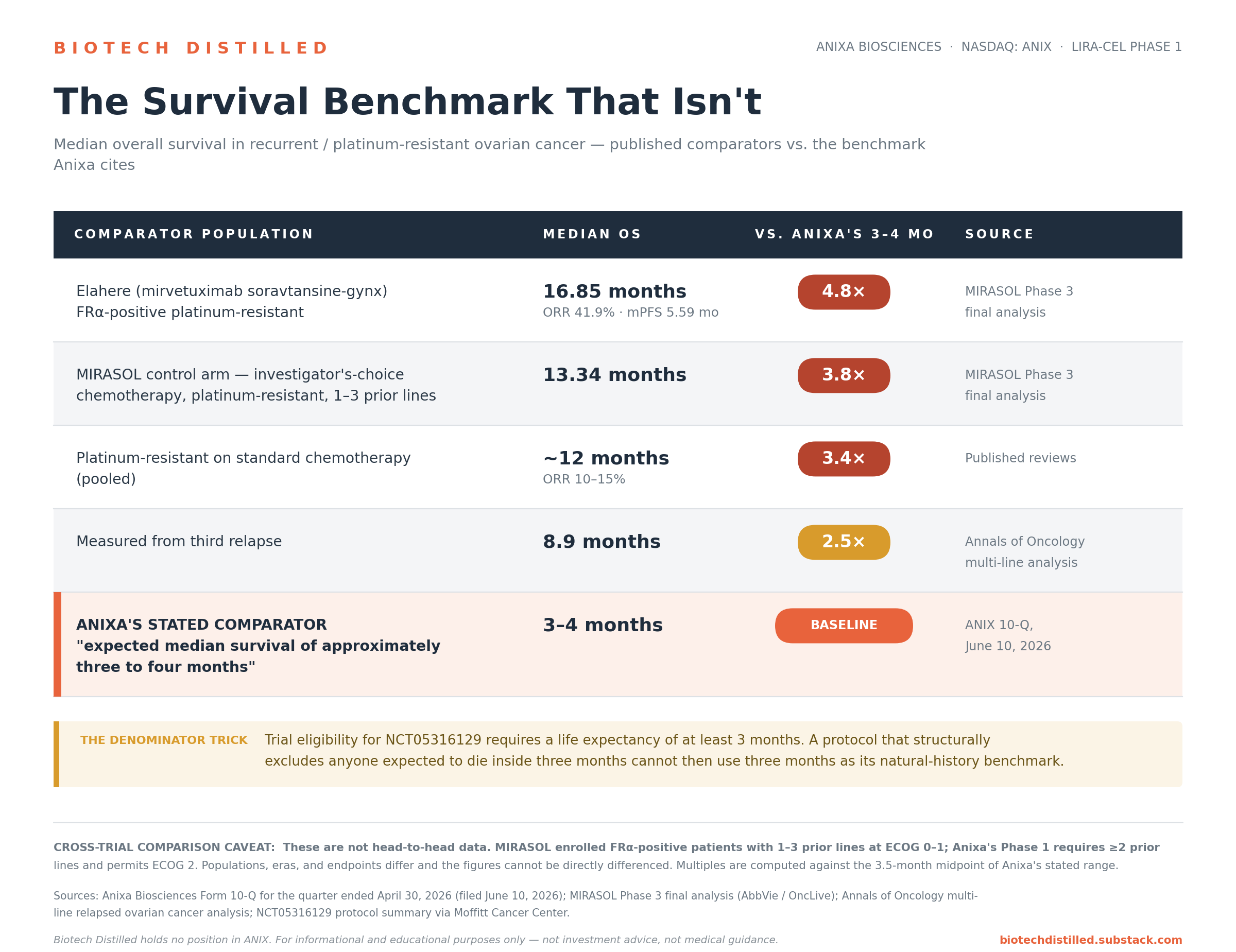
Even granting Anixa the more advanced-line population, the honest benchmark is 9–13 months, not 3–4. Against 9 months, five of 14 patients exceeding 12 months is roughly what chance produces.
The P-Hacking Check. Three findings, ascending in seriousness.
The denominator trick, and it is textbook. Eligibility requires a life expectancy of at least 3 months and ECOG ≤2 / Karnofsky ≥60%. The protocol structurally excludes every patient who would have died inside three months. Using three months as the natural-history comparator for a cohort screened to exceed three months is circular. Add the standard Phase 1 organ-function requirements plus the autologous manufacturing interval a patient must survive to be dosed at all, and the selection filter is severe. These are, by construction, the healthiest patients in the recurrent population.
The survival tallies do not reconcile. May 11 reported 28 months, then 18/17/17, then 11/11/8/7. The June 10-Q reported 28, then 19/18/17/12, then “four additional patients have survived 11, 8 and 7 months” — four patients, three numbers. July 6 reported 28/20/17/17/13. Between June 10 and July 6 the 10-Q’s 19-month survivor correctly becomes 20 and the 12-month survivor becomes 13, but the 10-Q’s 18-month living patient does not appear as 19 in the July tally; a second 17 appears instead. The discrepancies are small and not systematically self-serving, so could be read as sloppiness rather than manipulation. But a company whose sole efficacy claim is a survival count should have a consistent count.
The fact sheet overstates what the trial can establish. The July 2026 investor fact sheet claims lira-cel has shown “improvements in quality of life and overall survival in multiple patients.” A single-arm study with no control arm cannot demonstrate an improvement in overall survival — there is nothing to improve relative to. The phrase “quality of life” appears in none of the six source documents, and no QoL instrument or data appears in any filing or release.
Safety/Tolerability — The Quiet Killers. The strongest part of the dataset, with one scoping caveat. As of July 6, 2026, no DLTs “across any cohort up to and including the dose level of 3x10⁶/kg” — through cohort 4. The ICANS and CRS claims are narrower than the headline suggests: the May 11 release reports “no observations of ICANS or significant CRS,” and Kumar’s own quote scopes DLTs, ICANS and CRS to “the first three dose cohorts” — nine patients, not fourteen. All significant adverse events were adjudicated unrelated to lira-cel; all doses were delivered IP. For context, BNT211 reported CRS in 10 of 22 patients (46%) including one Grade 3, and Grade 1 ICANS in 1 of 22. Anixa’s record is meaningfully better — with the caveat that clean safety at doses the company itself calls sub-therapeutic is a weak predictor of safety at 1×10⁹/kg. Cohort 5 is the first real test and it changes two variables at once: a ~3.3× dose increase plus cyclophosphamide/fludarabine lymphodepletion. The historical pattern in cell therapy is that CRS and ICANS emerge exactly when lymphodepletion is added and dose becomes therapeutic.
Data Integrity — lira-cel. Open-label, single-arm, unblinded, single-site (Moffitt), n=14 since August 2022, no control arm, no independent central review disclosed, 3–6 patients per cohort. PI: Dr. Robert Wenham, Chair of Gynecologic Oncology at Moffitt. Every reported number is investigator-assessed and company-reported.
Efficacy — breast cancer vaccine. Phase 1 complete: 35 patients across three cohorts (26 in 1a, post-SOC TNBC at recurrence risk; 4 in 1b, BRCA/PALB2 carriers pre-prophylactic mastectomy; 5 in 1c, residual disease on pembrolizumab). All primary endpoints met; MTD 10 μg α-lactalbumin / 10 μg zymosan; 74% of subjects showed a protocol-defined immune response]. The deck’s “no safety concerns” is not quite what the 10-K says: “Two participants in Cohort Ic experienced Grade 3 adverse events consisting of greater irritation at an injection site.” Mild in substance — injection-site irritation in the pembrolizumab arm — but a Grade 3 event the deck rounds to zero.
Two caveats on the 74%. It pools all dose levels including sub-MTD cohorts; the deck’s own line at the MTD is “4 of 6 patients at the MTD exhibited a positive immune response,” 67% on n=6. And a protocol-defined immune response is an immunogenicity endpoint, not a clinical one — this Phase 1 demonstrated the vaccine is immunogenic and tolerable, not that it prevents or treats cancer. The recurrence-risk framing also drifts: the 10-K and 10-Q cite “42% of TNBC patients will have a recurrence,” the deck says “40-80% recur in 5 years.”
The Phase 2 bar is high. In neoadjuvant TNBC the vaccine adds on top of a standard of care already delivering 64.8% pathologic complete response (pembrolizumab + chemotherapy, KEYNOTE-522, vs. 51.2% for chemotherapy alone). Beating that requires either a large trial or a large effect.
Pipeline
Lira-cel — recurrent/platinum-resistant ovarian cancer. Phase 1 dose escalation, cohort 5 of 7, NCT05316129, Moffitt, global rights via Wistar. No Fast Track, no Orphan Drug, no Breakthrough, no RMAT — notable, since recurrent ovarian cancer (~21,000 U.S. cases annually) would almost certainly qualify for orphan designation, which carries a 7-year U.S. exclusivity backstop and fee waivers at essentially no cost. Four years in the clinic without it is either an oversight or a signal about regulatory engagement. Reality check: this is the entire equity story. Value driver, unproven.
α-Lactalbumin breast cancer vaccine. Phase 1 complete (35 patients), Phase 2 neoadjuvant in preparation, global rights via Cleveland Clinic, IND now sponsored by Anixa. Phase 1 was fully funded by a DoD grant to Cleveland Clinic — Anixa carried essentially none of the cost and will carry all of it in Phase 2. No designations. Reality check: real optionality with a genuinely differentiated concept, but a Phase 2 with no start date, no disclosed size, and no disclosed budget, against a 64.8% pCR incumbent.
AMHR2-ED ovarian cancer vaccine. Preclinical, inside the NCI PREVENT program, where NCI performs “virtually all pre-clinical research and development, manufacturing and IND enabling studies... with NCI financial resources and will require no material financial expenditures by the Company”. Reality check: free optionality, literally. Zero cost, zero near-term value, non-zero call option.
Lung / colon / prostate “retired protein” vaccines. R&D stage under the May 2024 Joint Development and Option Agreement with Cleveland Clinic. No disclosed targets or candidates. Reality check: zero-NPV placeholder.
Pipeline Verdict. At a ~$90M enterprise value ($103.8M market cap less $13.7M cash), lira-cel carries essentially all of it. The breast vaccine is worth something real but is unfundable at scale on a $13.7M balance sheet without a partner — which is exactly the stated model (“Out-license or sell programs to pharma for late-stage clinical development”). The bottom two rows are free options attached to other institutions’ budgets.
Intellectual Property & The Moat
The summary provided below is based on the Form 10-K filed by the Company in January 2026 and the Form 10-Q filed in June 2026.
There is no patent count, no U.S./foreign issued-or-pending breakdown, no patent number, and no expiration date anywhere in the annual report. IP appears only as Item 1A boilerplate and as license descriptions. For a company whose entire asset base is in-licensed intellectual property, that is remarkable. Anixa’s IP disclosure is delivered exclusively by press release — a choice about audience, not about materiality.
Asset-specific patent runways, reconstructed from press releases rather than filings:
Breast cancer vaccine. U.S. Patent 12,370,244, issued July 29, 2025, which the company reports covers “novel methods of immunizing patients against breast cancer by administering an immunogenic composition containing human α-lactalbumin protein,” reportedly extending protection into the mid-2040s. Korean Patent 10-2960889, granted June 2026, described by the company as composition-of-matter, through 2040. Mexican patent issued; Australian application accepted.
Lira-cel. No patent numbers, jurisdictions, or expiration windows disclosed anywhere — filings or releases. The underlying Wistar work, “including the animal studies showing efficacy,” was published in Clinical Cancer Research in January 2017, implying priority around 2015–2016 and a nominal composition-of-matter expiry around 2035–2036 before adjustment or extension. That is an estimate, not a company disclosure.
A reading of the vaccine estate. Two precision points the press releases blur.
U.S. 12,370,244 as characterized is a method-of-use patent — “methods of immunizing... by administering.” That is among the weakest tier of pharmaceutical IP: it may not stop a competitor making or selling α-lactalbumin, only promoting it for the claimed method, and induced-infringement enforcement against off-label practice is notoriously difficult. This is not a drafting failure — α-lactalbumin is a naturally occurring human protein, and under Myriad and Mayo the isolated natural protein is not patent-eligible in the U.S., so method-of-use and formulation/adjuvant claims are the strongest protection available. The Korean grant being characterized as composition-of-matter reflects a different jurisdiction’s eligibility standard — most likely claims to a composition for use or the formulated composition including the zymosan adjuvant — and does not imply an equivalent U.S. claim exists.
“Extending global protection through 2040” is geographic expansion, not term extension. Patent term is fixed by priority date; adding Korea, Mexico, and Australia adds jurisdictions, not years. A separate press release for each foreign national-phase grant on a Phase 2-ready asset is IR cadence, not value creation.
Realistically, the exclusivity backstops matter more than the patents here. A therapeutic protein vaccine should qualify for 12-year BPCIA biologic exclusivity from first licensure; lira-cel, as a cell therapy biologic, the same. Given how far both are from a BLA, that clock — not the patent staircase — will mostly likely be the binding constraint on commercial life.
Ownership & licensing structure. Nothing is wholly owned. Every asset is in-licensed, exclusive, worldwide, and royalty-bearing: Wistar (lira-cel, November 13, 2017), held by subsidiary Certainty Therapeutics, requiring cash and equity milestones — Wistar received 5% of Certainty’s stock, diluted to 3.9% at April 30, 2026, meaning lira-cel value sits one level down, in a subsidiary with a minority holder, not at the parent; Cleveland Clinic for the breast vaccine (July 8, 2019, plus amendment), with “royalties and other commercialization revenues” payable; Cleveland Clinic for the ovarian AMHR2-ED vaccine; and the Cleveland Clinic Joint Development and Option Agreement (May 3, 2024).
Royalty rates, milestone amounts, diligence obligations, sublicensing terms, and change-of-control triggers are all undisclosed. Near-term license commitments are small — approximately $150,000 over the next twelve months — but that covers maintenance, not the milestone stack triggering on IND/Phase 3/BLA/first sale. An acquirer must diligence three separate academic agreements with undisclosed economics, and the licensors retained non-commercial research rights.
Competitive Landscape. Lira-cel would enter behind Elahere (mirvetuximab soravtansine-gynx, AbbVie) — 41.9% ORR, 16.85-month median OS in FRα-positive platinum-resistant disease, off-the-shelf, IV, already standard of care. In cell therapy the closest comparator is BioNTech’s BNT211 (CLDN6 CAR-T ± CARVac), reporting 43% ORR in 14 patients across germ cell, ovarian, and other solid tumors; others pursue mesothelin, MUC16, and folate receptor. Anixa’s differentiation is real — natural-ligand binder, restricted antigen, IP delivery, dual anti-angiogenic mechanism — but none of it has been converted into a response rate, while BNT211 has a number.
In breast cancer vaccines, Greenwich LifeSciences’ GLSI-100 (GP2) is in Phase 3 FLAMINGO-01 in HER2-positive disease with Fast Track and a 750-patient target, several stages ahead in a different subset; Moderna/Merck’s mRNA-4157 (V940) and BioNTech’s individualized programs pursue personalized neoantigen vaccines with large-pharma balance sheets. Anixa’s approach is meaningfully differentiated — an off-the-shelf single shared self-antigen rather than a bespoke neoantigen cassette, a real manufacturing and cost advantage if it works — and it is the only credible prophylactic breast cancer vaccine concept in the clinic. That is the most underrated asset in the company.
The Verdict
Scientific Conviction: Medium. FSHR is among the best-validated tissue-restricted antigens available and the natural-ligand CAR design is a real, non-obvious contribution — but four years of dosing has produced no pharmacodynamic data, no response rate, and no evidence the cells expand or persist.
Commercial Viability: Low. Autologous cell therapy with four employees and no manufacturing footprint is not a commercial model; it is a licensing model, and the company says so. The vaccine faces a 64.8% pCR incumbent and an unfunded, undated Phase 2.
M&A Appeal: Low-to-Medium. Logical acquirers exist — Gilead/Kite and BMS for cell therapy, AbbVie for ovarian given the Elahere franchise, Merck for anything combining with pembrolizumab, J&J/Legend for CAR-T manufacturing scale. But nobody buys a solid-tumor CAR-T without a response rate, and an acquirer must first diligence three undisclosed academic license agreements plus a subsidiary with a 3.9% minority holder. The vaccine is the more likely partnering asset.
Trader Profile. Binary-event gamblers and retail momentum traders. A 52-week range of $2.32–$5.46 on a $104M float tells you this trades on press releases, not fundamentals — the periodic-data-release cadence is the catalyst structure. Long-term compounders should think twice. M&A specvestors appear to be early by at least two cohorts.
Buy Thesis
Target Audience. Small-position speculators who can size to zero and believe cohorts 5–7 convert clean safety into objective responses now that dosing is finally therapeutic.
Rationale. The stock is $3.05–$3.37 against a 52-week high of $5.46, with 19–23 months of runway and no debt, warrants, or preferred. Cohorts 1–4 were self-described sub-therapeutic; cohort 5 is a 100-fold increase over cohort 1 and the first time this CAR-T gets the standard conditioning every approved CAR-T requires. If FSHR biology is right, this is the cohort where you first see it.
Execution/Strategy. Consider a starter position only, sized as a total loss. Thin twice before adding before the cohort 5 safety readout — a Grade 3+ CRS event at the first lymphodepleted dose reprices this hard. Selling cash-secured puts is not attractive: implied vol is rich, but the ATM caps rallies, so you are short a stock whose upside is administratively limited while its downside is not. Own the shares and keep the powder.
Hold Thesis
Target Audience. Existing holders, particularly anyone in above $4.00.
Rationale. With 19–23 months of runway there is no forced-liquidation catalyst, and cohorts 5–7 will report something inside the holding period. Selling at $3.05 after a slide from $5.46 crystallizes a loss immediately ahead of the first therapeutic dose cohort in the program’s history.
Execution/Strategy. Consider holding the core, stop adding. Consider covered calls at $5.00–$5.50 into any press-release-driven spike — this stock has a documented pattern of running on announcement and giving it back, and the $97M ATM guarantees supply into strength. Consider trimming mechanically above $5.00 rather than waiting for the next release. Consider treating every “patient survived N months” release as a liquidity event, not a thesis update.
Sell Thesis
Target Audience. Anyone who bought the survival narrative at face value, and anyone who needs dated catalysts to underwrite a position.
Rationale. The core efficacy claim benchmarks against 3–4 month survival when the literature says 9–13 months and the protocol’s own eligibility floor is 3 months. The fact sheet claims an overall survival improvement a single-arm trial cannot establish. The deck says “clean capital table” while carrying a 40.6% option overhang and a $97M ATM equal to 93% of market cap. Enrollment runs at 3.6 patients per year against a 24-to-48-patient design. G&A exceeds R&D. Zero specialist biotech funds own it. No orphan designation after four years. That is not a valuation argument; it is a disclosure-quality argument — and disclosure quality is the only thing you can underwrite before there is data.
Execution/Strategy. Consider exiting into strength — selling into the next survival-update release rather than at $3.05. Thing twice before shorting it: a $104M market cap on 171K average daily volume, the attendant borrow cost, and a team producing positive-sounding headlines monthly is a short-squeeze machine. The best expression of the bear case seems to be zero position, not negative position.
Final Verdict
WATCH LIST. The FSHR mechanism is legitimate and cohort 5 is the first honest test this program has ever run — but the survival benchmark is misstated by a factor of three to four, no objective response has been reported in four years, and the “clean capital table” carries a 40.6% option overhang plus a $97M ATM. Revisit on RECIST-confirmed responses from cohorts 5–7, reported with denominators.
This report is strictly for informational and educational purposes only. It does not constitute financial advice, investment advice, or a recommendation to buy or sell any securities mentioned.
The scientific and clinical analyses herein should not be interpreted as medical guidance, diagnostic information, or treatment recommendations.
At the time of writing, the author does not hold a position in Anixa Biosciences (ANIX).
Biotech investing is inherently volatile. Past scientific validation does not guarantee future clinical or regulatory success. Treat all clinical-stage biopharma allocations accordingly.
For informational and educational purposes only — not investment advice. The author's position (if any) is as stated in the original article. Always verify against primary sources and do your own due diligence.