
X4 Pharmaceuticals (XFOR) - Scientific Deep Dive for Mavorixafor (XOLREMDI) and Pipeline Products
Executive Summary
The Hook.
Mavorixafor is an oral CXCR4 antagonist that empties the bone marrow’s neutrophil reserve into the blood. It is approved for WHIM syndrome, an ultra-rare disease caused by an overactive CXCR4 receptor. X4 is now betting the whole company on a 126-patient Phase 3 (4WARD) in chronic neutropenia (CN), where CXCR4 works normally and the drug has to do something harder: raise neutrophil counts pharmacologically for a year and show fewer infections than placebo.
Three facts frame the stock.
The approval is real, and the launch is small. XOLREMDI was approved in the US in April 2024 and in the EU in April 2026 (under exceptional circumstances). US net sales were $2.47 million in Q1 2026 and $2.37 million in Q2 2026, down quarter on quarter. At the $496,400 list price, that is roughly 20 patients on drug, against a company estimate of about 1,000 US WHIM patients. X4 says it is “no longer prioritizing investment in the WHIM indication”.
The CN evidence is ten patients and no infection data. The only multi-month CN data are an open-label Phase 2 with 10 patients on mavorixafor alone and 13 on mavorixafor plus G-CSF (granulocyte colony-stimulating factor). The monotherapy arm’s mean ANC (absolute neutrophil count) rose from 750 to about 1,500 cells/µL at Month 6, in 8 patients, one of them a carried-forward value. No infection rates were reported.
The pivotal trial has been resized twice. 4WARD was announced at 150 patients (June 2024), raised to 176 (November 2025) and cut to 126 (September 2026), while full enrolment slid from the “third or fourth quarter of 2025” to “year-end 2026” and topline from 2H 2026 to H1 2028. The September deck said both co-primary endpoints were “powered to >96%”. The October deck says “93% and 89%, respectively”.
The Bull Case.
An approved molecule priced like a Phase 3 asset. At $2.77, common equity is $275 million. Counting the ~27 million pre-funded warrants that trade as stock, it is ~$350 million; enterprise value (EV) is roughly $220–250 million against an estimated $185 million of cash at 30 September (arithmetic). The safety database, manufacturing, label, EU partner and specialty-pharmacy channel already exist.
The pharmacology is not in doubt. In the Phase 1b, a single 400 mg dose raised ANC in all 25 CN patients, and all 14 neutropenic patients reached normal ANC (>1,500 cells/µL). In WHIM, the randomized 4WHIM trial (n=31) showed time above the ANC threshold of 15.0 versus 2.8 hours per day (p<0.0001) and a ~60% lower annualized infection rate (1.7 vs 4.2).
The market is real and has one injectable incumbent. Filgrastim (G-CSF) is the only approved therapy for severe chronic neutropenia. It is a daily or alternate-day injection that causes bone pain, and in severe congenital neutropenia it is associated with a 21% ten-year cumulative incidence of MDS/AML (myelodysplastic syndrome/acute myeloid leukaemia) in registry data. X4’s claims analysis counts ~57,000 US patients with primary CN and ~15,000 with moderate or severe disease and infections.
Smart money is in the stock and some of it is adding. Coastlands Capital led the August 2025 PIPE (private investment in public equity) and filed a 13D. Perceptive (8.1%), Deep Track (8.33%) and Bain Capital Life Sciences (8.08%) hold large positions, Perceptive and Deep Track increased theirs in 1H 2026, and Venrock crossed 5% on 14 September 2026, after the Type C sell-off.
The refinancing removed a pre-data maturity. The Hercules loan ($75 million plus fees) was due 1 July 2027, six to twelve months before topline. K2’s $80 million first tranche repaid it, and the new facility has a 48-month maturity.
The Bear Case.
The disease mechanism that made WHIM work is absent in CN. WHIM is a gain-of-function CXCR4 disease, so mavorixafor corrects the defect. 4WARD excludes WHIM syndrome (and X4’s CN patents claim only patients without a CXCR4 gain-of-function mutation); in its population the drug can only mobilize a marrow reserve that may be small (congenital neutropenia with maturation arrest) or fluctuating (idiopathic CN). Even in WHIM, ANC was below 500 cells/µL for about nine hours a day on drug.
The pivotal is powered on an effect nobody has measured. At 63 patients per arm, 89% power on the annualized infection rate (AIR) requires an assumed reduction of roughly 35–55%, depending on the placebo rate and how clustered infections are (arithmetic). That is the size of filgrastim’s effect in severe chronic neutropenia (~50%, Dale et al. 1993) and of mavorixafor’s in WHIM (~60%). No randomized CN infection data exist for mavorixafor. If the true reduction is 30%, power falls to roughly 35–73%.
The co-primary endpoints must both win. 93% × 89% is 83% joint power if the endpoints were independent; X4 has not published a joint figure. A month earlier the same trial was “>96%” on both.
The Phase 2 is the wrong population for the Phase 3.
Combination arm: the G-CSF-sparing story (deck slides 13–14) comes from patients whose mean baseline ANC on G-CSF was 4,034 cells/µL. 4WARD requires ANC <1,000 and holds background G-CSF stable for the whole trial, so it cannot test G-CSF sparing at all.
Monotherapy arm: baseline ANC ranged up to 2,356 cells/µL (above 4WARD’s <1,000 cut-off), and the efficacy measure was an 8-hour post-dose mean, not a trough.
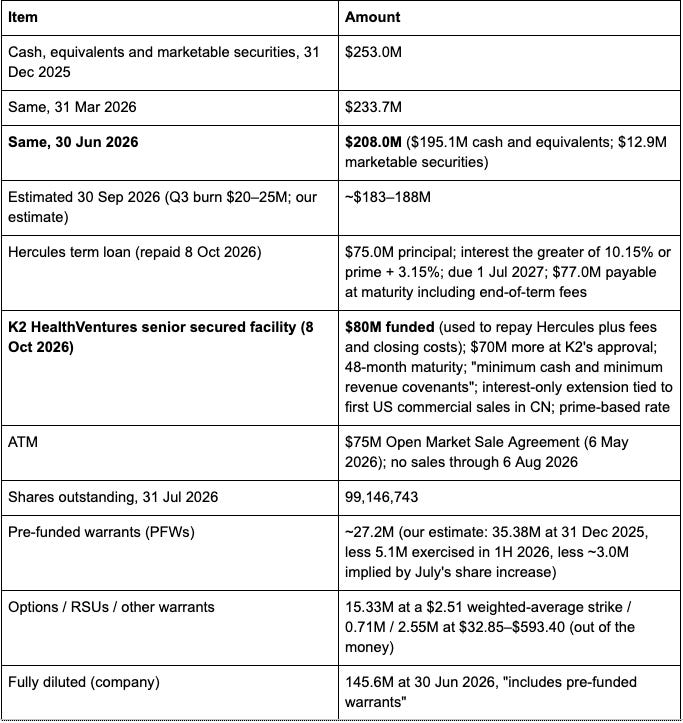
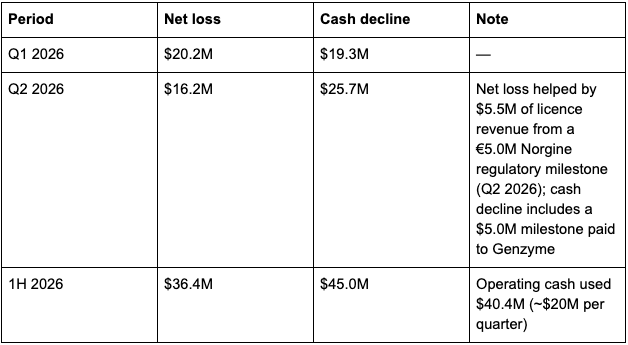
The cash runs to the binary, not past it. Cash was $208.0 million at 30 June. At the 1H 2026 operating burn (~$20 million per quarter), an estimated ~$185 million at 30 September falls to about $45 million by 30 June 2028, the end of the topline window, with $80 million of senior secured debt and an undisclosed minimum-cash covenant outstanding (arithmetic). The “into 2029” runway counts cash down to near zero.
Bottom Line.
X4 owns a real, approved, well-characterized drug and a cleaner balance sheet than it had a year ago, held by credible specialists. But the only thing that matters, whether a year of CXCR4 blockade reduces infections in non-WHIM chronic neutropenia, has never been measured. The trial built to measure it has changed size twice, and its power claim changed within a month. WATCH LIST until enrollment closes with a disclosed N and baseline profile, and the K2 covenant terms are filed; the realistic entry window is the run-up into the H1 2028 topline, not today.
Catalyst Calendar & Financial Runway
Upcoming Catalysts (next 12–18 months)
Q4 2026 (guided): full enrollment of 4WARD (NCT06056297) at 126 patients. The single most important near-term disclosure.
What to ask for: the number actually randomized, the split of congenital, autoimmune and idiopathic patients, the share on background G-CSF, and the pooled blinded baseline infection rate.
What would worry me: enrollment “substantially complete” language, a further N change, or an extension into 2027.
Q4 2026: the K2 loan agreement on EDGAR. The interest rate, the minimum-cash and minimum-revenue covenant levels, any warrants or conversion rights, and the conditions on the $70 million second tranche.
November 2026: the Q3 10-Q. The first filing after the Type C meeting and the refinancing; check whether the risk factors finally change (the August 10-Q said there were “no material changes”).
November 2026: PMR 4625-3 due. The 26-week Tg.rasH2 mouse carcinogenicity study under the WHIM approval. The hepatic-impairment study (PMR 4625-1) was due September 2026.
30 November 2026: the Boston headquarters lease ends. The move to a smaller Watertown office (~11,000 sq ft, ~$0.3 million a year) is planned for “late 2026 or early 2027”.
2027: no efficacy catalyst. 4WARD is a 52-week double-blind trial. Watch for EU launch milestones under the Norgine agreement (up to €221 million of milestones remain) and for blinded safety disclosures.
26 April 2028: NCE-1 date. Generic companies may file ANDAs with a Paragraph IV certification one year before NCE exclusivity ends (26 April 2029).
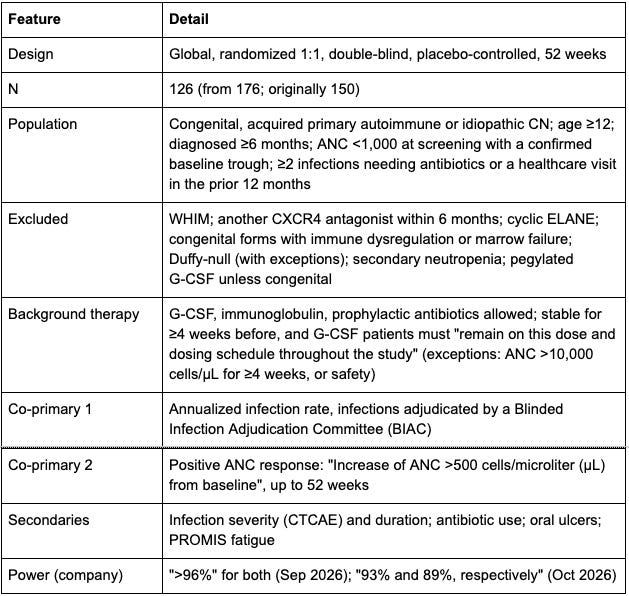
H1 2028 (guided): 4WARD topline. Co-primary endpoints: the annualized infection rate (adjudicated by a blinded committee) and ANC response (an increase of >500 cells/µL from baseline), both over 52 weeks.
Late 2028 / early 2029 (guided): potential FDA approval of a supplemental NDA (sNDA) in CN.
December 2028: PMR 4625-2 due (two-year rat carcinogenicity study). 31 December 2028: the Catalent capsule-manufacturing agreement expires.
Enrollment arithmetic (guidance-implied averages from the 6 June 2024 study start; arithmetic):
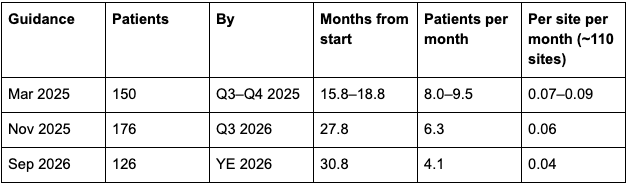
At completion, the trial will have randomized about 1.1 patients per site. The registry lists 114 sites in 25 countries; 22 are in the US, and Ukraine (6), Turkey (5), Romania (5), Georgia (4) and Colombia (4) each contribute several. Seven sites are withdrawn or terminated, including all four in India.
The Dilution Gap
Cash and obligations:
Burn.
Runway guidance history.
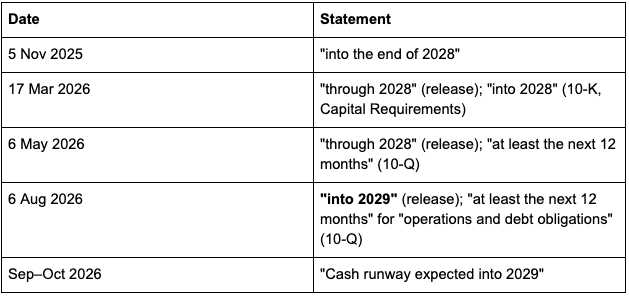
The August extension needed the refinancing. On 6 August the runway moved later while cash had fallen by $45 million, and the Hercules maturity ($77.0 million on 1 July 2027) was still on the balance sheet. From $208 million, paying Hercules at maturity and reaching 1 January 2029 would have required spending no more than about $13 million a quarter, against ~$20 million in 1H 2026 (arithmetic). “Into 2029” only worked if the maturity was refinanced or extended, or if ATM sales or partner milestones filled a gap of roughly $70 million. The 10-Q filed the same day contains neither the phrase nor a refinancing. K2 has since made the maturity problem go away.
What the runway actually covers (arithmetic, from ~$185 million at 30 September):
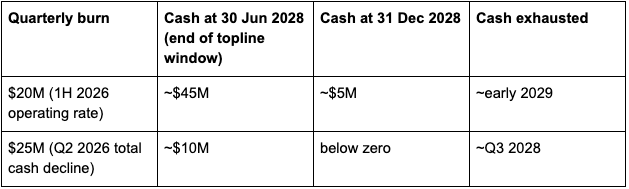
This is gross runway. It counts cash down to near zero while $80 million of senior secured debt is outstanding. K2’s minimum-cash covenant is not yet disclosed. Hercules required 20% of principal (~$15 million). For comparison only, K2’s May 2026 facility with Cartesian Therapeutics requires, from April 2027, unrestricted cash of 80% of obligations while market capitalization is below $750 million, stepping down to 50% after later tranche milestones. A covenant of that kind here would lock up ~$64 million and end the usable runway around topline. I do not know X4’s terms; flagged because the release itself names the covenant as a risk.
Costs are more likely to rise than fall. The new oncology CRO, full enrollment, 52 weeks of follow-up, database lock and sNDA preparation all land in 2027–2028; launch preparation would follow.
Is a raise likely before the next data drop?
Before topline: possible, not required. The $75 million ATM is in place and unused; opportunistic sales into strength in 2027 would not surprise me.
Around a positive topline: near certain. X4 cannot fund an sNDA review, a launch and a covenant floor from ~$10–45 million. Expect an equity raise on the data, perhaps alongside the $70 million K2 tranche (at the lender’s discretion).
After a negative topline: cash per share, net of the K2 loan, would be well under $0.50 (arithmetic), and the remaining value would be WHIM royalties, EU milestones and a tax asset.
Valuation at $2.77 (arithmetic):
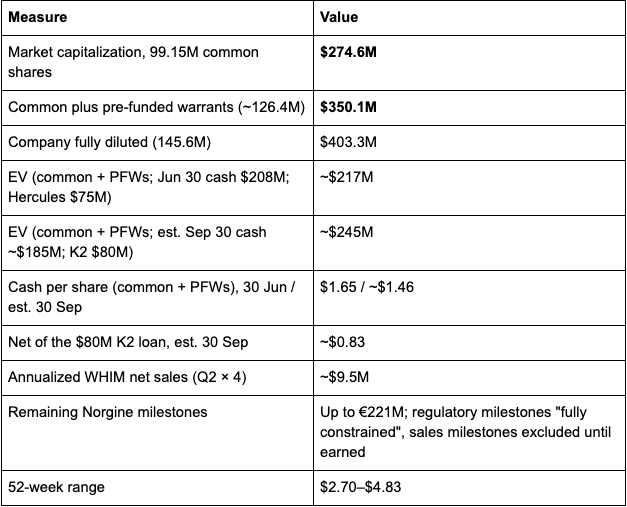
What the Type C meeting did to the price. The stock closed at $4.04 on 4 September 2026. After the “positive” Type C release on 8 September it closed at $3.51 (−13.1%) and at $3.40 on 10 September (−15.8%). It closed at $2.77 on 6 October, 31% below the 4 September close and 4.5% below the October 2025 offering price of $2.90. The market read the resizing as a delay, not as a de-risking.
Insiders & Institutions
The register is specialist-heavy, and partly built on pre-funded warrants.
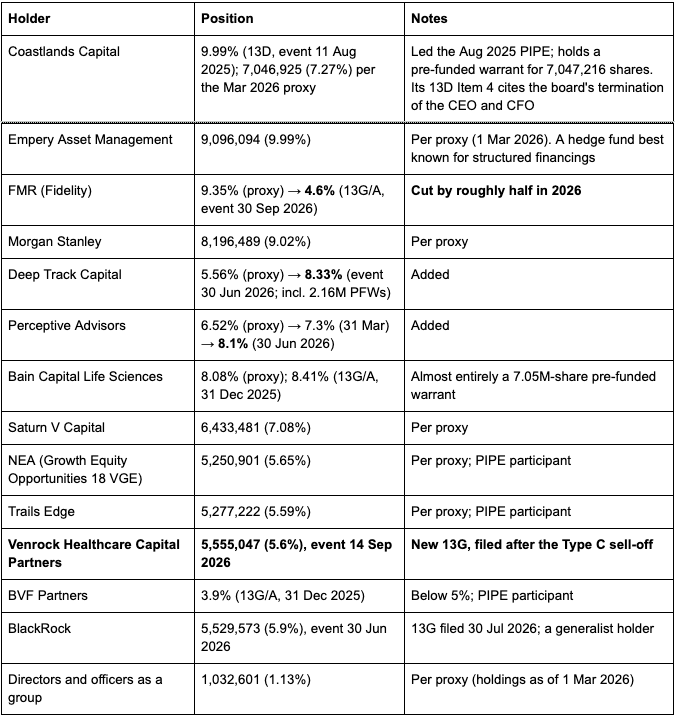
How to read it.
The conviction signal is genuine. Perceptive, Deep Track, Bain Capital Life Sciences, NEA, BVF, Venrock and Coastlands are elite specialist names. Two added in 2026, and Venrock crossed 5% in September, after the sell-off.
The exits matter too. Fidelity halved its holding in 2026, and much of the specialist position sits in non-voting pre-funded warrants with 9.99% blockers.
Funding history. The August 2025 PIPE was struck at $1.42 (11.0 million shares and 48.9 million PFWs; $81.0 million net; announced as $60 million and upsized). The October 2025 offering was struck at $2.90 (52.8 million shares and 0.7 million PFWs; $145.6 million net; Leerink, Stifel, Guggenheim). The deck’s “$240M raised from blue chip investors” is the gross of the two. The PIPE holders are about 95% in the money; the October buyers are under water.
Insiders.
One purchase, in the offering: Executive Chairman Adam Craig bought 86,206 shares at $2.90 in the October 2025 underwritten offering ($250,000). No officer or director has bought in the open market since the management change.
Sales since: Craig 47,436 and President John Volpone 24,576 at $4.44 on the same day in August 2026; CFO David Kirske 16,961 at $4.29 (May), 8,543 at $4.26 (June) and 11,767 at $2.86 on 1 October 2026. The Forms 4 for Craig (August) and Kirske (June and October) state that the shares were sold “to cover personal income tax obligation upon settlement of restricted stock unit award”. These are tax sales, not signals.
The incentive is options. 15.3 million options were outstanding at 30 June (308,000 a year earlier), at a $2.51 weighted-average strike; 4.0 million were granted in 1H 2026 at $4.01. Volpone held no common stock as of 1 March 2026.
The Science: Mechanism & Chemistry
Mavorixafor (formerly AMD070 / AMD11070, X4P-001) is a small molecule, N1-(1H-benzimidazol-2-ylmethyl)-N1-[(8S)-5,6,7,8-tetrahydroquinolin-8-yl]butane-1,4-diamine. It is an orally bioavailable CXCR4 antagonist from AnorMED’s bicyclam-successor programme of the early 2000s, first developed for HIV entry inhibition and later licensed from Genzyme (Sanofi) in 2014.
Novelty: it was a new chemical entity at its 2024 approval (NCE exclusivity to 26 April 2029). It is first-in-class as an oral CXCR4 antagonist and the first approved drug for WHIM.
In CN it is a repurposing, not a new molecule. The CN bet is a new indication for an old compound.
Mechanism Validation
CXCR4 antagonism is validated as a way to move cells out of the marrow. Plerixafor (Mozobil) and motixafortide (Aphexda) are approved injectable CXCR4 antagonists for stem-cell mobilization.
In WHIM it is validated as a disease-modifying treatment, because WHIM is caused by gain-of-function CXCR4 mutations that trap neutrophils in the marrow (myelokathexis).
In non-WHIM CN it is validated only as pharmacology. The receptor is normal, so the drug mobilizes whatever reserve the marrow holds. It reliably raises ANC within hours (Phase 1b), but whether a year of that reduces infections is untested. The deck’s “Validated mechanism with the potential to increase neutrophil counts and decrease infection rates” (slide 5) runs the two together.
Manufacturing / CMC Risks
Two single-source suppliers. Evotec (Oxford; formerly Aptuit) makes the API; Catalent is the “sole manufacturer for the final capsule drug product”. No alternate suppliers are qualified. The Catalent agreement expires on 31 December 2028, the month the guided approval window opens.
No China manufacturing for the US supply chain is disclosed; BIOSECURE is not an issue on the filings. Abbisko holds Greater China rights, including to manufacture.
A fasting requirement. XOLREMDI must be taken “on an empty stomach after an overnight fast, at least 30 minutes before food”; a high-fat meal cuts AUC by 55% and Cmax (peak concentration) by 66%. For an ultra-rare paediatric-onset disease that is manageable. For a chronic therapy in 15,000 adults, real-world exposure will be lower than in a trial.
A drug-interaction profile that matters in adults. Mavorixafor is contraindicated with drugs “highly dependent on CYP2D6 for clearance” (dextromethorphan AUC rose 9-fold). Strong CYP3A4 inhibitors require a cut to 200 mg, and strong inducers must be avoided.
Biochemical Deep Dive
The Target
CXCR4 and CXCL12. CXCR4 is a G-protein-coupled chemokine receptor. Its ligand, CXCL12 (SDF-1), is made in abundance by marrow stromal cells. CXCR4 signalling holds mature neutrophils, lymphocytes and stem cells in the marrow; when it is blocked, cells leave for the blood within hours. CXCR2 signalling pulls in the opposite direction, so the CXCR4/CXCR2 balance sets how many neutrophils circulate.
WHIM syndrome. Truncating mutations in the CXCR4 C-terminal tail stop the receptor from being internalized after it binds CXCL12. Signalling persists, mature neutrophils stay trapped (myelokathexis), and patients have neutropenia, lymphopenia, warts and recurrent infections. A CXCR4 antagonist treats the cause.
Chronic neutropenia (the 4WARD population). A heterogeneous group with ANC <1,000 cells/µL for more than three months:
Idiopathic: about 93% of the claims-based target population. Often adult women; the marrow is usually normocellular, and the mechanism is unknown (immune-mediated destruction is suspected in many).
Congenital: about 7%. 4WARD excludes cyclic ELANE neutropenia, congenital forms with immune dysregulation and those with marrow failure. The ones that remain include severe congenital neutropenia variants in which the problem is production (maturation arrest), not release.
Autoimmune: antibody-mediated peripheral destruction.
Why it matters for the investment case. Mavorixafor mobilizes neutrophils that already exist. Its effect depends on the size of the marrow’s mature-neutrophil pool. That pool is large in WHIM (by definition), probably reasonable in many idiopathic patients, and small where maturation is arrested. 4WARD’s mix of these populations is not disclosed.
The Chemistry
Scaffold. A tetrahydroquinoline-benzimidazole amine, one of the AnorMED compounds designed to replace the bicyclam plerixafor (AMD3100) with an orally absorbed small molecule. Plerixafor’s two cyclam rings are highly charged and cannot be taken orally; AMD070 keeps a basic, nitrogen-rich pharmacophore that binds the receptor’s acidic transmembrane pocket, at a size and charge the gut can absorb.
Pharmacokinetics. Tmax (time to peak) ~2.8 hours; terminal half-life ~82 hours; steady state after 9–12 days; >93% protein-bound; cleared mainly by CYP3A4 with a CYP2D6 contribution; exposure rises more than dose-proportionally from 50 to 400 mg.
Flat PK, sawtooth pharmacodynamics. The half-life is long enough for once-daily dosing to give fairly flat plasma levels. The neutrophil response is not flat: in WHIM, where the drug works best, time above an ANC of 500 cells/µL averaged 15.0 hours out of 24 across four quarterly assessments over 52 weeks. Even in the validated disease, patients spent roughly 9 hours a day below the threshold. Mobilization empties a reservoir faster than the marrow refills it.
Safety pharmacology. Concentration-dependent QTc prolongation (15.6 ms at 800 mg, twice the top dose); embryo-fetal toxicity (contraception required during treatment and for three weeks after).
The Mechanism
Mavorixafor binds CXCR4 and blocks CXCL12 signalling.
The retention signal falls; mature neutrophils and lymphocytes cross into the blood, peaking within about two to four hours of a dose (Phase 1b: all monotherapy patients with severe CN reached normal ANC within 2 hours of a single 400 mg dose).
In WHIM: the drug offsets the gain-of-function defect, so the effect is durable and clinically meaningful (TAT-ANC 15.0 vs 2.8 hours; infections down ~60%).
In CN: the drug adds a mobilizing push to a normal receptor. Higher circulating ANC should mean faster delivery of neutrophils to infection sites. Whether the pool is deep enough to sustain that for a year, and whether more circulating neutrophils for part of the day translates into fewer adjudicated infections, is precisely what 4WARD tests.
With G-CSF: G-CSF increases production; mavorixafor increases release. The combination is mechanistically complementary, which is the logic behind the G-CSF-sparing story.
The Biomarker Receipts
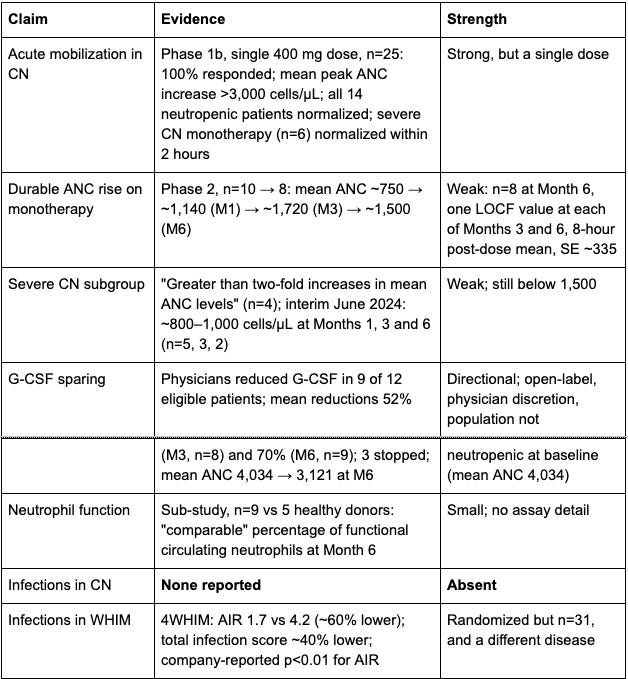
Bottom Line. The biomarker does exactly what the mechanism predicts: mavorixafor moves neutrophils into the blood, quickly and in nearly everyone. The investment thesis needs something the biomarker cannot show: that a partial, time-varying rise in circulating neutrophils prevents infections in patients whose CXCR4 is normal. In WHIM the biology and the clinical endpoint moved together. In CN nobody has looked.
Clinical Data
The Approved Indication — 4WHIM (WHIM syndrome)
Design. Global, randomized 1:1, double-blind, placebo-controlled, 52 weeks; 31 patients aged ≥12 (14 mavorixafor, 17 placebo). Baseline mean ANC was 155 cells/µL on drug and 281 on placebo.
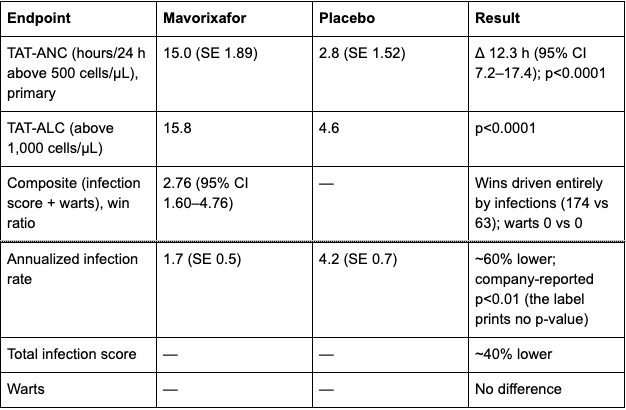
How to read it. A clean pharmacodynamic win and a supportive infection signal in 31 patients. The label’s indication is phrased around the biomarker (”to increase the number of circulating mature neutrophils and lymphocytes”), not around infections.
The CN Evidence — Phase 1b/2 (open-label)
Design. The Phase 2 was an amendment of the Phase 1b protocol: once-daily mavorixafor for six months, alone or with G-CSF; G-CSF dose changes allowed from Month 2 or 3 at the physician’s discretion. Blood was drawn up to seven times over eight hours at each visit, and the efficacy measure was the “daily mean ANC” over those eight hours.
Population (n=23). 15 idiopathic, 6 congenital (ELANE ×2, VPS13B/Cohen, G6PC3, SRP54, WASp), 2 cyclic; 13 women; mean age 34.
Monotherapy (n=10): mean baseline ANC 750 cells/µL (range 180–2,356).
Combination (n=13): mean baseline ANC 4,034 cells/µL on G-CSF (range 470–11,183); 4 on stable G-CSF, 9 adjusted.
Monotherapy results (deck slide 12, rebuilt from the bar heights; calibrated to the stated 750 baseline, ±10 cells/µL):
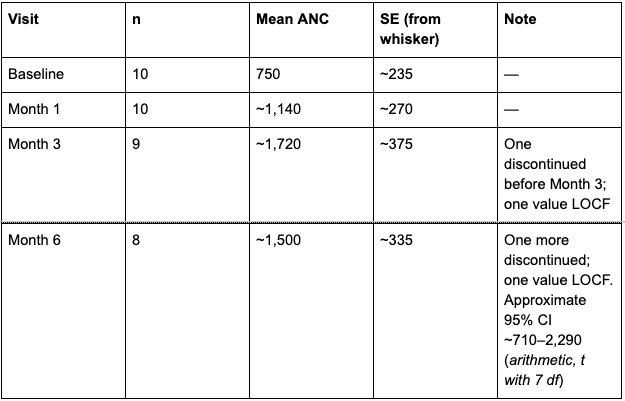
The slide headline, “Mean ANC reached normal levels (ANC ≥ 1,500 cells/µL) at 3 and 6 months”, is true at Month 6 to within a reading error, in eight patients, one of them carried forward. The reasons for the two discontinuations are not disclosed.
Combination results. Mean ANC 4,034 → 4,573 → 4,322 → 3,121 cells/µL (n=13, 12, 12, 12), while mean G-CSF doses fell 52% (Month 3) and 70% (Month 6).
The Pivotal — 4WARD
What the power claims imply (arithmetic; two-sided α=0.05, 63 per arm, normal approximations; a negative-binomial model for infections with dispersion k):
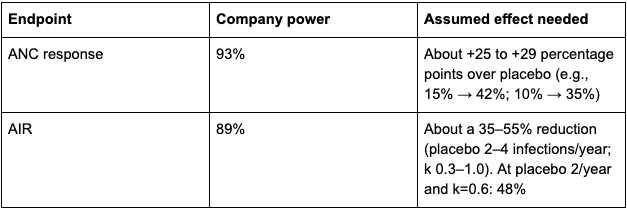
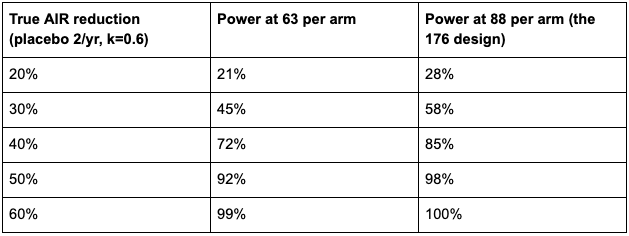
How to read it.
The trial is powered for a filgrastim-sized effect. Filgrastim cut the incidence and duration of infection-related events by about 50% in severe chronic neutropenia (Dale et al., Blood 1993; 123 enrolled). Mavorixafor cut WHIM infections by ~60%. 4WARD assumes an effect in that range without any randomized CN infection data behind it.
The joint probability is lower than either number. Both co-primary endpoints must succeed. At 93% and 89%, joint power is 83% if the endpoints were independent and at most 89% if they were perfectly correlated.
Regression to the mean works against the infection endpoint. Patients qualify after two or more infections in the prior year. Some of them had an unusually bad year; on placebo they will have fewer infections anyway. A lower placebo rate reduces power for the same relative effect.
The ANC endpoint depends on timing. “Increase of ANC >500 from baseline” can be easy or hard depending on whether it must be sustained, how many visits count, and when blood is drawn relative to the dose (peak ~2–4 hours; baseline is a “trough”). The Phase 2 measured an 8-hour post-dose mean. The protocol’s definition is not public.
The G-CSF thesis is not in the trial. Background G-CSF is held at a fixed dose for 52 weeks (except for safety or very high ANC), so 4WARD cannot generate a G-CSF dose-reduction claim. A label from 4WARD would say nothing about G-CSF sparing.
The P-Hacking Check
A mid-trial sample-size cut. Reducing N in a blinded trial is legitimate if it is based on blinded pooled data and pre-agreed with the FDA, as X4 says it was. But the same leadership raised N ten months earlier, and the power claim then moved from “>96%” to “93%/89%” between two decks a month apart. The Statistical Analysis Plan’s assumptions (placebo rate, effect size, dispersion, dropout, multiplicity) are not public.
An efficacy measure that flatters. The Phase 2’s “daily mean ANC” averages draws over the eight hours after dosing, which include the mobilization peak. A trough-based or single-draw responder endpoint is harder.
Completers and LOCF. The monotherapy means fall from n=10 to n=8 and include two carried-forward values (one at Month 3, one at Month 6). No responder analysis was ever published.
The combination data come from mostly non-neutropenic patients. Mean baseline ANC of 4,034 cells/µL on G-CSF (range 470–11,183). 4WARD excludes such patients.
Small-subgroup claims. “Greater than two-fold increases” in severe CN rest on n=4.
Infection p-values in WHIM. The company reported p<0.01 for the 4WHIM infection rate; the label prints point estimates without a p-value. The May 2023 topline release described “participants on mavorixafor experiencing less than one infection per year versus 4.5 for those on placebo”, against the label’s 1.7 versus 4.2 over 52 weeks. The release may have used a different window or definition; the label governs.
Moving goalposts on eligibility. ANC <1,500 (June 2024) became <1,000 (by March 2025).
Individually, most of these are normal for a small company. Together, every one pushes in the same direction.
Safety/Tolerability — The Quiet Killers
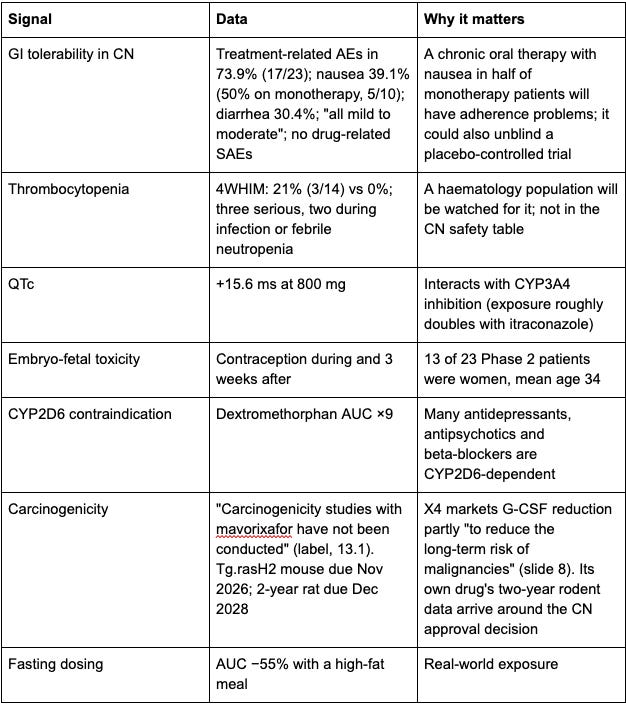
Benchmark. Filgrastim’s known burdens are injections, bone pain, splenomegaly and, in severe congenital neutropenia, MDS/AML (21% cumulative at ten years in the registry cohort; 40% among poor responders on high doses). Mavorixafor does not need to be safer than G-CSF to succeed; it needs to work, and to be tolerable enough to take every day on an empty stomach.
Data Integrity
4WHIM: randomized and double-blind, but n=31.
CN Phase 1b/2: open-label, single-arm, 23 patients, sponsor-reported. No infection data.
4WARD: randomized, double-blind, with blinded infection adjudication; the right design. The risks are operational:
A CRO change mid-trial. X4 “transitioned management of the Phase 3 4WARD trial to a premier Clinical Research Organization” in 2026, after a “complete overhaul of the clinical operating infrastructure” (Q2 release). CRO transitions mid-study are a common source of data-handling problems.
Geography. About 19% of sites are in the US. A 126-patient trial spread over 25 countries, including six sites in Ukraine, will have heterogeneous background care and infection-reporting practices. The FDA will ask how applicable the result is to US patients.
Enrolment pace. About 0.04 patients per site per month, on the current guidance.
Pipeline
Mavorixafor — chronic neutropenia (congenital, autoimmune, idiopathic). Phase 3 (4WARD), 126 patients; full enrolment guided for YE 2026; topline H1 2028; potential approval late 2028/early 2029.
Designations: Fast Track (CN). No orphan drug designation identified for CN in the filings; the 10-K lists orphan designation for WHIM only.
Partners: Norgine holds Europe, Australia and New Zealand for all indications, including CN.
Reality check: the entire valuation. This is a single binary with no second shot.
Mavorixafor — WHIM syndrome (XOLREMDI). Approved: US (April 2024), EU (April 2026, exceptional circumstances, marketing authorization transferred to Norgine in July 2026). A distribution agreement covers MENA (Taiba), and Abbisko holds a licence for Greater China (regulatory, manufacturing and distribution rights).
Designations used: Breakthrough, Fast Track, Rare Pediatric Disease (voucher sold for $105 million in 2024) and Orphan (US and EU).
Economics: US net sales $6.5 million in 2025 and $4.8 million in 1H 2026. Norgine pays escalating double-digit royalties “of up to the mid-twenties” and up to €221 million in remaining milestones; a €5.0 million milestone was booked in Q2 2026.
Reality check: a small, deprioritized cash flow. X4 has no US commercial field team (cut in early 2025) and says it is “not actively promoting XOLREMDI in the U.S.” Quarterly sales fell from Q1 to Q2 2026.
Preclinical (X4P-002, X4P-003). Paused in the 2025 restructuring; zero direct spend in 2025; the Vienna research site is closed.
Reality check: zero.
What the CN bet could be worth (illustrative scenarios; peak US net sales; not company guidance):
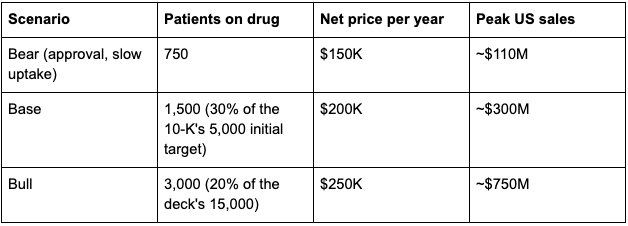
The price is a real unknown. One capsule at one dose serves both indications. XOLREMDI’s list price is $496,400 a year for patients over 50 kg. A CN price will have to be set against generic and biosimilar filgrastim, and a single NDA cannot easily carry two very different prices.
The royalty stack. Genzyme takes 6% of US net sales up to $150 million, 10% from $150–300 million and 12% above, plus sales milestones of $0.5, $1.5 and $3.0 million at $50, $150 and $300 million of cumulative sales.
The arithmetic of the base case. $300 million of peak sales at a 3–4× multiple, risk-adjusted at a 45–55% probability of success, is worth roughly $400–650 million today before dilution, against an EV of ~$220–250 million. That is a cheap option if the probability of success is that high. The bear case is that it is lower, because the infection effect has never been measured.
Pipeline Verdict. Mavorixafor in CN carries the whole valuation. WHIM provides the safety database, the supply chain and a modest royalty floor; nothing else is in development.
Intellectual Property & The Moat
The summary provided below is based on the 10-K filed by the Company in March 2026, checked against the 10-Qs filed in May and August 2026. Because the 10-K’s IP disclosure gives a single expiry sentence and no patent counts, patent numbers, dates and claims come from the FDA Orange Book listing (via DrugPatentWatch and GreyB), Google Patents, the USPTO Official Gazette, USPTO full-text images and the Federal Register. I have not verified them in USPTO Patent Center.
Portfolio Overview
What the company reports. The IP section says X4 has “pending patent applications or issued patents in the United States and foreign countries directed to mavorixafor”, and gives one expiry: “Patents issued from our co-owned portfolio, if all maintenance fees are paid, are expected to expire in 2036, not including any Patent Term Adjustment (PTA), Patent Term Extension (PTE), or other extensions of term that may be available”. There are no patent counts, families or claim types; the risk factors list filings in the “US, Canada, China, Japan and in countries within Europe via the European Patent Office”. Elsewhere:
The deck: “U.S. patent protection expected through 2038”.
The 10-Q: the Genzyme milestone intangible is amortized over “the remaining life of the underlying patent protecting the intellectual property through 2038”, a 14-year period from April 2024.
The risk factors: the Genzyme agreement “includes a number of issued patents that are exclusively licensed to us”.
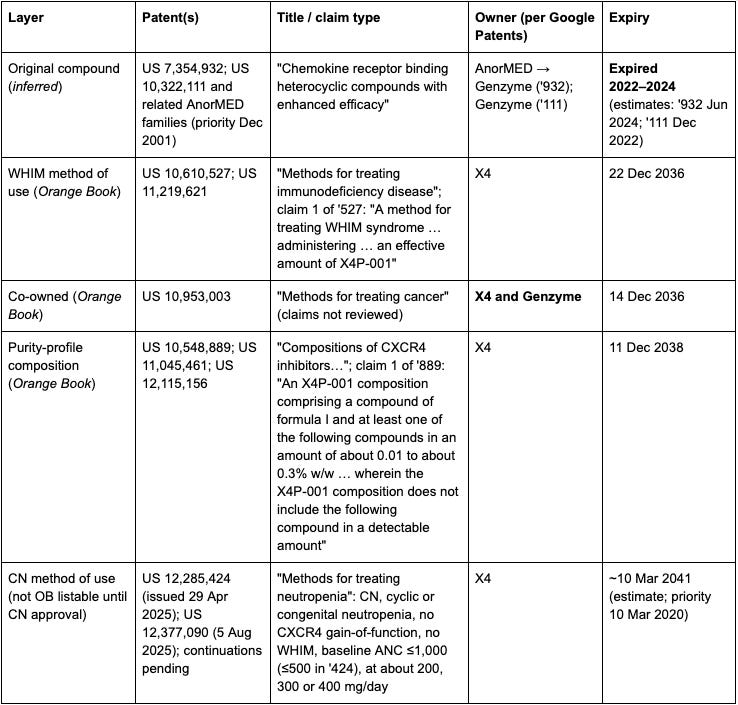
What the public record shows (findings, not company reported):
Asset-Specific Patent Runways
The Read (the company “reportedly” owns these families; I have not audited the docket):
There does not appear to be a composition-of-matter floor. The patents on the molecule itself, filed by AnorMED in 2001–2003, have expired. X4’s February 2020 release called US 10,548,889 a “New Composition of Matter Patent” providing exclusivity “through 2038”. Its claim is to a composition with a specified impurity profile. That is a composition-of-matter claim in the literal sense, but it is not the hard floor: a generic manufacturer with a different impurity profile, or one that makes the excluded compound detectable, may design around it. The Orange Book flags it as a drug-product patent, not drug-substance.
The WHIM method patents and the 2038 date. X4 filed PTE applications on all three 2036 patents; the FDA determined a regulatory review period of 6,923 days (testing phase from the AnorMED IND of May 2005) in a Federal Register notice signed 11 June and published 16 June 2025. Only one patent can be extended. Counting only the review period after US 10,610,527 issued (April 2020), the extension would be about 2.4 years, which the statute caps at 14 years from approval: 26 April 2038 (arithmetic; not yet granted). So the deck’s “2038” is supported by two separate layers that happen to end in the same year: the purity-profile patents (December 2038) and a pending PTE capped at April 2038.
The CN patents appear to be the best part of the estate. Issued, X4-owned, with claims that track the 4WARD population (ANC ≤1,000, non-WHIM, 200–400 mg/day). They run to about March 2041 before any term adjustment. They are method-of-use claims, however, and they cannot be listed in the Orange Book until CN is on the label.
The skinny-label risk. After the WHIM patents (2036–2038) and the purity patents (2038) lapse or are designed around, a generic could launch with a WHIM-only label and carve out CN. Whether X4 could then enforce its CN method patents against off-label substitution depends on induced-infringement law that remains unsettled after GSK v. Teva. This is a mid-2030s problem, not a 2028 one.
Regulatory exclusivity:
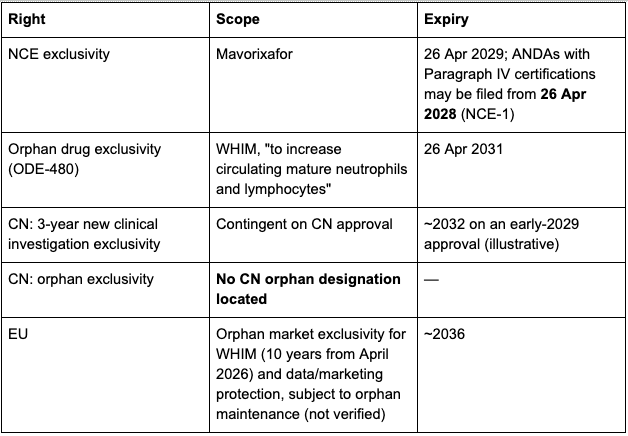
Accelerated approval: a filing that disagrees with the regulator. The 10-K and both 2026 10-Qs say XOLREMDI “received accelerated approval”. The FDA’s 26 April 2024 approval letter cites approval under section 505(b) and contains no reference to Subpart H, 21 CFR 314.510, accelerated approval or verification of clinical benefit. Its postmarketing requirements are a hepatic-impairment study (due September 2026), a 26-week Tg.rasH2 mouse carcinogenicity study (November 2026) and a 2-year rat carcinogenicity study (December 2028), plus a CYP3A4-inducer interaction commitment (April 2026). X4’s own 8-K of 29 April 2024 said simply that the FDA “has approved” XOLREMDI.
If the letter is right, the 10-K’s language is a drafting error in a document signed by the new management.
If the 10-K is right, there is a confirmatory obligation it never describes.
Seems more likely to be the former. Either way, it does not change the WHIM franchise’s economics.
Ownership & Licensing Structure
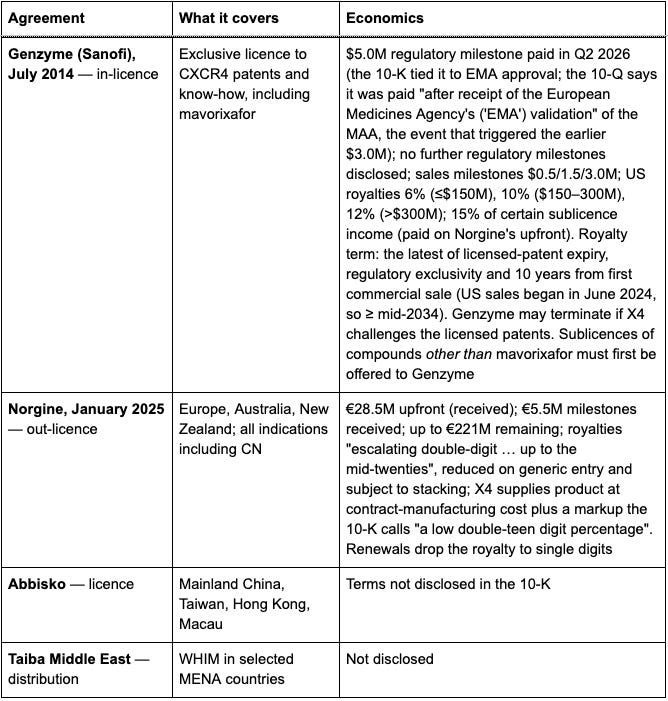
Change-of-control and encumbrances. The Hercules loan excluded IP from collateral but restricted encumbering it. The K2 facility is “senior secured”; whether IP is now pledged will be in the agreement.
Competitive Landscape
Chronic neutropenia:
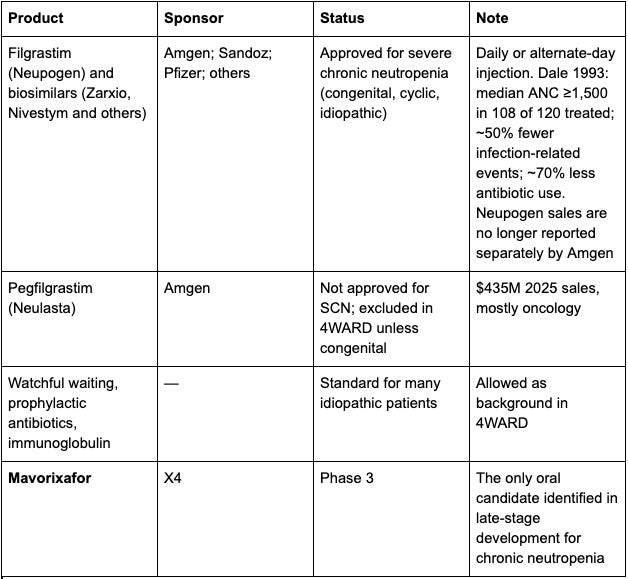
WHIM: mavorixafor is the only approved therapy. Plerixafor (injectable) has been used off-label and studied by the NIH.
Where mavorixafor is and isn’t differentiated.
Where it is: oral, once daily, and complementary to G-CSF; no injection-site or bone-pain burden. Physicians in X4’s survey ranked “oral treatment options” first among unmet needs (35 of 95 put it in their top three).
Where it isn’t (yet): no infection data in CN; an untested effect size; a fasting requirement and a drug-interaction profile that G-CSF does not have; and a price set for an ultra-rare disease against a generic incumbent.
The first-mover question: there is no oral competitor in sight. If 4WARD wins, X4 owns the category. If it loses, nobody else is in a position to try.
The Verdict
Scientific Conviction: Medium.
For: a mechanism that works exactly as advertised on the biomarker, in every patient population tested; a randomized infection signal in WHIM.
Against: in the 4WARD population the receptor is normal, and the drug’s effect on infections has never been measured. Even in WHIM, patients spent ~9 hours a day below an ANC of 500.
Commercial Viability: Low–Medium.
For: an oral option in a market with one injectable incumbent and ~5,000–15,000 target US patients.
Against: the WHIM launch reached ~20 patients in two years and was deprioritized; CN pricing is unresolved; the label would carry fasting, CYP2D6 and contraception restrictions; and the deck’s G-CSF-sparing positioning is not tested in the pivotal.
M&A Appeal: Medium (after data, not before).
Logical acquirers: Sobi, which bought this management team’s last company (CTI BioPharma, $1.7 billion, 2023) and sells rare haematology drugs; Pharming (Joenja, a rare primary immunodeficiency franchise with WHIM adjacency); Norgine, which already holds Europe; Chiesi; Ipsen.
Why buyers will wait: the asset is binary on one 2028 readout, and the CN price is unknowable until then. Defences are modest: there is no CEO (an executive chairman leads), and a register concentrated in specialist funds would decide any bid.
Trader Profile.
Event traders: the H1 2028 topline is a classic binary, too far away for most to hold today.
Catalyst-anticipation accumulators: the natural window is late 2027, after enrolment and the first blinded safety updates, before topline.
Long-term investors: wait for data.
The Buy Thesis
Target Audience. Patient specialist investors who can hold an 18-month binary and accept a capital raise around the readout.
Rationale.
Pricing: an approved drug with a randomized Phase 3 under way in a 15,000-patient indication, at an EV of ~$220–250 million.
Register: Perceptive, Deep Track, Bain, Venrock, NEA and BVF behind it, and the PIPE lead (Coastlands) still in.
Balance sheet: the refinancing removed the July 2027 maturity, and the CN patents (to ~2041) give a winner real duration.
The base-case arithmetic is worth more than today’s EV if the probability of success is near 50%.
Execution / Strategy.
Size: small now; add on the Q4 2026 enrolment announcement only if it discloses N and baseline characteristics.
Timing: the main accumulation window is 2H 2027 (buy the rumour), with a plan to trim into the topline rather than hold the full position through it.
Options: listed options on a $2.77 stock with 18 months to the catalyst are a poor tool. If liquidity allows, longer-dated calls seem to be cleaner than selling puts; a put seller here is effectively underwriting the 2028 equity raise.
Exit triggers: another change in N or in the enrolment date; K2 covenants that lock up a large share of cash; ATM sales below ~$2.
The Hold Thesis
Target Audience. Holders from the October 2025 offering ($2.90) or the PIPE ($1.42).
Rationale.
Why hold: the stock has already absorbed the resizing and the timeline slip (down 31% since 4 September). Nothing scheduled before enrolment completion should materially change the probability of success.
Why not hold blindly: cash per share falls by roughly $0.16–0.20 a quarter (arithmetic), and the next value-creating event is 18 months away.
Execution / Strategy.
PIPE holders: hold a core position; consider taking cost basis off the table into any 2027 strength.
October 2025 holders: hold through Q4 enrolment; reassess on the K2 covenant terms. If a large share of cash is restricted, the 2028 raise gets bigger and earlier.
The Sell Thesis
Target Audience. Anyone who owns XFOR for “approved drug, de-risked mechanism”.
Rationale.
The mechanism is de-risked in WHIM, not in CN.
The pivotal’s power rests on an assumed ~50% infection reduction with no randomized precedent in CN, and its power claim changed within a month.
Commercial proof is weak: the WHIM launch is ~20 patients and falling.
Capital: cash runs to the topline window, not past it, with $80 million of secured debt ahead of equity.
Disclosure: thin on IP and enrollment, and careless on the approval pathway and competition, which matters for a company asking investors to trust a resized trial.
Execution / Strategy.
Sell into strength around the Q4 2026 enrollment news.
Think twice before shorting it. The specialist register, the approved-drug floor and an 18-month wait make it an expensive and crowded short with acquisition optionality.
Final Verdict
WATCH LIST. Mavorixafor is a real drug with a validated mechanism and an approval, held by serious investors at an undemanding valuation. But the CN thesis, that a year of CXCR4 blockade reduces infections where CXCR4 is not broken, has no randomized evidence. The trial built to test it has been resized twice; its power claim moved from “>96%” to “93% and 89%” in a month; and the cash reaches the readout, not the launch.
What could move it to SPECULATIVE BUY:
A clean enrolment close. Full enrolment by year-end 2026 at 126, with N randomized, subtype mix, G-CSF share and pooled blinded baseline infection rate disclosed.
Benign K2 terms. A minimum-cash covenant that leaves most of the cash usable.
The 4WARD design published with its power assumptions (a 2027 conference poster would do), showing a placebo rate and effect size.
What could move it to PASS:
Another change in N or in the enrolment date.
Restrictive covenants, or ATM issuance below cash plus the value of WHIM.
Disclosure of a protocol change to the co-primary endpoints.
This report is strictly for informational and educational purposes only. It does not constitute financial advice, investment advice, or a recommendation to buy or sell any securities mentioned.
The scientific and clinical analyses herein should not be interpreted as medical guidance, diagnostic information, or treatment recommendations.
At the time of writing, the author does not hold a position in X4 Pharmaceuticals, Inc. (XFOR).
Biotech investing is inherently volatile. Past scientific validation does not guarantee future clinical or regulatory success. Treat all clinical-stage biopharma allocations accordingly.
For informational and educational purposes only — not investment advice. The author's position (if any) is as stated in the original article. Always verify against primary sources and do your own due diligence.