Compass Therapeutics (CMPX) — Scientific Deep Dive for Tovecimig and the Bispecific Antibody Pipeline
Executive Summary
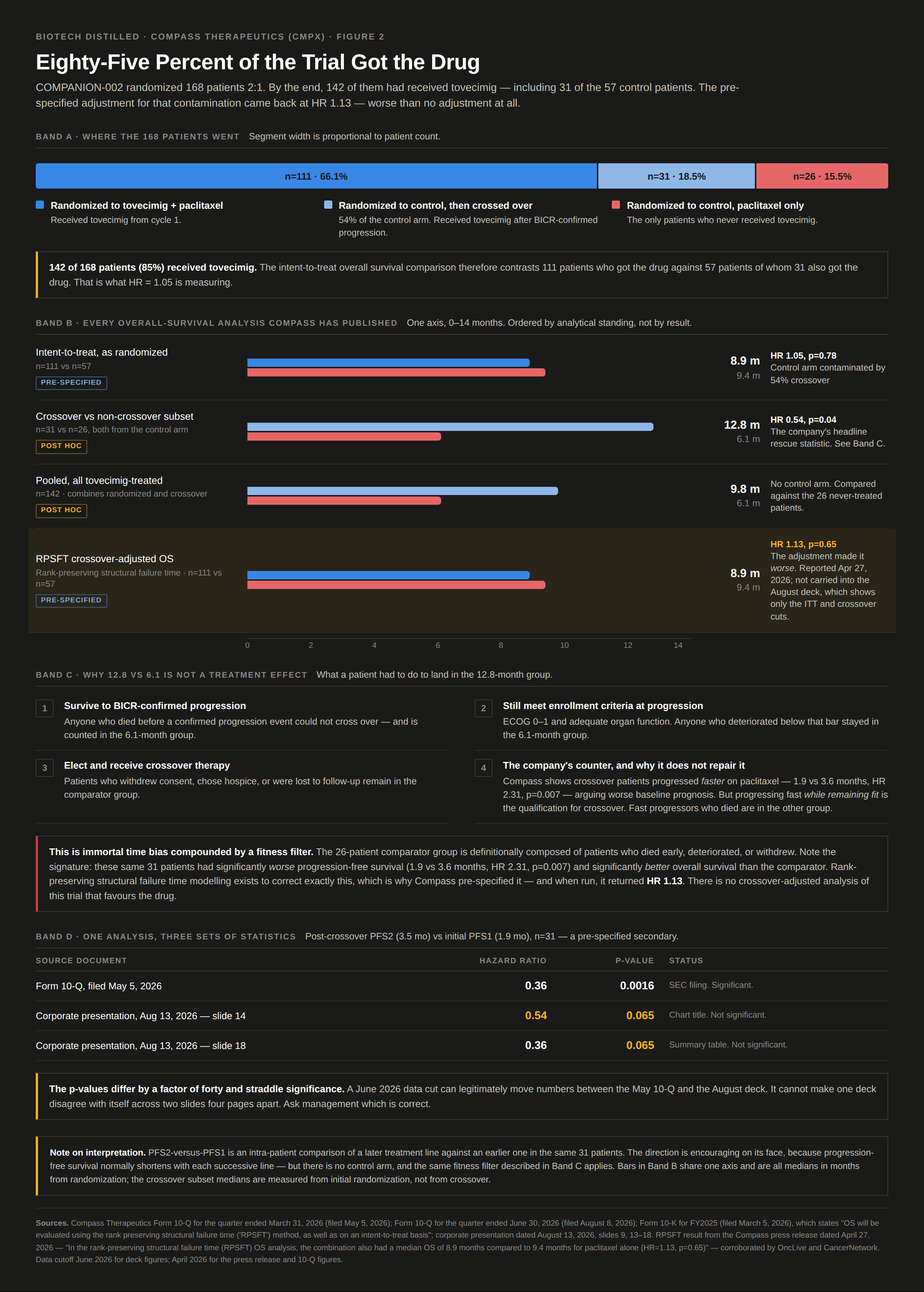
The Hook. Tovecimig is a bispecific antibody that blocks VEGF-A and DLL4 simultaneously, converting productive tumor angiogenesis into non-productive angiogenesis. In a 168-patient randomized trial in second-line biliary tract cancer — a setting with no approved biomarker-agnostic therapy — it tripled response rate and cut progression risk 56%. Then overall survival came in flat. The company says that is because 54% of the control arm crossed over onto the drug — and the one analysis built to test that explanation came back worse, not better.
The Bull Case.
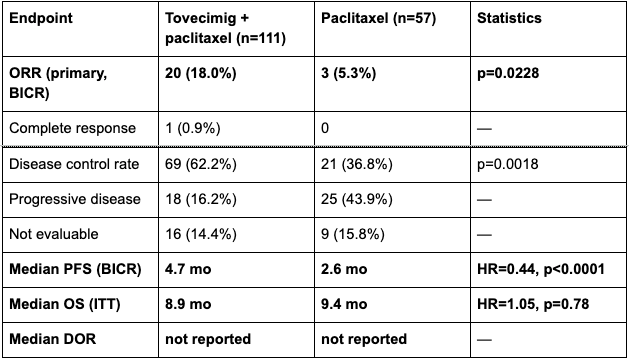
COMPANION-002 hit its primary endpoint: ORR 18.0% (20/111) vs. 5.3% (3/57), p=0.0228, BICR-assessed, with the key secondary endpoint delivering median PFS 4.7 vs. 2.6 months, HR=0.44, p<0.0001. Against a benchmark where FOLFOX in ABC-06 produced a 5% ORR and 6.2-month median OS, that is a three-to-four-fold response improvement in a disease where nothing biomarker-agnostic is approved.
Tovecimig carries Fast Track designation (granted April 25, 2024, for the paclitaxel combination in previously treated BTC — which supports a rolling submission and priority-review eligibility) and Orphan Drug Designation granted April 2026
The full dataset has an ESMO proffered-paper oral on October 24, 2026, and there is a direct, same-disease regulatory precedent: Servier’s Tibsovo was approved in cholangiocarcinoma in 2021 with an ITT overall-survival HR of 0.79 that missed significance (p=0.09) under 70.5% crossover, on the strength of PFS plus a crossover-adjusted OS analysis.
Behind tovecimig sit two more clinical bispecifics, a CD137 agonist, and $180M of cash. At $2.40 (Aug 21, 2026) the enterprise value is roughly $268M, and the stock sits 65% below its 52-week high of $6.88.
The Bear Case. Compass pre-specified the exact analysis that rescues a crossover-confounded survival curve — “OS will be evaluated using the rank preserving structural failure time (‘RPSFT’) method, as well as on an intent-to-treat basis”. It ran it. The crossover-adjusted result was HR 1.13, p=0.65 — median OS 8.9 vs 9.4 months, directionally worse than the unadjusted ITT hazard ratio of 1.05. Compass disclosed that number, then declared its own pre-specified method invalid in the same paragraph — “its validity depends on certain assumptions that were not met in this study and thus its results here are largely uninterpretable” — and the RPSFT result appears nowhere in the 45-slide August 2026 corporate deck. Compass is not hiding the failure. What it has stopped showing is the adjusted failure, the one it pre-specified. What carries the survival narrative instead is a post-hoc comparison of 31 crossover patients against 26 non-crossover patients, structurally contaminated by immortal time bias: crossing over required surviving to confirmed progression and still being fit enough to re-enroll. Meanwhile the safety profile is the DLL4 class profile — hypertension 69% any grade, 52% Grade ≥3 versus 19%/6% on paclitaxel alone. Three law firms opened investigations, Raymond James downgraded, and Canaccord cut its target from $13 to $7 while explicitly not expecting the data to support full approval. Tovecimig is in-licensed; the patent families start expiring in 2033 — and the 10-K never says what kind of claims they are — against $399M of milestones and single-digit royalties owed to ABL Bio. And $180M does not fund a commercial launch.
Bottom Line. There is no crossover-adjusted analysis of this trial that favors the drug — the only one that exists came back at 1.13. Every favorable survival cut is post hoc. Compass deserves credit for publishing the bad number in April; it deserves none for dropping it from the deck by August. The PFS curve is real, the unmet need is real, and the regulator’s view of whether a 0.44 progression hazard ratio can carry a BLA past a flat survival curve is knowable within roughly two weeks. WATCH LIST.
Catalyst Calendar & Financial Runway
Upcoming Catalysts (next 12–18 months)
FDA meeting outcome — guided to be discussable “around Labor Day,” i.e. the week of September 7, 2026. This is the binary, and it is roughly two weeks away. The filings say only that Compass expects “feedback from the FDA in the third quarter regarding the COMPANION-002 Phase 2/3 data, prior to a potential BLA filing later this year” — note the conditional: potential. The tighter timeline came at the Jefferies Global Healthcare Conference on June 4, 2026, where management laid out a briefing package around early July, a meeting in approximately the first half of August, and meeting minutes available around Labor Day, after which the company would discuss the outcome publicly. The August 6 release then said engagement would happen “later this month.” There is no PDUFA date to trade here — the disclosure of the meeting outcome is the event, it is discretionary as to timing and detail, and nothing has been said in the three weeks since.
What to listen for in that disclosure, in order of importance: whether the pathway is accelerated approval or full approval — management has said “both full approval and accelerated approval would be potential approval pathways”, and the corporate deck contains no accelerated-approval language at all; whether FDA is requiring a confirmatory trial, for which management has already floated two designs (tovecimig added to first-line gem/cis/durvalumab, or tovecimig plus paclitaxel versus investigator’s choice); and whether the agency accepts a rolling submission, which tovecimig’s Fast Track designation permits.
ESMO Congress 2026 — Saturday, October 24, 2026, 10:15–11:45 CET, Madrid. Proffered paper oral presentation of the full COMPANION-002 dataset by Dr. Nilofer Azad (Johns Hopkins, Sidney Kimmel). A proffered-paper slot means the full dataset gets presented, which means duration of response and any crossover-adjusted OS analysis should appear here or nowhere. Circle this date harder than the guidance dates.
BLA submission — guided Q4 2026. Contingent on the Q3 FDA meeting. Sixty days after submission the FDA makes a filing decision; a Refuse-to-File is the specific tail risk given the OS result.
CTX-8371 Phase 1 expansion cohort data — Q4 2026. TNBC (n=28), NSCLC (n=28), Hodgkin lymphoma (n=12), split across 3.0 and 10.0 mg/kg, all post-checkpoint-inhibitor. The deck’s milestone slide hedges this to “Q4 26 / Q1 27.”
CTX-10726 Phase 1 dose-escalation data — Q4 2026. RCC, gastroesophageal, HCC, endometrial.
CTX-471 Phase 2 initiation — still guided “mid-2026.” Both the March 10-K and the August 13, 2026 deck say mid-2026. Mid-2026 has passed and the trial has not been announced as initiated. The company has not re-guided — it has left a stale date on the slide.
Tovecimig Phase 2 basket study in DLL4+ tumors — “H2 2026”. Gastric, ovarian, CRC, renal, HCC. Unfunded incremental spend against a runway that already assumes a commercial build.
Potential approval and launch — 2H 2027.
The Dilution Gap
Cash, cash equivalents and marketable securities were $179.879M at June 30, 2026 ($35.453M + $144.426M), down from $194.687M at March 31 and $208.906M at December 31, 2025. Management states these resources “will enable us to fund our operating expenses and capital expenditure requirements into 2028”.
Run the arithmetic on both sides of that sentence.
The reported burn is flattering. Net cash used in operating activities was $32.007M for the first half — $16.0M a quarter. But the net loss was $43.471M for the same period, and the wedge is non-cash: $9.895M of stock-based compensation plus working-capital timing ($1.3M of accounts payable build, $0.2M of accruals). Cash and securities actually fell $14.8M in Q2 and $14.2M in Q1 — but Q1 was cushioned by $3.854M of option-exercise proceeds and both quarters by $1.8–2.0M of interest income that shrinks as the balance does. Accumulated deficit reached $474.6 million against $568 million of gross equity raised since inception.
The forward burn is not the trailing burn. Q2 total opex was $26.979M, up 28% year-over-year, with G&A up 59% on “an increase of $1.4 million of pre-commercialization expenses” — plus $0.8M of stock-based compensation, which is non-cash and which we are not counting against the burn. Tovecimig program spend alone was $12.261M in Q2 versus $8.112M a year earlier. Accrued expenses carry “$7.5 million of accrued manufacturing expenses primarily related to tovecimig“ — registration and validation batch work, which is exactly what a BLA requires and exactly what does not stop until approval.
Reconcile that with the strategy slide. The deck’s own summary says Compass is “building focused commercial organization to support tovecimig in BTC”. A U.S. oncology launch — even the highly targeted one Compass describes, at ~250 high-volume BTC accounts — is a $40–60M annual incremental line. Add the FY2026 BLA application fee (roughly $4.3M for an application requiring clinical data), the Phase 2 basket study, and three ongoing early-stage trials, and 2027 opex plausibly runs $130–160M against $135M of cash entering the year.
The read: “into 2028” holds only if the commercial build does not happen on the schedule the deck advertises. Both statements are in the same August document. One of them is going to give.
Is a raise likely before the next data drop? Not before the Q3 FDA feedback — that catalyst is a couple of weeks out and fully funded. Is a raise likely before approval? Yes, near-certainly, and probably immediately after BLA acceptance. The mechanics are already in place: a 2026 ATM Agreement with Leerink Partners and Cantor Fitzgerald signed December 2025, entirely unused through June 30. The prior Jefferies ATM was terminated. An untouched ATM in front of a BLA acceptance is a loaded gun, and companies do not sign one in order to leave it loaded.
The reference price is unhelpful. The August 2025 underwritten offering priced at $3.00 — 33.29M shares plus 6.71M pre-funded warrants plus a 6.0M-share over-allotment fully exercised, for net proceeds of $129.3M after $8.3M of underwriting discounts and $0.4M of other offering costs. The stock closed at $2.40 on August 21, 2026 — 20% below where the last institutional round cleared, twelve months later.
Insiders & Institutions
The holder table is unusually strong for a $432M market cap, and it is split.
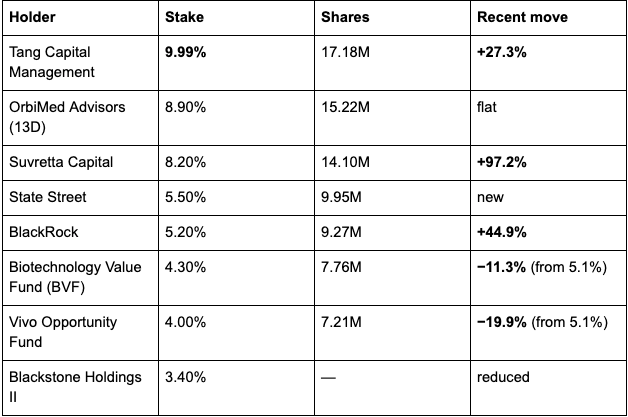
Read the split carefully. The two dedicated biotech crossover funds that had built new positions in late 2025 — BVF (new at 5.1% in October 2025) and Vivo (new at 5.1% in November 2025) — both trimmed in 2026, after the April survival readout. Blackstone trimmed in February. The buyers are Suvretta (nearly doubled), BlackRock and State Street (index and quant flows following the August 2025 offering’s float expansion), and Tang Capital.
Tang Capital at 9.99% deserves its own sentence. Kevin Tang parked precisely one basis point below the 10% Section 16 insider threshold and added 27% in the most recent period. Tang’s affiliated vehicle Concentra Biosciences is the most active acquirer of busted small-cap biotechs in the market, running cash-tender offers at or near net cash plus a CVR. A 9.99% Tang stake in a company trading at 2.5x net cash is not unambiguously a vote of confidence in the science. It is a position that pays off if the BLA works or if the board is eventually persuaded to hand back the balance sheet. Do not read it as a straightforward smart-money endorsement — read it as an option on both outcomes.
OrbiMed’s 8.9% is a 13D, not a 13G — a control-intent filing, with Carl L. Gordon on the board as a director and 10% owner. Note also that Gordon/OrbiMed sold 3,571,428 shares at $1.59 in April 2025.
The sell side and the plaintiffs’ bar both reacted, and the writeup would be incomplete without them. On the April readout, Raymond James downgraded from Outperform to Market Perform, noting the study “missed on overall survival with a hazard ratio above 1 in the intent-to-treat population” and that it was “awaiting clarifications on FDA feedback related to biologics license application submission”. Canaccord Genuity kept its Buy but cut the target from $13 to $7, and — the detail that matters more than the rating — does not expect the data to support full FDA approval). William Blair said the OS miss “will clearly be a review issue at the FDA”.
Separately, three securities firms opened investigations — Johnson Fistel on April 27, Pomerantz on April 30 and again May 21, and Bronstein Gewirtz on May 3 — all on the theory that the April 27 release headlined a statistically significant benefit while the study missed overall survival. Johnson Fistel’s notice quotes the RPSFT “largely uninterpretable” language directly. No class action complaint has been filed in the four months since, which is the relevant fact: these are solicitation notices, not litigation, and a company can go years collecting them without a case. Treat it as a disclosure-quality signal, not a liability.
Insider buying is real but small. On April 29, 2026 — two days after the survival readout crushed the stock — CAO Neil Lerner bought 15,000 shares at $1.89 and General Counsel Jonathan Anderman bought 25,000 shares at $1.89, together about $75,600. CEO Thomas Schuetz bought 10,000 shares at $2.11 in May 2025. These are the right people buying at the right moment, and they are also four- and five-figure checks. Executive officers, directors and principal stockholders together beneficially owned approximately 18% as of December 31, 2025. No director or officer adopted, terminated or modified a Rule 10b5-1 arrangement during Q2 2026.
Overhang, and the share count that matters. 180,087,915 common shares outstanding as of July 28, 2026, plus 6,710,000 pre-funded warrants at $0.0001 that the company already counts in its own EPS denominator (186.8M weighted average). At $2.40 that is a $448M market capitalization — $432M on common alone — and, against $179.9M of cash and securities, an enterprise value of roughly $268M. Beyond that: 23,650,088 options at a $3.87 weighted-average exercise price and 1,606,250 RSUs. At $2.40 essentially the entire option book is underwater — aggregate intrinsic value collapsed from $36.6M at December 31, 2025 to $3.25M at June 30, 2026. That is a retention problem at a 39-employee company preparing a first commercial launch, and it is the most likely reason the board granted 9.681M new options at a $5.07 average weighted exercise price in the first half — a figure that includes the 2.0M inducement options issued to two new officers on January 1, 2026.
The Science: Mechanism & Chemistry
All four clinical assets are antibodies — one IgG4 monoclonal (CTX-471) and three bispecifics. Tovecimig is a first-in-class DLL4 × VEGF-A bispecific in the sense that no DLL4-targeting agent of any format has ever been approved; it is emphatically not first-in-class in the sense of being first to try. CTX-8371 (PD-1 × PD-L1) is close to first-in-class but not uniquely so. CTX-10726 (PD-1 × VEGF-A) is a me-too entering the single most crowded bispecific race in oncology. CTX-471 is a best-in-class attempt at a class that has never produced a winner.
Mechanism Validation — half de-risked, half a graveyard. The VEGF-A arm is as validated as targets get: bevacizumab (Avastin) is approved across CRC, NSCLC, RCC, ovarian, glioblastoma and cervical cancer. The DLL4 arm is the opposite. No DLL4-targeting agent has ever reached Phase 3 successfully, and the attrition is instructive:
Demcizumab (OncoMed, DLL4 mAb) — two Phase 2 failures within a month in 2017. In DENALI (1L non-squamous NSCLC), the demcizumab arm was worse than placebo on every measure: ORR 28% vs. 52%, clinical benefit 79% vs. 92%, median PFS 5.5 vs. 8.7 months. OncoMed halted all demcizumab dosing.
Navicixizumab (OncoMed, DLL4 × VEGF — tovecimig’s closest structural analogue) — survives only as a partnered asset, now with Feng Biosciences after passing through Mereo and Oncologie; no active sponsor-run development.
Dilpacimab / ABT-165 (AbbVie, DLL4 × VEGF DVD-Ig) — discontinued; “not well tolerated and did not provide clinical benefit” versus bevacizumab.
Enoticumab (Regeneron, DLL4 mAb) — Phase 1 only.
That is four dead programs against the same biology. Compass’s counter is that the chemistry is different (below), and the COMPANION-002 PFS curve is the first randomized evidence that anyone has made DLL4 blockade work in humans. Both things are true.
The “Cringe” Test — mostly passes, with two failures. StitchMabs is a real described method, not a buzzword: a combinatorial screen that fixes one antigen-binding domain (PD-1) and pairs it against a library of common-light-chain antibodies, then screens the resulting bispecifics functionally in T-cell activation assays. That is how CTX-8371 was found, and finding a PD-1 × PD-L1 pair through unbiased screening rather than rational design is a legitimate and non-obvious result. Credit where it is due.
The two cringe items are commercial, not scientific.
First, the TAM funnel. The deck asserts “>26,500 patients diagnosed with BTC,” of whom “>24,000 receive 1L treatment,” “>17,000 receive 2L,” and “>15,000 are eligible for tovecimig.” The 26,500 figure is sourced: the 10-K states it directly — “We estimate that there are approximately 26,500 patients newly diagnosed with BTC in the United States each year and over 200,000 patients worldwide” — and slide 22 footnotes it to PMID 33825840 plus an unpublished 2026 Cholangiocarcinoma Foundation conference abstract (Gunchick et al.).
The problem is what PMID 33825840 actually is. It is Van Dyke et al., CEBP 2021, whose site-by-site table of U.S. average annual cases for 2013–2017 sums to roughly 16,400: 5,669 intrahepatic, 3,615 extrahepatic, 4,142 gallbladder, 2,076 ampulla of Vater, 908 overlapping. ACS Cancer Facts & Figures 2026 implies roughly 21,000 on a generous reading. Incidence has genuinely been rising, so a 2026 estimate above a 2013–2017 average is defensible — but 26,500 sits 25–60% above the registry-derived range, and the only citation that closes the gap is a conference abstract no outside investor can check. The funnel below it leans the same way: the deck does adjust for resection (it flags 10% resection, 5% cure), but 17,000 of 24,000 reaching second line implies a 71% progress-and-get-treated rate in a disease whose first-line median survival is 12.8 months. Treat the “$3B+ addressable US market” as an addressable-population exercise, not a forecast.
Second, and worse because it is a clinical claim: the deck states that 1L standard of care “offers only 24.9% 2-year survival benefit.” 24.9% is the absolute 24-month OS rate in the durvalumab arm of TOPAZ-1, not a benefit. The benefit versus placebo was +14.5 percentage points (24.9% vs. 10.4%), and at extended follow-up the durvalumab figure was revised down to 23.2% against a control arm of 13.7%. Calling a raw survival rate a “benefit” inflates the incumbent’s apparent benefit by roughly 10 percentage points. Oddly, that cuts against Compass’s own pitch — it makes the standard of care look better than it is, and the unmet need smaller. Read charitably it is sloppy drafting rather than spin; read either way it is a clinical claim that should not be wrong on an investor slide.
Manufacturing / CMC Risks — the under-discussed CRL vector. Compass owns no manufacturing and relies entirely on third-party CDMOs.. The specific language that matters for a Q4 2026 BLA: “we will likely need to change our CDMO for manufacturing any of our product candidates to one that can support commercial-scale manufacturing,“ and such changes “may also require additional testing, FDA notification or FDA approval,” potentially requiring “bridging clinical trials”. A BLA names its commercial facility and that facility must pass pre-approval inspection. A bispecific antibody with a commercial-scale process change in front of a first BLA is a live CMC-CRL risk independent of the efficacy question, and the $7.5M of accrued manufacturing tells you the tech transfer is in flight right now.
No BIOSECURE exposure is disclosed — the term appears nowhere in the 10-K, and no CDMO is named. That is not reassurance, it is an absence of disclosure. What is newly disclosed is tariffs: the August 10-Q adds a risk factor noting the July 2026 U.S. tariffs of ~10–12.5% on virtually all imports and “significantly higher tariffs applicable to certain imports in select industries, including certain pharmaceuticals,” stating plainly that this “will result in increased research and development expenses”. For a company with no domestic manufacturing and an undisclosed CDMO footprint, that is an unquantified cost line running straight into a launch build.
Biochemical Deep Dive
The Target. Tumors need blood vessels. VEGF-A drives endothelial proliferation and sprouting; blocking it is the validated anti-angiogenic mechanism. The problem is that anti-VEGF monotherapy fails, and it fails in a specific way — tumors escape by building vessels through VEGF-independent routes, and the surviving vasculature normalizes into a functional, perfusing network that feeds the tumor. DLL4 (Delta-like ligand 4) is the Notch ligand that governs which endothelial tip cells are allowed to sprout. DLL4-Notch1 signaling is the brake on angiogenic sprouting: it enforces an orderly, low-density, high-function vascular architecture. Critically, DLL4 is upregulated in tumor vasculature under anti-VEGF pressure — it is part of the escape mechanism.
Biliary tract cancer is where this matters clinically. BTC is a group of aggressive malignancies of the bile ducts and gallbladder with roughly 10–15% five-year survival. After progression on gemcitabine/cisplatin ± a checkpoint inhibitor, the FDA has approved no biomarker-agnostic second-line therapy. Every 2L approval — Ziihera for HER2 IHC3+, Pemazyre and Lytgobi for FGFR2 fusions, Tibsovo for IDH1 mutations, Bizengri for NRG1 fusions — is biomarker-restricted, and together they address roughly 15–20% of patients — a figure the 10-K gives twice, once as “approximately 15% to 20% of the patient population” and once, in the competition section, as “appropriately 10-15% of patients with BTC”.
The Chemistry. The design choice is simultaneous, single-molecule blockade of a pathway and its escape route, delivered as one bispecific IgG rather than two antibodies. That is not a trivial reformulation. Blocking VEGF alone lets DLL4-Notch build a functional collateral network. Blocking DLL4 alone increases sprouting — you get a dense, chaotic, hypoperfusing vascular bed, which sounds bad and is actually the point. Blocking both converts productive angiogenesis into non-productive angiogenesis: a vessel network that is simultaneously denser and less functional, starving the tumor rather than merely pruning its supply. The 10-Q states the mechanism in exactly those terms — “simultaneous blockade of the VEGF-A and the Notch pathways is known to turn productive angiogenesis into non-productive angiogenesis, which leads to tumor shrinkage and apoptosis”.
The single-molecule format also solves an avidity problem that a cocktail cannot: both arms engage the same endothelial microenvironment at the same local concentration, with one pharmacokinetic profile. And it fixes a dosing problem — the DLL4 arm of a bispecific can be affinity-tuned below the level at which standalone DLL4 blockade produced the vascular neoplasms and cardiopulmonary toxicity that killed demcizumab.
Across the pipeline, the engineering choices are individually defensible. CTX-471 uses a human IgG4 backbone chosen deliberately to engage FcγRI and FcγRIIb — required for the CD137 cross-linking that makes agonism work — while avoiding FcγRIIIa and the ADCC-mediated depletion of the very immune effector cells the drug is meant to activate. It also binds a CD137 epitope that does not block CD137-ligand binding, unlike competitor antibodies. CTX-10726 is a tetravalent PD-1 × VEGF-A fully human IgG1 with silenced Fcγ receptor binding, limiting off-target immune activation.
The Mechanism — CTX-8371’s four-part story is the most interesting biology Compass owns. A PD-1 × PD-L1 bispecific should be redundant. Blocking either end of the same axis ought to produce the same effect, and combining pembrolizumab with atezolizumab should equal the bispecific. Compass reports it does not: the bispecific was “hundreds to thousands fold more potent in a T-cell activation assay than a PD-1 antibody alone,” a result the company itself calls unexpected. The mechanistic explanation has four legs, and only the first is conventional:
Dual checkpoint blockade — relieves the PD-1 signal from both sides.
Cell engager — physically bridges the PD-L1-expressing tumor cell to the PD-1-expressing T cell, forcing synapse formation. This is the leg that a cocktail cannot replicate.
PD-1 downregulation — triggers cleavage of the PD-1 extracellular domain off the T-cell surface, converting PD-1-positive T cells into PD-1-negative ones. That is receptor removal, not receptor occupancy — a durability mechanism.
Indirect CD28 agonism — by occupying PD-L1, it frees the pool of CD80 on tumor cells (PD-L1 sequesters CD80 in cis), making CD80 available to engage CD28 and deliver a genuine costimulatory signal.
Legs 2–4 are why this is not a me-too. Whether they matter in patients is the Q4 2026 question.
The Biomarker Receipts — thin, and honest about it. This is where Compass is weakest relative to the protocol’s bar. For tovecimig, the translational evidence is a directional signal, not a biomarker: in the Phase 2 CRC monotherapy study, “patients with DLL4-positive tumors did better with tovecimig therapy than patients with DLL4-negative tumors,” with the important note that “DLL4 expression on colorectal tumors is a negative prognostic factor”. So the drug appears to reverse a bad prognostic marker — encouraging, but reported without a hazard ratio, cutoff, assay, or n-per-subgroup. No pharmacodynamic data on Notch pathway engagement, vessel density, or perfusion has been published from COMPANION-002.
For CTX-471 the biomarker work is better specified: NCAM (CD56) expression in baseline tumor biopsies correlates with disease control, presented at SITC 2024, with a mechanistic hypothesis — NCAM enriches for activated NK cells expressing CD137, and the effect is specific to NCAM-expressing lymphocytes and “not observed in other lymphocyte subsets such as CD8 T cells”. That specificity claim is what makes it a candidate selection marker rather than a fishing expedition, and the entire Phase 2 is built on it with central IHC confirmation.
Bottom Line. The biology matters to the thesis in one specific way: the DLL4 arm is what makes tovecimig worth more than a bevacizumab biosimilar, and the only human evidence that it works is the PFS curve. If the FDA discounts PFS because OS is flat, the mechanism has no other receipt to fall back on — no pharmacodynamic marker, no predictive biomarker, no dose-response. That is the structural weakness underneath the whole regulatory case.
Clinical Data
Efficacy
COMPANION-002 (NCT05506943) — 168 patients, 34 U.S. sites, randomized 2:1. Inclusion: progression after gemcitabine-and-platinum, unresectable/advanced/metastatic/recurrent BTC, ECOG 0–1, explicitly excluding patients eligible for a molecularly targeted therapy. Tovecimig 10 mg/kg days 1 and 15 plus paclitaxel 80 mg/m² days 1, 8, 15 of a 28-day cycle, versus paclitaxel alone. Baseline demographics are well balanced across age, sex, ECOG, and intrahepatic-vs-other primary site.
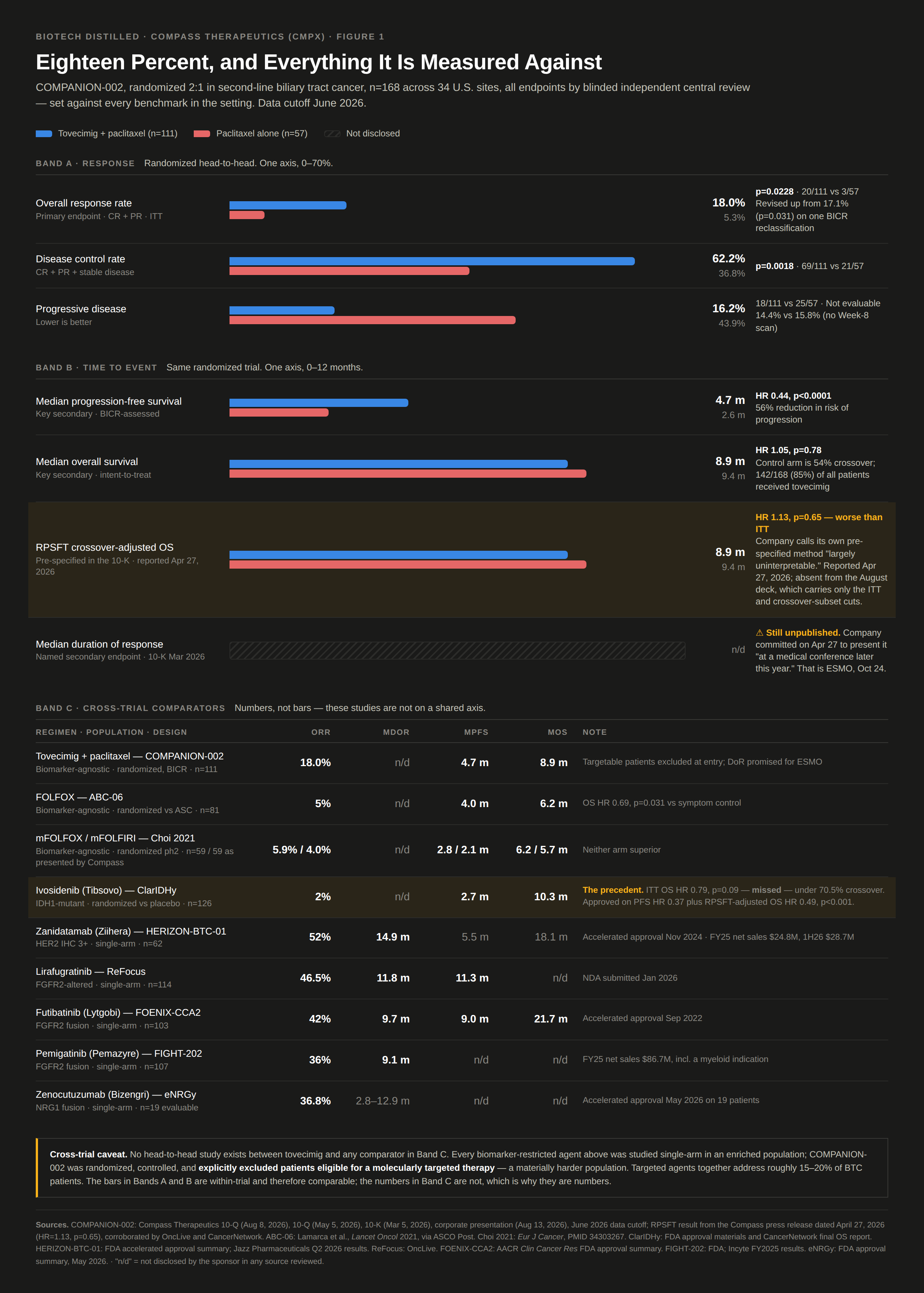
Cross-trial benchmarks. The 2L BTC comparator set is uniformly grim. ABC-06 (FOLFOX + active symptom control vs. ASC, n=81/81) delivered ORR 5%, median PFS 4.0 months, median OS 6.2 vs. 5.3 months, HR 0.69, p=0.031. Choi 2021, the randomized mFOLFOX-vs-mFOLFIRI study Compass benchmarks against on slide 19, gave ORR 5.9% / PFS 2.8 mo / OS 6.2 mo for mFOLFOX and 4.0% / 2.1 mo / 5.7 mo for mFOLFIRI, at n=59 per arm as Compass presents it (the publication reports 51 and 50 evaluable of 56 and 58 enrolled). Against those, an 18% ORR and 4.7-month PFS is a genuine step up.
Against the biomarker-selected agents it is not close. Ziihera (zanidatamab, HER2 IHC3+): ORR 52%, median DOR 14.9 months. Lytgobi (futibatinib, FGFR2): ORR 42%, DOR 9.7 months, median PFS 9.0, median OS 21.7. Pemazyre (pemigatinib, FGFR2): ORR 36%, DOR 9.1 months. Lirafugratinib (Elevar, NDA submitted January 2026): ORR 46.5%, DOR 11.8 months, PFS 11.3 months. Tovecimig’s advantage is that it treats the 80–85% of patients none of those drugs can touch — which is the entire commercial thesis, and also why the ORR gap is not itself disqualifying. Cross-trial caveat applies with unusual force here: every one of those trials was single-arm and biomarker-enriched, while COMPANION-002 was randomized, controlled, and explicitly excluded targetable patients — a materially harder population.
The P-Hacking Check
Five flags, in descending order of severity.
1. The pre-specified crossover adjustment was run, came back worse than the unadjusted analysis, and has since disappeared from the deck. The 10-K states: “To adjust for this treatment crossover, OS will be evaluated using the rank preserving structural failure time (’RPSFT’) method, as well as on an intent-to-treat basis”. RPSFT is the standard, regulator-accepted method for exactly this problem, and Compass ran it. From the April 27, 2026 press release, verbatim:
“In the rank-preserving structural failure time (RPSFT) OS analysis, the combination also had a median OS of 8.9 months compared to 9.4 months for paclitaxel alone (HR=1.13, p=0.65). Though the RPSFT analysis is intended to adjust for crossover, its validity depends on certain assumptions that were not met in this study and thus its results here are largely uninterpretable.”
Read the direction. Adjusting for crossover made the hazard ratio worse — 1.13 against the unadjusted ITT’s 1.05. There is no crossover-adjusted analysis of this trial that favors tovecimig. Every survival cut that does favor it is post hoc.
Two things must be said, and they cut opposite ways.
In Compass’s favour: it published the unfavourable number voluntarily, on the day, in the headline release, and said on the webcast it was provided “solely for full disclosure.” That is more candour than most managements show, and the statistical objection is not frivolous — RPSFT assumes a common treatment effect regardless of when treatment starts, and Compass’s entire narrative is that late crossover patients derived an unusually large benefit. If that narrative is true, RPSFT’s central assumption genuinely fails. A company cannot be criticised for running a pre-specified analysis and reporting that its assumptions did not hold. And the strongest version of Compass’s argument — which Compass itself has never articulated, and which we will make on its behalf because it is the fair one — has a direction. RPSFTM estimates a single acceleration factor applied uniformly to all treated time. If crossover patients genuinely derived a larger benefit from late treatment than the randomized arm derived from early treatment, a common factor strips too little benefit out of the control arm, leaving it artificially long and biasing the adjusted hazard ratio against the drug. That is a coherent mechanism for 1.13 sitting above 1.05, and it is not special pleading.
Against Compass: you cannot have it both ways. The assumption RPSFT violates is violated because of the differential-benefit claim, and that claim rests on the same post-hoc subset comparison the adjustment was supposed to replace. It is circular. But the presentation has drifted, and the drift is narrower than it first looks. The August 13, 2026 deck carries exactly two overall-survival analyses across 45 slides: the ITT result on slides 13, 18 and 19, and the post-hoc crossover subset on slides 15 and 18. RPSFT is not among them. Credit where it is due — slide 13 is titled “OS Analysis Confounded by Crossover” and prints HR 1.05, p=0.78 without softening, and the summary table on slide 18 repeats it. This is not a deck that buries the miss.
What it omits is the adjusted miss. A result material enough to headline the April release, and material enough for three law firms to quote in their investigation notices, does not appear in the document Compass hands investors four months later. That is the finding — not concealment of the failure, which is on slide 13, but the quiet retirement of the one analysis built to test the company’s own explanation for it.
One more thing to put to management, and it is the sharpest question in this report. Standard RPSFTM is randomization-respecting: the adjusted analysis conventionally carries over the ITT log-rank p-value, because the acceleration factor is estimated by finding the value that makes the randomized comparison null. Compass reports p=0.65 for the RPSFT analysis against p=0.78 for the ITT — different numbers. That implies either a non-standard variant, a re-estimated test, or a bootstrapped confidence procedure. Which it was, and how the acceleration factor was estimated, determines how much weight the 1.13 deserves.
2. The crossover subset comparison is structurally uninterpretable. The headline rescue statistic is that the 31 crossover patients achieved median OS 12.8 months versus 6.1 months for the 26 non-crossover patients (HR=0.54, p=0.04). To cross over, a patient had to (a) survive to BICR-confirmed progression, (b) still meet enrollment criteria — ECOG 0–1, adequate organ function. The 26-patient comparator group is therefore definitionally composed of patients who died before crossover, deteriorated below ECOG 1, or withdrew. This is textbook immortal time bias compounded by a fitness filter. Compass’s counter-argument — slide 16, showing crossover patients progressed faster on paclitaxel, 1.9 vs. 3.6 months, p=0.007, with the hazard ratio of 2.31 reported by OncLive rather than by the deck — implying worse baseline prognosis — does not repair it. Progressing faster while remaining fit is precisely the qualification for crossover; rapid progressors who died are in the other group. Note what the two statistics say together: the same 31 patients had significantly worse progression-free survival and significantly better overall survival than the comparator group. In an untreated comparison that combination is close to a definition of guarantee-time bias. This is why RPSFT exists — and RPSFT, when run, gave 1.13.
3. The PFS1/PFS2 statistics do not agree across three documents. The same prespecified secondary analysis (post-crossover PFS2 3.5 months vs. initial PFS1 1.9 months, n=31) is reported as:
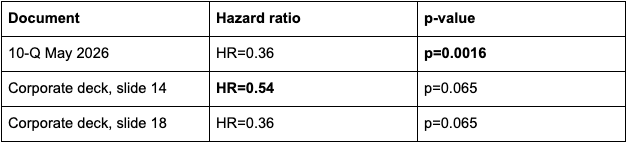
Three versions of one analysis, two of them four slides apart in the same August 13, 2026 investor deck. The p-values differ by a factor of 40 and straddle significance. A June 2026 data cut could legitimately move numbers between the May 10-Q and the August deck; it cannot make one deck disagree with itself. Ask management which is right. (Note separately that PFS2-versus-PFS1 is an intra-patient comparison of a later line against an earlier line — the direction is encouraging because PFS normally shortens with each line, but it has no control arm.)
4. The primary endpoint improved by reclassification. ORR moved from the originally reported 17.1% (p=0.031) to 18.0% (p=0.0228) because “one patient initially characterized as ‘Non-CR / Non-PD’ due to target lesion characteristics was ultimately adjudicated by blinded independent central review to be a partial response”. BICR adjudication is the right process and this is disclosed transparently. It is still one patient moving in the favorable direction and carrying the p-value with it — a reminder of how thin the margin is. Twenty responders is the entire efficacy case.
5. Duration of response still does not exist publicly — but the company said in April where it would appear. DOR is a named secondary endpoint and no COMPANION-002 median has been reported anywhere. The April 27 release is explicit about why: “The complete dataset, including Duration of Response (DoR), will be presented at a medical conference later this year.” ESMO on October 24 is that conference. So this is a scheduled disclosure, not a withheld one, and it would be unfair to score it as evasion.
It is still the single most important unknown in the name. For a response-rate-based approval, FDA evaluates ORR and DOR together — an 18% response rate lasting two months is not approvable; one lasting ten months plausibly is. Compass has published median PFS, ITT median OS, RPSFT-adjusted OS, PFS1/PFS2, and two post-hoc subset analyses. The one number still outstanding is the one an accelerated-approval review turns on. The only DOR figure that exists anywhere is 6.9 months from the 24-patient Korean Phase 2.
One more thing that is not P-hacking but belongs here: the Korean-to-U.S. efficacy collapse. The Simon two-stage Phase 2 in South Korea reported ORR 37.5% (9/24), median PFS 9.4 months, median OS 12.5 months. The randomized U.S. trial delivered 18.0% ORR and 4.7-month PFS — roughly half, on both. That is textbook regression to the mean from a small single-arm study. To be fair to both parties, the 10-K frames the decision to skip the second Simon stage as acceleration on strength rather than regulator scepticism: “Based on the efficacy data and following discussions with the FDA, while the trial had met the criteria to advance to Part 2, FDA recommended and we agreed to forego the second stage of the study and advance tovecimig directly to a randomized Phase 2/3 study”. Whatever the motive, going randomized was the right call — and anyone still modeling off the 37.5% Korean number is modeling the wrong drug.
Safety / Tolerability — The Quiet Killers
Hypertension is not a side effect here; it is the dominant clinical fact of taking this drug.
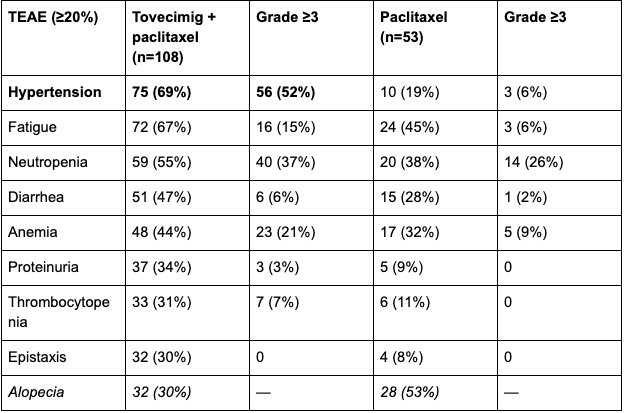
Grade ≥3 hypertension in 52% of patients — with 44% assessed as treatment-related — is nearly nine times the paclitaxel arm’s 6% and above what bevacizumab produces in most settings. In a population with a median age of 65 and metastatic biliary disease, that means antihypertensive management as a condition of therapy, dose interruptions, and a monitoring burden at community sites.
The tolerability numbers that matter most exist, and they are better than the AE table implies — but they live in exactly one place. On the April 27, 2026 webcast, management disclosed three events of pulmonary hypertension (2.8%), characterised as lower than in the prior Phase 1/2 studies, and four patients (3.7%) discontinuing due to hypertension, with hypertension described as the main between-arm difference. At the Jefferies conference in June, management put Grade 4 hypertension at “maybe one” patient — again a conference remark, not a filed figure. If those figures hold, they materially defuse the class-toxicity concern below — 2.8% pulmonary hypertension against 18–19% in the navicixizumab and dilpacimab programs is a genuine differentiation claim, and a 3.7% discontinuation rate on the drug’s dominant toxicity is a good number in a 4.7-month-PFS setting.
Two caveats keep this from being a clean bull point. First, none of it appears in a filing, a press release, or the corporate deck — not the 10-K, not either 10-Q, not one of 45 slides. It exists in a single secondary account of a webcast whose replay expired in late July. We have not verified it against a primary transcript, and it should be treated as company-reported and unconfirmed. Second, the overall treatment discontinuation rate is still not disclosed anywhere — only the hypertension-specific figure. In a trial where the combination arm ran 69% hypertension, 55% neutropenia and 47% diarrhoea, the all-cause discontinuation rate is the number that tells you whether the PFS benefit survives contact with community oncology. Ask for it at ESMO. So is GI perforation, which the mechanism predicts, which the Korean study reported at 8.3% Grade ≥3, and for which no COMPANION-002 rate has ever been given.
The class-level signals are the reason that 2.8% matters, and the reason it needs to be in print. DLL4 inhibition has a documented cardiopulmonary liability. A 2024 Pulmonary Circulation analysis of 13 clinical trials concluded that “pulmonary hypertension is a complication of DLL-4 inhibition,” occurring “in the absence of left ventricular dysfunction”. The per-drug primary sources:
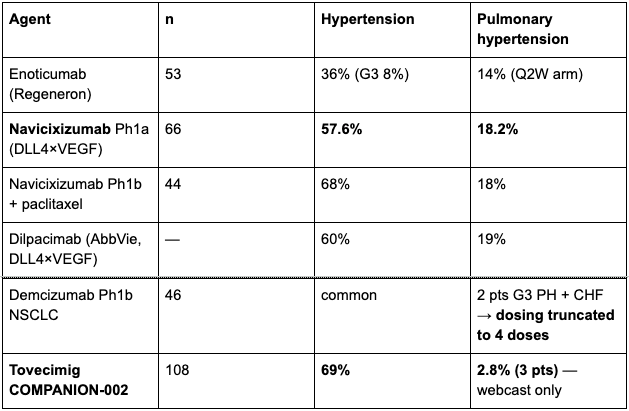
The Korean Phase 2 did screen for it — but read the qualifier. The 10-K reports Grade ≥3 TEAEs in 95.8% of 24 patients, and among adverse events of special interest, all at Grade ≥3: hemoptysis or hemorrhage 12.5%, GI or tumor perforation 8.3%, and 0% for pulmonary hypertension, wound healing complication and cardiac failure. That 0% is a Grade ≥3 rate. It does not exclude Grade 1–2 pulmonary hypertension, which is how most of the class signal presented. Twenty-four patients is not enough to exclude an 18% class event at any grade, and GI perforation at 8.3% in a population with biliary obstruction is the AE that would define a label. The 108-patient COMPANION-002 safety table shows neither perforation nor pulmonary hypertension as a ≥20% event, which tells us only that they were below 20% — and the webcast figure of 2.8% is the only number anyone has given. If 2.8% is right, tovecimig’s affinity-tuned DLL4 arm has done what the design was supposed to do, and that is the strongest scientific argument in the company’s favour anywhere in this report. It is also unverified, unfiled, and unrepeated in four months of subsequent disclosure. Get it into the ESMO paper.
Data Integrity
COMPANION-002 is the strongest thing Compass owns and it is genuinely well built: randomized, 2:1, 168 patients, 34 U.S. sites, ORR and PFS assessed by blinded independent central review, ITT analysis. That is a real trial, not a promotional exercise, and it deserves saying plainly after five paragraphs of criticism.
Two integrity caveats. It is open-label — patients and investigators knew the assignment, which matters less for BICR-assessed ORR and PFS than it would for investigator assessment, but matters for the crossover decision, which was made by unblinded investigators. And 85% of all randomized patients (142/168) received tovecimig at some point, which means the trial retains essentially no clean control arm for survival. Every other asset is single-arm, open-label, and small: CTX-8371’s headline is 2 responses in 6 evaluable patients at the top two dose levels, CTX-471’s Phase 1b is 5 responses in 60 patients across 17 tumor types.
Pipeline
Tovecimig (CTX-009) — DLL4 × VEGF-A bispecific. 2L BTC, Phase 2/3 complete; rolling BLA planned from late 2026. Fast Track (April 2024) and Orphan Drug Designation for BTC (April 2026). In-licensed from ABL Bio, global rights excluding South Korea (Handok) and China (out-licensed to Elpiscience). Reality check: this is the entire equity story. Strip it out and the remaining $268M enterprise value is three Phase 1 assets. Value driver, singular.
Tovecimig — Phase 2 basket in DLL4+ solid tumors, “H2 2026.” Gastric, ovarian, CRC, renal, HCC. The supporting monotherapy data is weak: the Phase 2 CRC study delivered ORR 5% (2/40) in bevacizumab-pretreated patients, with DCR 68%, median PFS 3.9 and median OS 10.2 months. Reality check: the deck’s 354,000-patient “DLL4-enriched solid tumors” incidence chart is an addressable-population slide, not a probability-weighted one. Optionality — and unfunded incremental burn.
Tovecimig investigator-sponsored trials. 1L BTC + gem/cis/durvalumab (NCT06548412, MD Anderson-initiated); 2L CRC + FOLFIRI (NCT07662031); 2L glioblastoma + CTX-471 (NCT07392957); 2L gastric + CTX-8371 + paclitaxel. Reality check: ISTs are cheap optionality and a genuine signal that academic investigators want the drug — but Compass does not control the timelines, the protocols, or the data release. Free options, not value drivers.
CTX-8371 — PD-1 × PD-L1 bispecific. Phase 1 expansion, data Q4 2026. Dose escalation: 3 responses in 15 DLT-evaluable patients — one TNBC, one Hodgkin partial metabolic response, one NSCLC complete resolution of target lesions after initial pseudo-progression; at the top two dose levels ORR 33% (2/6), with durability of 10.5+ months (TNBC) and 7.5+ months (HL) as of May 2026. No DLTs at any dose; all TRAEs Grade 1–2 except one asymptomatic Grade 3 lipase elevation. All post-checkpoint-inhibitor. Reality check: the most interesting asset in the company, and the one the market is pricing at zero. A complete resolution of target lesions in a 4th-line NSCLC patient who had already failed durvalumab and ipi/nivo is not a nothing event. Two caveats. Six patients. And the 10-K’s framing — “there is no approved therapy that combines inhibition of both PD-1 and PD-L1 in the same molecule” — is true but incomplete — Innovent/Eli Lilly’s IBI318 is a PD-1 × PD-L1 bispecific that has completed a 103-patient Phase 1 (ORR 15.5%; 45.5% in treatment-naive PD-L1≥50% NSCLC) and a 40-patient Phase 2 with lenvatinib (ORR 40%, mPFS 6.9 mo, mOS 18.2 mo). CTX-8371 is not alone in the format, and it is behind on patient numbers. Real optionality; the Q4 print matters.
CTX-10726 — PD-1 × VEGF-A bispecific, tetravalent. Phase 1 dose escalation, data Q4 2026. Reality check: the hardest asset to underwrite, because the competition is measured in billions of dollars of upfronts. Ivonescimab (Summit/Akeso) has a PDUFA date of November 14, 2026 and five Phase 3s. BMS paid BioNTech $1.5B upfront plus $2.0B in non-contingent payments for BNT327/pumitamig. Pfizer paid 3SBio $1.25B upfront. Merck paid LaNova $588M upfront for LM-299. BioPharma Dive counted “more than a dozen companies” in the class in March 2025 (link). Compass’s differentiation claim is preclinical potency versus ivonescimab in an HCC827 xenograft. A Phase 1 dose escalation entering a race where the leader is at a PDUFA date is not a value driver at any reasonable discount rate. Near-zero NPV until proven otherwise — with the important qualifier that ivonescimab’s own Phase 3 OS result missed statistical significance (HR 0.79, p=0.057), so the class is not the sure thing its deal values imply.
CTX-471 — CD137 (4-1BB) agonist. Phase 2 initiation guided “mid-2026,” not yet announced. Phase 1b: 60 patients, 17 tumor types, post-PD-1 — 1 CR (SCLC, PET-negative, >3 years on therapy), 3 PRs in melanoma (27% of 11), 1 PR in mesothelioma. Nine treatment-related SAEs, all resolved. DLT thrombocytopenia; MTD 0.6 mg/kg. Phase 2 is a Simon two-stage in centrally confirmed NCAM+ Grade 3 NET/NEC, requiring ORR ≥3/18 to expand. Reality check: no 4-1BB agonist has ever been approved anywhere. BMS’s urelumab caused two drug-related hepatotoxicity deaths and had all trials halted in 2008, with Grade 3/4 ALT elevations at 16.6% above 1 mg/kg. Pfizer’s utomilumab was safe and inert (monotherapy ORR 3.8%). Genmab discontinued acasunlimab in December 2025 despite positive Phase 2 data and a running Phase 3. Compass’s Fc engineering is a credible answer to urelumab’s problem and the biomarker hypothesis is credible — but a 3-of-18 bar in a rare tumor type, in a class with a decade of failure and one three-year responder as its best case, is optionality at best. The R&D spend agrees: $3.018M across the whole first half — 9% of R&D, and down 37% from $4.759M a year earlier, the only program line that shrank.
Novel cell engagers and CD277 discovery programs — preclinical. Zero-NPV placeholders.
Tovecimig holds two FDA designations. Fast Track, granted April 25, 2024 for CTX-009 in combination with paclitaxel in previously treated patients with metastatic or locally advanced biliary tract tumors — announced by press release and, notably, appearing in none of the filings we reviewed. And Orphan Drug Designation for BTC, granted April 2026 and disclosed in the May 10-Q.
Fast Track is the more useful of the two here: it permits a rolling BLA submission, which management described at Jefferies in June as beginning late in 2026 and completing in the first quarter of 2027, and it makes the application eligible to be considered for priority review. Neither a rolling submission nor priority review has been granted, and nothing in the timeline requires the latter — the deck’s own “Q4 26: Submit BLA” reaches a 2H 2027 action on a standard ten-month review. There is no Rare Pediatric Disease Designation and no Breakthrough Therapy designation, and therefore no Priority Review Voucher to underwrite. Anyone modeling a ~$100M PRV into a CMPX sum-of-the-parts is inventing it.
Pipeline Verdict. Tovecimig is carrying 100% of the valuation and probably more than 100% — at $268M enterprise value the market is assigning the three IO assets a negative number. The asset most likely to re-rate the story on a non-tovecimig basis is CTX-8371, on a Q4 2026 print from 68 expansion patients; the asset most likely to be quietly deprioritized is CTX-10726, which is competing against $3B of other people’s upfront payments with a Phase 1 dose escalation.
Intellectual Property & The Moat
The summary provided below is based on the 10-K filed by the Company in March 2026, supplemented by the 10-Qs filed in May and August 2026.
Portfolio overview. As of January 31, 2026 the Company reports “nearly 100 issued patents and patent applications pending“ across all programs. Broken out by program:
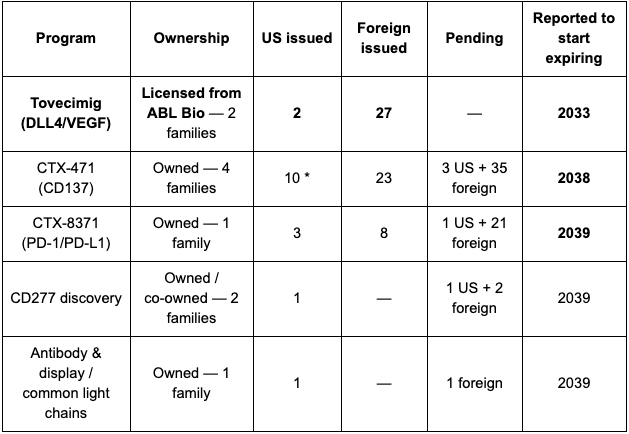
* The 10-K contradicts itself on this count: the summary paragraph reports “7 patents issued in the United States” for CTX-471; the program-detail paragraph two paragraphs later reports “10 issued U.S. patents.”
Asset-Specific Patent Runways — and the one number that reframes the whole moat question.
Tovecimig’s licensed patent estate is reported to start expiring in 2033. Against a target approval in 2H 2027, that is roughly six years of patent life post-launch — before any patent term extension. That sounds like a disaster, and for a small molecule it would be. For a biologic it is close to irrelevant, and here is why.
First, a precision point. The 10-K never characterizes the tovecimig claims by type. The disclosure reads only: “we have licensed 2 patent families with 2 issued patents in U.S. and 27 issued patents in foreign jurisdictions, related to our DLL4/VEGF antibody program including, but not limited to, our tovecimig therapeutic candidate”. Whether those are composition-of-matter claims to the bispecific itself, methods-of-use claims, or formulation claims is stated nowhere in the document — and the distinction is not cosmetic, because a methods-of-use claim is materially easier to design around than a claim to the molecule. For the company’s lead and only near-commercial asset, in a 187-page annual report, that is a conspicuous omission and it should be asked about.
Tovecimig is a biologic licensed under Section 351(a) of the PHS Act, which means that on first licensure it receives 12 years of reference product exclusivity under 42 U.S.C. § 262(k)(7)(A) — no biosimilar application can be made effective until 12 years after the reference product is first licensed, and none can even be submitted for 4 years. Approval in 2H 2027 therefore builds a regulatory wall to roughly 2039 — six years beyond the patent estate. Orphan Drug Designation, granted April 2026, adds 7 years of orphan exclusivity from approval (to ~2034); FDA’s own guidance is that a biologic with orphan exclusivity may not be licensed for the protected indication until the later of the 7-year orphan period or the 12-year RPE. The 12-year clock dominates; orphan adds scope, not duration. Orphan’s separate value is that it blocks approval of the same drug for the same disease regardless of pathway, including a full 351(a) BLA — a reach RPE does not have.
Patent term extension under Hatch-Waxman could add up to five years to one patent, capped at 14 years from approval — which would carry the 2033 floor to roughly 2038 — still short of the BPCIA wall. The practical moat on tovecimig is BPCIA, not necessarily the patent docket, and it is materially stronger than the 2033 date suggests. This is the single most important thing a patent-attorney read adds to the CMPX story, and it cuts for the bulls.
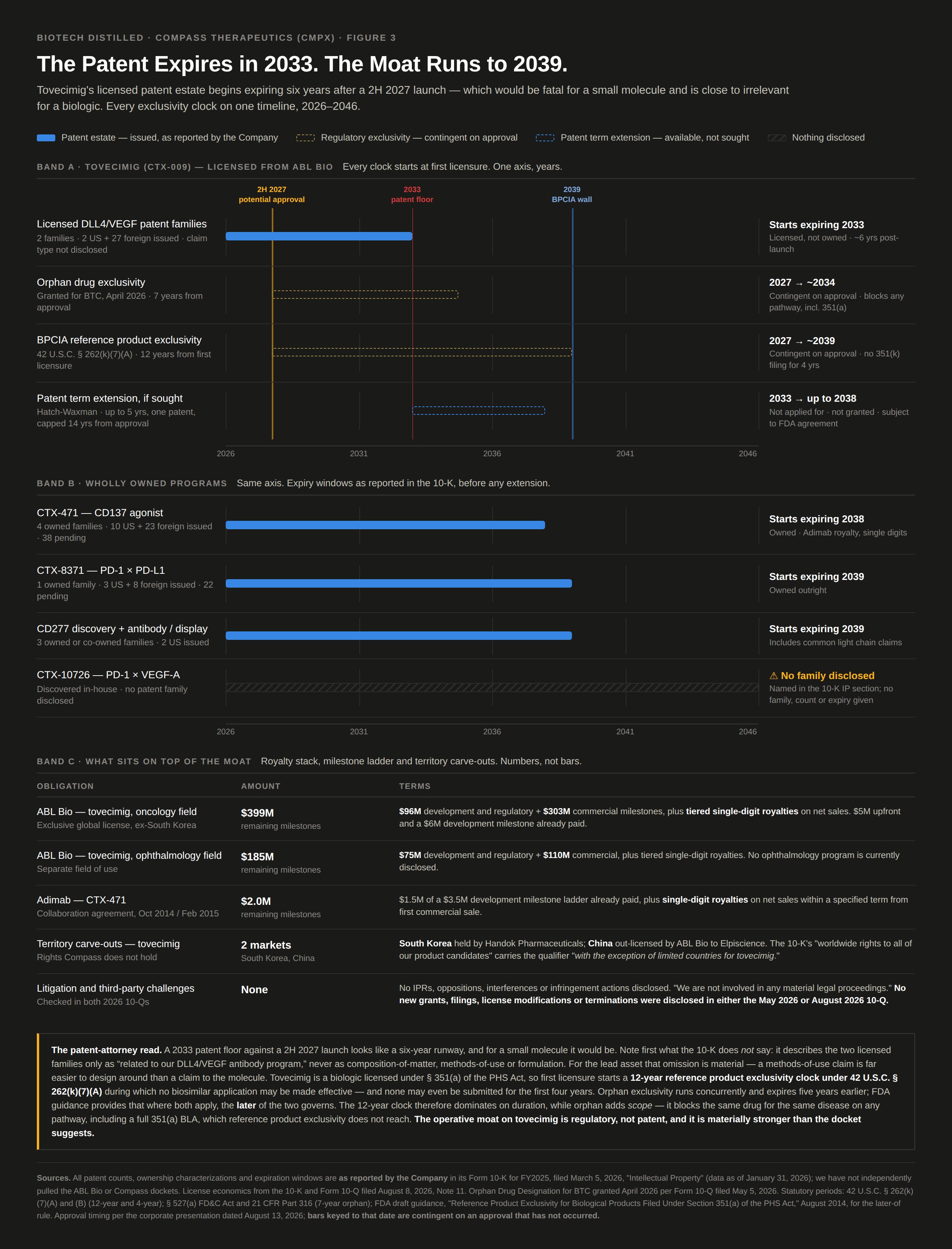
Ownership & licensing structure — the royalty stack is the real encumbrance. Tovecimig is not owned. It is licensed from ABL Bio through Compass’s wholly owned subsidiary TRIGR Therapeutics, on an exclusive global basis excluding South Korea (held by Handok), with China out-licensed to Elpiscience. Economics paid to date: $5M upfront plus a $6M development milestone. Economics still owed on the oncology field:
Up to $96 million in development and regulatory milestones
Up to $303 million in commercial milestones
Tiered single-digit royalties on net sales
Plus a separate ophthalmology field worth up to $75M development/regulatory and $110M commercial. The filings disclose no rate and no tiers — only “tiered single-digit.” On a $500M peak-U.S.-sales scenario that is somewhere between $5M and $45M a year of royalty before the commercial milestone ladder, and an outside investor cannot narrow it further. (Inference, not company disclosure.) Compass also owes Adimab single-digit royalties on CTX-471 plus $2.0M in remaining milestones. The 10-K states Compass holds worldwide rights to all candidates “with the exception of limited countries for tovecimig“ — meaning the ex-U.S. opportunity the deck describes as “substantial ex-US opportunities with higher incidence” excludes the two largest Asian markets for BTC.
Competitive Landscape. The 2L BTC shark tank is unusual: crowded with biomarker-restricted agents and empty of anything biomarker-agnostic.
Ziihera (zanidatamab, Jazz) — accelerated approval November 2024, HER2 IHC3+. FY2025 net sales $24.8M; 1H 2026 $28.7M. Note the number. The best-performing targeted agent in 2L BTC, with a 52% ORR, is doing roughly $60M annualized. That is the empirical ceiling on what this market pays.
Pemazyre (pemigatinib, Incyte) — FY2025 net sales $86.7M, across BTC and a myeloid/lymphoid indication.
Lytgobi (futibatinib, Taiho) — sales not disclosed.
Tibsovo (ivosidenib, Servier) — IDH1; sales not broken out.
Bizengri (zenocutuzumab) — accelerated approval May 2026 for NRG1-fusion CCA on 19 efficacy-evaluable patients, ORR 36.8%, via the FDA’s National Priority Voucher pilot. A vanishing population, but a live precedent that FDA will approve tiny-n, response-based applications in this disease.
Lirafugratinib (Elevar) — NDA submitted January 2026, FGFR2, ORR 46.5%.
Ivonescimab — China NMPA Breakthrough Therapy Designation, February 2026, for 1L BTC with chemotherapy, with a Phase 3 versus durvalumab+chemo fully enrolled. Not a 2L competitor, but a VEGF-pathway bispecific validating the same vascular biology in the same disease, one line earlier, with a $10.5B company behind it.
The honest competitive read: Compass’s claim that most 2L BTC patients have no approved option is accurate and verifiable. But the market it is entering has an observable revenue ceiling — the leading targeted agent does ~$60M — and the “$3B+ addressable US market” on slide 3 is an addressable-population arithmetic exercise, not a revenue forecast. If tovecimig is approved and captures the 80% of patients the targeted agents cannot reach, at a biologic price, U.S. peak sales of $300–500M is a defensible bull case. $3B is not.
The Verdict
Scientific Conviction: Medium. The PFS hazard ratio of 0.44 at p<0.0001 in a 168-patient randomized, BICR-assessed trial is the first credible human evidence that DLL4 blockade adds something to VEGF blockade, after four failed programs in the same class — and if the webcast’s 2.8% pulmonary-hypertension figure holds up in the ESMO paper, the affinity-tuned DLL4 arm has solved the problem that killed demcizumab, navicixizumab and dilpacimab. What caps conviction is that there is no pharmacodynamic or predictive biomarker to fall back on if the regulator discounts PFS, the Korean-to-U.S. efficacy halved, and every crossover-adjusted look at survival that exists — the one the company pre-specified — came back above 1.0.
Commercial Viability: Medium-Low. Real unmet need, genuinely concentrated call points (~250 accounts, 86 centers of excellence), Orphan designation, and a 12-year BPCIA wall. Against that: an observable market ceiling where the best targeted agent does ~$60M, a TAM funnel whose top-line incidence figure runs 25–60% above registry data, single-digit royalties and $399M of milestones flowing to ABL Bio, no rights in South Korea or China, and $180M that does not fund a launch.
M&A Appeal: Low today, Medium-High the day after BLA acceptance. Nobody acquires an asset with a flat ITT survival curve and an unresolved regulatory question at any premium worth taking. The logical acquirers are the companies already selling into BTC oncology call points and short of a biomarker-agnostic asset: Jazz (already commercial in BTC with Ziihera and hunting), AstraZeneca (owns the 1L franchise with Imfinzi and would defend it), Incyte (Pemazyre infrastructure, chronically acquisitive), Servier, Taiho/Otsuka, and Elevar as a consolidator. ABL Bio’s licensing position also makes a partnered ex-U.S. deal the more likely first transaction. Separately, and less pleasantly: at 2.5x net cash with Tang Capital at 9.99%, there is a non-trivial probability that the eventual “transaction” is a balance-sheet one rather than a strategic one.
Trader Profile. Binary event gamblers with defined risk, and deep-value cash-box investors. This is not necessarily a compounder — there is no revenue and the runway does not reach a launch. It is not a momentum name — it is 65% off its high with underwater options across the whole employee base. It is a name with a dated, undated binary (FDA feedback “in Q3,” disclosure timing at management’s discretion), a hard-dated data event (ESMO, October 24), and a cash floor at roughly 40% of the current price.
Buy
Target Audience. Investors who believe the Tibsovo precedent governs — that FDA will weigh a p<0.0001 PFS result plus an unmet need above a crossover-wrecked survival curve — and who can size for a total loss on the tovecimig thesis.
Rationale. The precedent is specific and same-disease. In ClarIDHy, ivosidenib in IDH1-mutant cholangiocarcinoma produced an ITT overall survival HR of 0.79 that missed significance (1-sided p=0.09) under 70.5% crossover, with an ORR of 2%. FDA approved it in August 2021, on PFS HR 0.37 plus an RPSFT crossover-adjusted OS HR of 0.49 (p<0.001). Be honest about where the analogy breaks: ClarIDHy’s RPSFT rescued the drug, and tovecimig’s did the opposite. The bull has to argue that FDA weighs the progression endpoint on its own merits and accepts that a 54% crossover with a differential late benefit is simply not adjustable — not that a crossover-corrected survival benefit exists, because it does not. Compass’s PFS result is comparable on hazard ratio and far more emphatic on significance (HR 0.44 at p<0.0001 against ClarIDHy’s HR 0.37), the ORR is nine-fold better (18.0% vs 2%), and the eligible population is more than tenfold larger — IDH1 mutations are a low-single-digit slice of BTC, against the 80–85% of patients tovecimig targets — and it pre-specified the same RPSFT method. FDA has also just demonstrated (Bizengri, May 2026) that it will approve on 19 evaluable patients in this disease, and tovecimig already holds Fast Track, which permits the rolling submission management has guided to. At $2.40 you are paying an enterprise value of roughly $268M — the whole company, cash already netted out — for that setup plus three more clinical programs, with $179.9M of cash underneath it and the stock 20% below where institutions bought at $3.00 twelve months ago.
Execution/Strategy. Consider sizing small and treating it as binary, potentially preferring defined-risk structures over the common here, because the downside on a Refuse-to-File or a “we need a confirmatory trial” outcome is a re-rate toward net cash — roughly $0.96/share on $180M over 187M shares — not a 20% drawdown. A call spread expiring after the ESMO date could capture both the FDA-feedback disclosure and the October 24 dataset for a known premium. If you prefer to be paid to wait, a cash-secured put struck near the net-cash floor would be the defined-risk version of the trade — you are saying “I will own this at book value,” which is a defensible statement here in a way that naked upside exposure is not. Think twice before selling puts struck above ~$1.75; that is inside the gap risk, not outside it.
Hold
Target Audience. Holders with a basis below the $3.00 August 2025 offering price who are already sized correctly.
Rationale. Two free looks arrive inside ten weeks — FDA feedback by September 30 and the full ESMO dataset on October 24 — and neither costs a dollar of dilution to reach. Cash is $180M against a $448M economic market cap, so the downside from here is cushioned in a way it is not for most burned-out small caps. Selling into a 65% drawdown, two weeks before the regulator’s view becomes discussable, is selling the uncertainty rather than the outcome.
Execution/Strategy. Consider holding the core and adding nothing before the FDA disclosure. Two dated checkpoints, in order.
The week of September 7 — the FDA meeting outcome. Three things determine whether the thesis survives: whether the pathway is accelerated or full approval; whether a confirmatory trial is required and on what timeline, since either of management’s floated designs is a multi-year, multi-hundred-million-dollar commitment this balance sheet does not fund; and whether the agency will accept a rolling submission. A disclosure that is vague on all three is itself an answer.
October 24 at ESMO — three numbers. (i) Median duration of response, promised in the April release and still unpublished; above six months the accelerated-approval case is live, under four it is not. (ii) The all-cause treatment discontinuation rate, which has never been given — only the 3.7% hypertension-specific figure from a webcast. (iii) Pulmonary hypertension and GI perforation, in print, with denominators — the 2.8% PH figure is the best scientific argument the company has and it currently rests on one secondary account of an expired webcast. Getting it into a peer-reviewed presentation converts it from a claim into a receipt.
Set a hard review at the Q3 10-Q in early November for the ATM. Consider trimming into any move above ~$4.50 that is not accompanied by a filed-and-accepted BLA — that is where the untouched Leerink/Cantor ATM becomes attractive to management, and they will use it.
Sell
Target Audience. Anyone whose thesis rests on the OS data, anyone who needs a funded path to launch, and anyone unwilling to hold through an equity raise of unknown size and price.
Rationale. The pre-specified crossover adjustment was run and came back at HR 1.13 — worse than the unadjusted 1.05 — and has since been dropped from a 45-slide investor deck that still finds room for two other survival cuts. There is no crossover-corrected analysis of this trial that favors the drug. Duration of response, the co-critical metric for a response-based approval, is still unpublished sixteen months after the ORR readout. The company’s own PFS1/PFS2 statistics disagree across three documents, including two slides of the same deck. The primary endpoint rests on twenty responders, one of whom was reclassified into that group. The drug is licensed, not owned, with $399M of milestones and single-digit royalties ahead of it and no rights in Korea or China. The commercial precedent in this exact market is a 52%-ORR agent doing $60M a year. A commercial-scale CDMO change sits in front of the BLA. And $180M does not fund a 2H 2027 launch — the ATM was signed in December 2025 and has not been touched, which is not restraint, it is timing.
Execution/Strategy. Consider exiting into the catalyst, not after it. This name has a documented sell-the-news pattern: on April 27, 2026 it fell 64.4%, from $5.03 to $1.79, on a day whose company headline was “Demonstrates Statistically Significant Benefit.” It has recovered 49% off the $1.61 low and remains roughly 52% below the pre-readout price. If the FDA feedback is disclosed positively, the stock gaps, the BLA is filed, and the raise follows the filing — sell the acceptance, not the approval. If you are short or hedging, be aware that the same 65% drawdown that makes this cheap also makes it a squeeze candidate on a clean RPSFT curve at ESMO; consider expressing the view with defined risk, not stock.
Final Verdict
WATCH LIST. A randomized PFS hazard ratio of 0.44 at p<0.0001 in a disease where FDA has approved no biomarker-agnostic second-line therapy, at a $268M enterprise value against $180M of cash, Fast Track, and a 12-year BPCIA wall, is genuinely undervalued if the BLA flies — but the only crossover-adjusted survival analysis that exists came back at HR 1.13, every favorable survival cut is post hoc, and duration of response is still unpublished. Revisit on the FDA meeting outcome, which management guided in June to be discussable around Labor Day — roughly two weeks out and free to wait for, though treat it as a window rather than a date, since the August 6 release still described FDA engagement as happening “later this month.” Accelerated approval with a workable confirmatory trial, or full approval on ORR and PFS, makes this a SPECULATIVE BUY on the spot. A requirement for a new randomized survival trial before approval makes it a PASS, because this balance sheet cannot fund one.
This report is strictly for informational and educational purposes only. It does not constitute financial advice, investment advice, or a recommendation to buy or sell any securities mentioned.
The scientific and clinical analyses herein should not be interpreted as medical guidance, diagnostic information, or treatment recommendations.
At the time of writing, the author does not hold a position in Compass Therapeutics (CMPX).
Biotech investing is inherently volatile. Past scientific validation does not guarantee future clinical or regulatory success. Treat all clinical-stage biopharma allocations accordingly.
For informational and educational purposes only — not investment advice. The author's position (if any) is as stated in the original article. Always verify against primary sources and do your own due diligence.