Achieve Life Sciences (ACHV) — Scientific Deep Dive for Cytisinicline and Pipeline Products
Executive Summary
The Hook. Cytisinicline is a plant alkaloid that has been sold in Bulgaria as Tabex since 1964 and taken by an estimated 20 million people. Achieve re-ran it through two modern U.S. Phase 3 trials at a novel 3 mg TID / 12-week regimen, hit both primary endpoints, published in JAMA and JAMA Internal Medicine, and is now trying to convert a public-domain natural product into a branded U.S. prescription drug — with no composition-of-matter patent, a single botanical supply chain, and an arbitration demand from the supplier that owns the extraction know-how.
The Bull Case. No new smoking-cessation drug has been approved in the U.S. since varenicline in 2006. Roughly 10.5 million cessation prescriptions were filled in 2025, the USPSTF Grade A rating requires non-grandfathered plans to cover cessation pharmacotherapy without cost sharing subject to reasonable medical management, and cytisinicline arrives with a cleaner nausea profile than varenicline. The June 2026 CRL was manufacturing-only — the FDA identified no clinical efficacy or safety deficiencies. The April 2026 PIPE brought in $180M from Frazier, TPG Life Sciences Innovations, venBio, Paradigm BioCapital and Marshall Wace, with Janus Henderson, Wellington, Venrock and Vivo participating; $174M more is triggered by approval. The Ohtuvayre launch team — Merck acquired Verona to obtain that drug at roughly $10B equity value — is now running Achieve’s commercial build. The bull math is a pricing bet, not a volume bet: at ~$1,200 per 12-week course and ~900,000 courses a year you clear $1B without taking unit share the incumbents don’t already have. That is the shape of Raymond James’s $1.1B unadjusted peak-sales estimate (June 26, 2026).
The Bear Case. Achieve’s own 10-K: “Cytisinicline is a naturally occurring product and, therefore, the compound itself is not patentable in the United States.” The estate — over 20 issued, over 50 pending, expiring 2037–2042 — covers dosing methods, salts, derivatives, extraction methods and formulations, and per the FY2022 breakout the extraction and formulation families are in-licensed from Sopharma — the counterparty that filed an arbitration demand in July 2026 seeking to be named designated manufacturer in any future NDA submission, colliding directly with the Adare-based Q4 2026 resubmission. Meanwhile the category is smaller and cheaper than the deck implies: U.S. varenicline sales were ~$412M at IQVIA MAT Nov 2023, generic varenicline runs ~$36/month on a GoodRx coupon across 21 ANDAs, Pfizer relaunched branded Chantix on TrumpRx in February 2026 “starting at $63.00,” and adult smoking prevalence fell from 11.6% (2022) to a preliminary 9.1% (2025). The real-world read on cytisine demand is discouraging: since UK launch in January 2024 with a NICE NG209 recommendation, only 0.2% of UK quit attempters used it — though the same source puts relaunched varenicline at 1.1%, a quarter of its pre-withdrawal share, so the honest reading is that the whole UK pharmacotherapy channel collapsed, not that cytisine specifically failed.
Bottom Line. The science is real and the approval is probably coming. The problem is everything downstream of it: an unpatentable molecule, a moat rented from a litigating supplier, a shrinking category with a $110-per-course generic incumbent, and a fully diluted share count roughly double the headline. A competent execution story wrapped around a structurally weak franchise. Watch List.
Catalyst Calendar & Financial Runway
Upcoming Catalysts (next 12–18 months)
Q4 2026 — NDA resubmission, naming Adare Pharma Solutions as finished drug product manufacturer for commercial supply. A Class 2 resubmission carries a six-month review clock, which is what underpins the 1H 2027 guidance.
Q4 2026 / Q1 2027 — Sopharma arbitration developments. Filed July 2026; no liability recorded, no loss range estimable. This is the most underappreciated binary on the calendar.
1H 2027 — potential FDA approval and U.S. commercial launch, followed by exercise of the $174M approval-triggered warrants.
ORCA-V2 Phase 3 (vaping) initiation. NCT07392125 was still listed not yet recruiting with an estimated May 15, 2026 start; original guidance was Q3 2025, so this has slipped roughly a year. ~800 adults, 3 mg TID × 12 weeks, primary endpoint weeks 9–12.
CNPV redemption window, ~October 2027. FDA “expects that the voucher process would generally be initiated within two years” of issuance. With ORCA-V2 not yet enrolling, that window is tight.
The Dilution Gap.
Cash and marketable securities were $187.3 million at June 30, 2026, up from $36.4 million at year-end. H1 operating cash burn was $17.7 million against $28.9 million of GAAP opex — roughly 39% non-cash — so do not annualize the P&L to get a burn rate; $6.5 million of Q2 G&A alone was share-based. Two flags. First, the 10-Q gives no dated runway guidance. “Sufficient to fund” and “at least the next twelve months” appear zero times; Note 1’s only forward assertion is the weaker “we will be able to settle our commitments and liabilities in the normal course of business as they fall due during the next 12 months.” Companies funded into a launch usually say so with a date. What has disappeared is more encouraging: “going concern” and “substantial doubt” now appear zero times, where the FY2025 10-K’s very first summary risk factor read “Substantial doubt exists as to our ability to continue as a going concern.” The PIPE cured it. Second, the negative working capital of $9.4 million and negative stockholders’ equity of $(14.7) million are artifacts of the $183.4 million warrant liability in current liabilities, not cash distress.
The real gap is structural. Achieve is funded through resubmission and probable approval; it is not funded through launch on current cash. The $174 million second tranche is triggered by approval — the common warrants (49,518,569 at $3.51) expire twenty business days after the later of Achieve’s public announcement and holder notification. Exercise is optional, not automatic; at $3.51 against a $6.77 stock it is rational, which is the point. If approval slips again, the launch capital doesn’t arrive and a conventional raise follows. Run the count: 102,902,490 shares outstanding at August 11, 2026, plus 70,153,233 warrants, 10,274,447 options, 14,479,065 RSUs and at most ~2,458,650 conversion shares on the $15M SVB convertible = ~200.3 million fully diluted, 1.95× the headline count. At $6.77 that’s a $1.36 billion fully diluted market cap against a $697 million headline, or ~$873 million fully diluted EV after crediting ~$295 million of exercise proceeds. Achieve is not a $700M company. It is a $1.4B company that hasn’t finished issuing the stock yet. The convertible itself: $15.0 million at the greater of 7.0% or prime minus 1.0%, maturing June 1, 2028, secured by substantially all assets other than intellectual property, with a covenant requiring deposits at SVB; interest-only ended June 30, 2026.
Insiders & Institutions. This is the strongest part of the file. The 13D/G cluster on April 24–27, 2026 confirms an elite syndicate: Paradigm BioCapital ~14.77%, TPG ~6.70%, Frazier Life Sciences ~6.45%, venBio ~5.76%, plus Venrock Healthcare Capital Partners III, Vivo Opportunity Fund, BlackRock and Franklin Resources. TPG and venBio took board seats (Iancovici, Royston) as a deal condition. Two 13Ds — not 13Gs — from crossover specialists is a conviction signal, not a passive index footprint. Against that: short interest of 14.73 million shares, ~17.04% of float, and the CEO’s 11,706,270 market-condition RSUs (11.4% of shares outstanding, $56.2 million grant-date fair value) vesting across eight price milestones from 2× to 9× a $3.39 reference price — $6.78 to $30.51. The first tranche is essentially struck at today’s price.
The Science: Mechanism & Chemistry
Cytisinicline is a small-molecule quinolizidine alkaloid extracted from plants in the Faboideae subfamily. It is neither first-in-class nor novel — it is a 60-year-old marketed drug in Eastern Europe being repositioned at a new dose and duration for a new regulatory jurisdiction. Achieve’s own contribution is the regimen (3 mg TID for 6 or 12 weeks versus Tabex’s traditional 1.5 mg tapering 25-day course) and the U.S. clinical package. Call it what it is: a regimen-defined bio-better of a public-domain natural product, not a new chemical entity in any commercially protective sense.
Mechanism Validation. De-risked. Cytisinicline is an α4β2 nicotinic acetylcholine receptor partial agonist — the same primary mechanism as varenicline (Chantix), an approved drug with a 20-year label, and varenicline was in fact derived from cytisine’s scaffold (Coe et al., J Med Chem 2005). Target risk is as close to zero as it gets in this business, which is precisely why the CRL was about a factory and not about biology.
Manufacturing / CMC Risks. This is the whole story, and it is worse than the CRL headline. The 10-K: “all of the cytisinicline sourced to date for our product candidate has been from natural sources” with “no guarantee that any potential synthetic route developed will be commercially viable.” The source plants grow in “the mountains of Southern Europe, Russia, China and other limited locations” — with an explicit risk that “the countries from which we can secure them will continue to allow the exportation of cytisinicline.” An agricultural, geopolitically-exposed, single-molecule botanical supply chain is not a footnote for a company whose only asset is that molecule. Add the nitrosamine risk the 10-K itself raises — the impurity class that destroyed branded Chantix in 2021 — and the CMC surface area is large. Finished drug product has moved to U.S.-based Adare; API extraction has not left the botanical chain.
Governance flag. Adare Pharma Solutions is a related party: board member Thomas Sellig is Adare’s Chief Executive Officer, chairs Achieve’s Compensation Committee, and sits on the Audit Committee. Achieve is about to name a company run by its own compensation-committee chair as the manufacturer in its NDA resubmission, while its API supplier arbitrates to be written into that same submission. Expected spend under the Adare agreements is ~$3.2 million. The dollar amount is trivial; the optics in an arbitration record are not.
Biochemical Deep Dive
The Target. The α4β2 nicotinic acetylcholine receptor is the predominant high-affinity nicotine binding site in the brain and the pharmacologically relevant one for dependence — though within the ventral tegmental area, α6β2*, α4α6β2β3 and α7 subtypes also contribute materially to nicotine-evoked dopamine signalling. Nicotine binding drives dopamine release in the nucleus accumbens (reward), while receptor upregulation and withdrawal-state hypodopaminergia drive craving. Any effective pharmacotherapy must do two contradictory things at once: supply enough agonism to blunt withdrawal, and occupy enough receptor to block the reinforcement from a cigarette.
The Chemistry. Cytisinicline (C₁₁H₁₄N₂O, MW 190.24) is a compact tricyclic quinolizidine-class alkaloid: a 2-pyridone fused to a bispidine (3,7-diazabicyclo[3.3.1]nonane) core. It is small, rigid and relatively polar — and it is that low lipophilicity, not its size, that gives it poor passive blood-brain-barrier permeability relative to varenicline. Limited CNS exposure plus a short plasma half-life (~4–5 h) is why the regimen is 3 mg three times daily. Pfizer’s chemists did not open this scaffold to build varenicline; they retained the methano-bridged diazabicyclic amine, ring-expanded the piperidine to a benzazepine and swapped the pyridone for a fused pyrazine — a larger (MW 211.3), more lipophilic molecule dosed BID. Achieve is running the older, tighter alkaloid and paying for it in dose frequency. Worth noting: the deck attacks NRT for “frequent, multiple-daily dosing limits real-world adherence” while cytisinicline’s own TID schedule appears only in an abbreviation footnote and never in the body.
The Mechanism. As a partial agonist, cytisinicline produces sub-maximal dopaminergic stimulation sufficient to attenuate withdrawal while competitively occupying the receptor so inhaled nicotine cannot deliver full reward — the standard “blunt the withdrawal, kill the payoff” dual action. The primary mechanism is the same as varenicline’s; the differentiation claim rests on subtype-efficacy and off-target profile, where the two genuinely diverge (varenicline is a full agonist at 5-HT₃ and α7, cytisine’s α3β4 and α7 behavior differs).
The Biomarker Receipts. Achieve’s differentiation evidence is a receptor-binding screen: 99% displacement at α4β2 and −8% (i.e., none) at 5-HT₃, the receptor implicated in emesis. Be precise about what that is. It is a single-concentration human binding assay at 10 µM — orders of magnitude above therapeutic exposure and far above cytisine’s sub-nanomolar α4β2 Kᵢ — so 99% on-target displacement conveys no selectivity information. The informative half is the negative: essentially no 5-HT₃ binding at a concentration where promiscuous binders would show it. Varenicline’s nausea — 30% versus 10% on placebo per the Chantix label, which the deck renders as “4.4× the odds of nausea vs placebo” citing Drovandi 2016 — is widely attributed to 5-HT₃ agonism. Cytisinicline’s pooled nausea rate was 6.7% versus 7.9% on placebo. So the claim is mechanistically coherent and clinically corroborated — more than most differentiation stories manage. It is also the only one, and it is not a translational biomarker: no human PET occupancy data, no craving-scale dose-response, no biomarker linking exposure to abstinence.
Bottom Line. The biology carries the tolerability thesis and nothing else. Investors should underwrite cytisinicline as “varenicline without the nausea, at three pills a day” — a real but narrow commercial wedge — rather than as a mechanistic advance.
Clinical Data
Efficacy — and the denominator trick. Trial-level, not the pooled deck numbers:
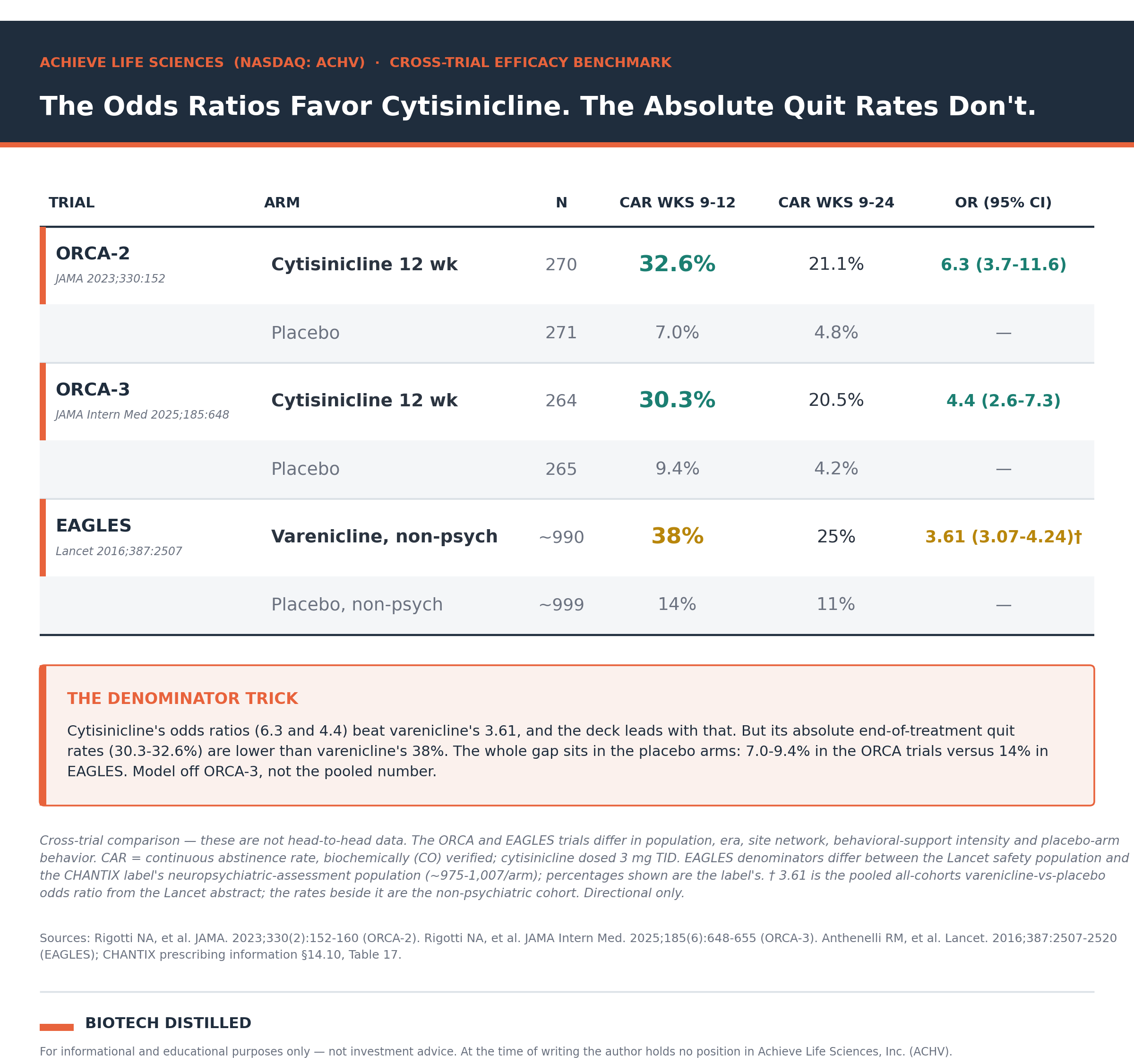
Read that table carefully, because it inverts the deck’s headline. Cytisinicline’s absolute end-of-treatment quit rate (30.3–32.6%) is below varenicline’s EAGLES rate (38%). The deck’s pooled OR of 5.3 beats varenicline’s 3.61 only because cytisinicline’s placebo arms quit at 7.0–9.4% versus EAGLES’ 14%. That is a denominator artifact. What drives the low placebo arms is not established — ORCA-2 ran through the pandemic, but ORCA-3 ran January 2022 to March 2023 and still posted a 9.4% placebo rate, so a COVID explanation does not carry it. Model off ORCA-3, not the pooled number. The “best-in-class odds of quitting” claim on the deck’s efficacy slide is an odds-ratio claim masquerading as an efficacy claim.
Two independent checks cut against the deck. The only randomized cytisine-versus-varenicline trial — Courtney et al., JAMA 2021;326:56, n=1,452 — failed to demonstrate noninferiority: 6-month CO-verified abstinence 11.7% cytisine vs 13.3% varenicline, risk difference −1.62% with a one-sided 97.5% CI of −5.02% to ∞ against a −5% margin. Be fair about its limits, though — it was open-label, adverse events were significantly fewer on cytisine (IRR 0.88, 95% CI 0.81–0.95), and a post hoc 7-day point-prevalence analysis favored cytisine (42.5% vs 32.3%). Separately, Cochrane’s direct cytisine-versus-varenicline comparison has not demonstrated an advantage for cytisine in any recent update, with point estimates near unity. Both bodies of evidence used the traditional low-dose Tabex taper rather than Achieve’s 3 mg TID × 12-week regimen — a material caveat, and precisely the caveat Achieve needs. But Achieve has never run the head-to-head that would settle it. Against that backdrop, the deck’s MAIC slide — cytisinicline OR 1.95 vs varenicline at weeks 9–24, P<0.05 — is a company-sponsored, unpublished draft manuscript reweighting ORCA-2/3 data to EAGLES baseline characteristics, contradicted by the one actual randomization. Treat it as marketing.
The P-Hacking Check. The primary endpoints are clean, prespecified and replicated across two trials — the strongest thing in this file, and it should be said plainly. The soft spots are the subgroup slides. The COPD analysis is explicitly post hoc, with n=47 per arm in the COPD cell and p=0.04 — one or two events from non-significance. The cancer-history analysis (ASCO 2026, n=120 of 1,602) is labeled “post-hoc / exploratory” and both odds ratios have confidence intervals crossing 1 (OR 2.75, 95% CI 0.81–10.74; OR 2.56, 95% CI 0.84–8.24) — yet the deck heads that slide “EFFICACY RESULTS” without noting that neither is significant. The prior-varenicline-use slide’s “approximately 8-fold higher odds” rests on a 6.2% placebo cell. None of these were alpha-protected.
Safety / Tolerability — The Quiet Killers. The deck’s pooled table reports TEAEs 65.9% cytisinicline (N=1,534) vs 60.2% placebo (N=636); insomnia 10.9% vs 5.5%; abnormal dreams 9.9% vs 3.9%; discontinuation for TEAE 4.4% vs 2.4%. Nausea is genuinely better than varenicline’s 25–30%. Two flags.
Those denominators don’t reconcile with the 1,602 randomized across the two Phase 3s — the footnote reveals the table pools ORCA-2/3 with the ORCA-OL interim analysis, and ORCA-OL enrolled rollovers, so the active column is neither independent nor exposure-matched.
The line the deck prints and never discusses: serious TEAEs 4.0% (61/1,534) versus 1.7% (11/636) — a 2.3× ratio, with one treatment-related serious TEAE. Given the active column’s far greater person-time (ORCA-OL: 475 participants, median 361 days), this is not a safety signal — but printing an unadjusted 2.3× SAE ratio without comment is a choice. Four deaths in ORCA-3 all occurred in cytisinicline arms and were all adjudicated unrelated; the DSMC found no new signals at 52 weeks.
The real tolerability risk is not toxicity — it is TID adherence, at 78% inside a trial with behavioral support.
Data Integrity. Strong: both Phase 3s randomized, double-blind, placebo-controlled, CO-verified, U.S.-only (17 and 20 sites), n=1,602, with 76.3% and 79.3% 24-week completion. A well-run program — and the CRL’s silence on clinical matters is consistent with that, though a CRL is a refusal to approve, not an endorsement, and it does not bind the next cycle.
Pipeline
Cytisinicline — smoking cessation (NDA, resubmission Q4 2026). Stage: post-CRL, pre-resubmission. Designations: none applicable (no Breakthrough, no orphan, no CNPV for this indication). Catalysts: resubmission Q4 2026, potential approval 1H 2027. Reality check: this is 100% of the current valuation. Everything else is optionality.
Cytisinicline — e-cigarette/vaping cessation (Phase 2 complete; ORCA-V2 Phase 3 not yet enrolling).
Designations: FDA Breakthrough Therapy (July 2024) and Commissioner’s National Priority Voucher (October 2025).
ORCA-V1 (n=160): weeks 9–12 continuous abstinence 31.8% vs 15.1%, OR 2.64 (95% CI 1.06–7.10), P=0.035 — with the CI lower bound at 1.06, a hair from null on a 53-patient placebo arm.
Critically, the durability endpoint at weeks 9–16 was 23.4% vs 13.2%, OR 2.0 (95% CI 0.82–5.32) — the confidence interval crosses 1. The point estimate held; the significance did not, on a 53-patient placebo arm at an endpoint the trial was not powered for.
FDA agreed at the December 2024 end-of-Phase-2 meeting that one Phase 3 plus ORCA-V1 supports an sNDA.
Reality check: real optionality, thin data, and a clock.
On the CNPV — correct the record. The deck frames “FDA CNPV awarded” as a value driver alongside Breakthrough Therapy. It is non-transferable — FDA FAQ Q8: “No. CNPVs are non-transferable; however, they remain valid through changes in company ownership.” So it carries zero standalone resale value, unlike a Rare Pediatric Disease PRV (comparables: Zevra $150M, Abeona $155M) — though it does survive an acquisition, preserving value to a buyer. And it applies only to vaping — FDA’s Round 1 list reads “Cytisinicline for nicotine vaping addiction.” It cannot be redirected to the smoking resubmission. Any SOTP assigning ~$100M of sellable-PRV value here is wrong by construction.
Pipeline Verdict. One asset, one indication carrying the entire valuation, with a second indication that is genuinely differentiated (zero approved vaping-cessation drugs, ~18 million U.S. vapers) but sits behind an unstarted Phase 3 and a voucher that expires around October 2027. The vaping program is the only place a second leg of value exists — and the biggest competitive threat to it is already on pharmacy shelves: generic varenicline showed 51% vs 14% week-12 abstinence in 16–25-year-old daily vapers (Evins, JAMA 2025;333:1876), off-label, at ~$36/month.
Intellectual Property & The Moat
The summary provided below is based on the 10-K filed by the Company in March 2026 and the 10-Q filed in August 2026.
The company reports that as of December 31, 2025 it “owned, co-owned or in-licensed over 20 issued patents and over 50 pending patent applications,” expiring “ranging from 2037 to 2042, absent any term adjustments or extensions.” No patent numbers appear anywhere in the 10-K, and the FY2025 disclosure is materially vaguer than FY2022’s, which itemized four owned families with exact counts (15 issued / 3 allowed / 43 pending) and named jurisdictions. Vaguer disclosure of a maturing estate is not a good sign.
Asset-specific patent runway — and the hole in it. The company states, in plain English: “Cytisinicline is a naturally occurring product and, therefore, the compound itself is not patentable in the United States. Furthermore, cytisinicline has been used in other parts of the world for decades, creating further challenges to patenting uses of the compound.” There is no composition-of-matter patent for the API and there cannot be one. What exists covers dosing methods, derivatives, salts, extraction methods and formulations — all secondary families. A generic copying the labelled 3 mg TID regimen may infringe a method-of-treatment patent, and a §viii carve-out is unavailable when the patented regimen is the only labelled use. The real exposure may be validity. A dosing-regimen patent on a compound administered to 20 million people over sixty years is exactly the claim that draws obviousness and prior-art challenges, and formulation patents can be designed around by reformulating. Composition of matter is the hard floor because it can’t be worked around at any price.
Regulatory exclusivity backstop. The 10-K’s entire exclusivity claim is one sentence: “It is anticipated that cytisinicline tablets could receive up to seven and a half years of data exclusivity under the ... Hatch-Waxman Act.” Scrutinize that number. Seven and a half years is not a statutory term; it appears to be 5-year NCE exclusivity plus the 30-month Paragraph IV stay, aggregated — implicitly assuming NCE status. Yet “new chemical entity” returns zero hits in the FY2025 10-K, and “505(b)(2)” appears nowhere in it either. The company has never asserted NCE status by name. For a molecule marketed abroad since 1964, whether FDA grants five-year NCE exclusivity is a live question, not a given — and it is the single most consequential unanswered question in the file, because with no composition-of-matter patent, NCE exclusivity is effectively the entire moat.
Ownership and licensing. Per the FY2022 breakout, the owned families are derivatives, salts and dosing methods; the extraction-method and formulation families are in-licensed from Sopharma, plus one cytisine-purity family from a third party. Achieve pays Sopharma a mid-single-digit royalty on Tabex-branded net sales (reduced from mid-teens in the May 2015 amendment) plus $2.0 million contingent on FDA or EMA approval (carried at $1.372 million using a 90.6% probability of success and a 30.8% discount rate), plus up to $4.8 million in milestones and low-single-digit royalties to the University of Bristol. Two structural problems: the Sopharma License Agreement terminates May 26, 2029 — roughly two years after the anticipated launch, and long before the 2037–2042 patent expirations it partly underpins. And Sopharma retains the right to supply third parties; the risk language “begin supplying other third parties with cytisinicline” survives verbatim into the FY2025 10-K.
Updates from the latest 10-Q, and the litigation. The Q2 2026 10-Q contains no new patent grants, no new applications, no patent-term data and no patent litigation. What it does contain is the material development: “In July 2026, Sopharma filed an arbitration demand alleging breach of the Sopharma Supply Agreement. Sopharma seeks actual, compensatory, incidental, and consequential damages; costs and attorneys’ fees; restitution; declaratory relief; and an order requiring us to include Sopharma as our designated manufacturer in any future NDA submission.” No liability has been recorded; no loss range is estimable. Note where this sits — Note 4, not Subsequent Events. Sopharma is simultaneously Achieve’s API supplier, its licensor of the extraction and formulation IP, the counterparty on a $2.0M approval milestone, the seller of 75% of Extab, and now its adversary in an arbitration seeking to be named designated manufacturer in an NDA Achieve plans to resubmit naming somebody else. Get the history right: Sopharma was never the manufacturer designated in the June 2025 submission — Achieve had already routed around it after concluding Sopharma might not pass an FDA pre-approval inspection. This is a fight over a seat Sopharma never held.
Landscape.
Cytisine holds active approvals in roughly 33 countries, 12+ in Western Europe, and most Western European products are Aflofarm/Adamed, not Sopharma — Achieve’s Sopharma territorial carve-out does not bind them. Grey-market Tabex ships to U.S. addresses today at ~$62–$70 per course.
Domestically the competition is two generic molecules — varenicline (21 approved ANDAs; ~$36/month on a GoodRx coupon, ~$110 for a full 12-week course) and bupropion — plus OTC NRT, with branded Chantix relaunched February 5, 2026 as a cash-pay product on TrumpRx “starting at $63.00.”
Achieve must price a branded course against a $110 generic that posted a higher absolute quit rate in EAGLES, into a category whose largest component — U.S. varenicline — was ~$412 million at MAT November 2023 and is shrinking with prevalence. That excludes bupropion and OTC NRT and is a 2023 datapoint, so it understates the total. The direction isn’t in dispute: U.S. Chantix ran ~$1.0 billion at MAT June 2021 before generics — roughly 60% of the category’s dollar value destroyed in two and a half years. Patents are not necessarily the binding constraint here. Pricing power appears to be.
The Verdict
Scientific Conviction: High. Two prespecified, replicated, CO-verified Phase 3 primary endpoints published in JAMA and JAMA Internal Medicine, a fully validated target, and a mechanistically coherent tolerability advantage backed by receptor-binding data.
Commercial Viability: Low-to-Medium. A prescription category in secular decline whose largest component ran ~$412M at MAT Nov 2023, a $110-per-course generic incumbent with a higher absolute quit rate, TID dosing, and a UK natural experiment where cytisine reached only 0.2% of quit attempters after full availability plus a NICE recommendation — albeit in a channel where relaunched varenicline also managed just 1.1%.
M&A Appeal: Low-to-Medium. No composition-of-matter patent means no acquirer gets a durable franchise, though the CNPV does survive a change of ownership. Logical buyers would be commercial specialty pharma with primary-care reach — Viatris, Teva, Perrigo, or a Harrow-style asset consolidator — not big pharma. The Verona/Ohtuvayre comparison in the deck is aspirational: ensifentrine had composition-of-matter protection and no in-class generic.
Trader Profile: Binary-event traders and catalyst-anticipation accumulators. Not necessarily long-term compounders — the terminal value is genuinely uncertain. With 17% of float short and a stock that has run +152% year-over-year into a resubmission, this trades on positioning as much as fundamentals.
The Buy Thesis. For catalyst traders who believe manufacturing CRLs get fixed. The rationale is that the FDA explicitly found no clinical efficacy or safety deficiencies, the facility problem was not specific to cytisinicline, the technology transfer to Adare is already complete (analytical methods transferred, first engineering batch made, testing procedures qualified), and Class 2 resubmissions carry a six-month clock. Approval probability is materially higher than the market’s typical CRL discount implies, and $174M of warrant capital is triggered by approval.
Execution: consider accumulating into resubmission acceptance rather than into the approval decision itself; the resubmission-accepted headline with a new PDUFA date seems to be the highest reward-to-risk moment. Selling OTM puts at the $5.00–$5.50 strikes ahead of Q4 resubmission could be a short-volatility, premium-harvesting expression on a name the company’s own Monte Carlo modeled at ~88% volatility, where the near-term downside is a timeline slip rather than a data failure — but size it knowing the Sopharma arbitration is a genuine tail and short puts carry the full downside.
The Hold Thesis. For existing holders sitting on the +152% run. The rationale is that the crossover syndicate — Frazier, TPG, venBio, Paradigm, Venrock, Vivo, Wellington, Janus Henderson — did diligence you cannot replicate and took board seats and 13Ds, and the Ohtuvayre commercial team is the strongest operational signal in the file. But the fully diluted enterprise value is ~$873M against a prescription category whose largest component ran ~$412M/yr, and the CEO’s own incentive package is calibrated to a $3.39 reference price.
Execution: consider trimming into the approval headline rather than after it — approval starts a twenty-business-day clock on warrants covering ~49.5M shares struck at $3.51. Exercise is optional and creating shares is not the same as selling them, but a deeply in-the-money expiry concentrated into a three-week window is about as identifiable a sell-the-news setup as this market offers. Consider holding a residual stub for the vaping optionality.
The Sell / Avoid Thesis. For anyone underwriting terminal value rather than the next headline. The rationale is structural: no composition-of-matter patent by the company’s own admission, formulation and extraction IP rented from a supplier now in arbitration, a license that expires May 26, 2029, NCE exclusivity that constitutes the entire moat and has never been affirmatively claimed in any filing, and a UK read on real-world cytisine demand at 0.2% of quit attempters. Add ~200M fully diluted shares and 11.4% of the company granted to one executive.
Execution: consider avoiding outright, or expressing the view through the post-approval window rather than shorting into a resubmission with 17% of float already short and an elite syndicate defending the tape.
Final Verdict
WATCH LIST. The clinical package is legitimately good and the CRL was fixable, but two named questions have to resolve before this is investable: whether the Sopharma arbitration disturbs the Adare-based resubmission, and whether FDA grants five-year NCE exclusivity to a molecule sold in Bulgaria since 1964 — because with no composition-of-matter patent, that determination is the franchise.
This report is strictly for informational and educational purposes only. It does not constitute financial advice, investment advice, or a recommendation to buy or sell any securities mentioned.
The scientific and clinical analyses herein should not be interpreted as medical guidance, diagnostic information, or treatment recommendations.
At the time of writing, the author does not hold a position in Achieve Life Sciences, Inc. (ACHV).
Biotech investing is inherently volatile. Past scientific validation does not guarantee future clinical or regulatory success. Treat all clinical-stage biopharma allocations accordingly.
For informational and educational purposes only — not investment advice. The author's position (if any) is as stated in the original article. Always verify against primary sources and do your own due diligence.